Occasional DIY workshop cleaners
You mainly clear mixed debris, sawdust residue and the occasional small spill after a project, rather than extracting dust continuously while using a tool.


For occasional coarse debris and small spills after DIY, a general-purpose wet-and-dry vacuum is a practical starting point. If you regularly clear wood dust from sanding or cutting, prioritise an extractor explicitly rated Class M: the Health and Safety Executive advises at least that class for wood-dust clean-up in its woodworking guidance. A cordless vacuum can make short clean-ups easier away from a socket, but check its capacity, power supply and stated dust class against the work.
You mainly clear mixed debris, sawdust residue and the occasional small spill after a project, rather than extracting dust continuously while using a tool.
You sand or cut wood regularly enough that the stated dust class and a suitable extraction connection matter. The Health and Safety Executive advises at least Class M for wood-dust clean-up in its woodworking guidance.
You want to move between a workshop, vehicle or other work area without always relying on a nearby socket, and can accommodate the capacity and battery considerations of a portable model.
Start with the material you need to collect, particularly whether the job involves repeated wood-dust clean-up. Then consider wet-use instructions, container size and whether a mains lead suits your workspace.
| Concern | What to check | Who this matters to |
|---|---|---|
| Fine wood dust | Look for an explicitly stated dust class and a secure tool-extraction connection where needed. The Health and Safety Executive advises at least Class M for wood-dust clean-up in its woodworking guidance. | If sanding or cutting leaves fine wood dust behind, I need to collect it without relying on a wet-and-dry label as proof of its dust class; around 42% of consumers put fine-dust control first. |
| Mixed debris and spills | Check container capacity and the manufacturer’s instructions for switching between dry debris and liquid pickup. | After a project leaves chips, coarse debris and a small spill, I want one machine that can handle the clean-up without awkward emptying; roughly 33% of consumers prioritise mixed-mess capacity. |
| Mobility and power | Check battery compatibility, what comes in the box and whether mains operation is available. | When I clean away from a convenient socket, carrying a smaller machine matters more than a large tank; about 25% of consumers make mobility their primary concern. |
Wet-and-dry capability describes the mess a machine can collect, not its dust classification. The Health and Safety Executive advises at least Class M for wood-dust clean-up in its woodworking guidance.
For repeated sanding or cutting, check the exact model’s stated dust class and intended use rather than relying on motor wattage or a generic workshop-vacuum description.
Dry and wet collection can require different arrangements. Kärcher instructs users to remove the WD 6 P’s fleece filter bag for liquid pickup.
Follow the manual for your exact model when changing between dry and wet jobs, and empty the tank after wet use.
DEWALT sells the DCV517N-XJ without a battery or charger, so owning a compatible battery platform affects how readily you can use it.
Check the box contents and battery compatibility, then consider whether mains operation would suit longer clean-ups.
If you do not own compatible batteries, you will also need a battery and charger.
The Health and Safety Executive warns that compressed air disturbs dust and can increase inhalation exposure.
Use suitable extraction while working where possible, then collect settled wood dust with an appropriate vacuum rather than blowing it off surfaces.
Its wet-and-dry range includes models for general home, garage and workshop clean-up, such as the WD 3 and WD 6 P.
Its dust-extractor range includes the GAS 35 M AFC for work where a stated dust class matters.
Its portable wet-and-dry models are relevant if you already use compatible DEWALT batteries or need to clean away from a socket.
For occasional post-DIY mixed mess, this corded wet-and-dry vacuum is a general clean-up option. If repeated wood-dust collection is your main task, check the exact model’s dust classification before choosing it in place of a Class M extractor.
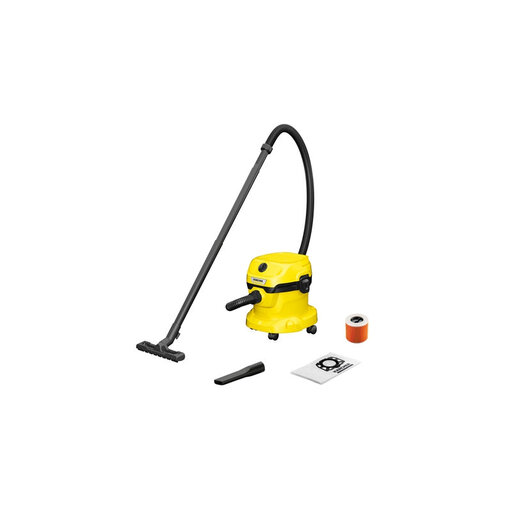 No image available
A corded wet-and-dry option to consider for occasional mixed clean-up after DIY. Before collecting liquids or fine wood dust, check the exact model’s wet-use instructions and stated dust class against the job.
For wood-dust clean-up at work, the Health and Safety Executive advises a suitable industrial vacuum that meets at least Class M. For home DIY, use that guidance to inform a purchase involving substantial wood dust rather than assuming an unspecified wet-and-dry vacuum offers the same dust control.
Follow the wet-use instructions for the exact vacuum before switching tasks. For example, Kärcher says to remove the WD 6 P’s fleece filter bag for liquid pickup.
No: blowing dust off surfaces is not a substitute for collecting it. The Health and Safety Executive warns against using compressed air to remove dust and advises suitable vacuum clean-up for wood dust.
Check that the vacuum has a compatible extraction adaptor or tool socket and that the hose fitting matches the tool. For wood cutting and sanding, the Health and Safety Executive also advises secure, tight-fitting connections and an extraction flow rate suited to the work.