
24/7 Customer Support

Free returns

Same-day & Next-day Delivery

Quality Guaranteed

Unlock Your Welcome Offers: FREE Delivery | Up to 80% OFF | Free 30-day JoyPlus trial
Download the APP
Finding suitable wet cat food pouches in jelly can be more complicated than comparing flavours and prices. A large multipack may look economical, while a smaller selection may offer ingredients or life-stage nutrition that better suits your cat. The practical choice depends on what is inside the pouch, how much your cat needs and whether the food is appropriate for daily feeding.
Words such as “tasty”, “natural” or “high protein” do not confirm that a product can be fed as the main diet. Look for the statutory description “complete pet food for cats” or equivalent wording. A complete and balanced cat food should provide the nutrients required for the stated life stage when fed according to its guidelines.
Treats, toppers and some speciality recipes may be complementary rather than complete. Feeding them as the only food could leave gaps in your cat’s daily nutrition.
A product described as chicken, tuna or salmon may contain several ingredient categories. Check the composition and any percentage declaration. For example, some recipes specify 4% chicken or fish in the chunks, while others provide a higher declared proportion of a named ingredient.
This does not automatically make one formula suitable or unsuitable, but it helps you compare fish cat food, poultry cat food and mixed recipes accurately rather than relying on front-of-pack imagery.
Kitten wet food is formulated for growing cats, while adult cat food pouches are intended for mature cats. Senior cat food may be labelled for cats aged 7+ or 11+, depending on the recipe. Always check the age range before ordering.
A 40-pouch cat food multipack can reduce the frequency of shopping, but it may be wasteful if your cat rejects a flavour. Smaller packs are useful when changing diets or testing a mixed flavour cat food selection.
Prioritise the wording on the product label over broad marketing claims. Check whether the food is designed for:
A complete food should also list analytical constituents, additives and feeding guidance. If your cat has a diagnosed condition, allergies or a prescribed diet, check the full composition and ask your vet before changing food.
Moisture is naturally high in cat food in jelly. The listed products include moisture levels around 83.7% to 85%, but protein, fat, energy and mineral values vary. Compare like with like by checking whether figures are shown per 100g, per pouch or per kilogram.
Feeding guides are starting points, not fixed rules. For example, several 85g adult pouch recipes suggest roughly 3½–4 pouches daily for a 4kg cat, while the exact amount depends on age, size, activity and any dry food or treats also provided.
An 85g pouch is convenient for portioning and can be easier to use than a large tin. Larger 400g tins may suit households with several cats, but opened food must be covered, refrigerated and used within the stated period.
Serve wet food at room temperature unless the label says otherwise. Refrigerate unused portions promptly and follow the product’s storage instructions. Keep fresh drinking water available even when feeding jelly-based food.
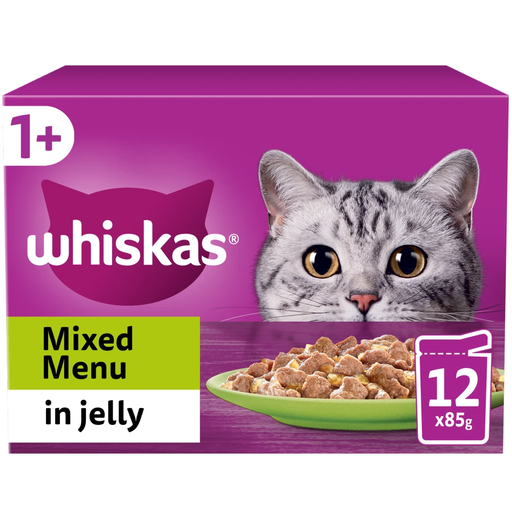
Why This Fits Their Persona: A manageable 12-pouch pack gives owners of one adult cat a way to introduce beef, chicken, salmon and tuna without committing to a large bulk order.
The pack size limits waste when testing preferences, while the adult 1+ label helps avoid choosing a kitten or senior formula by mistake.
Complete adult nutrition; four listed flavours; convenient 85g pouches.
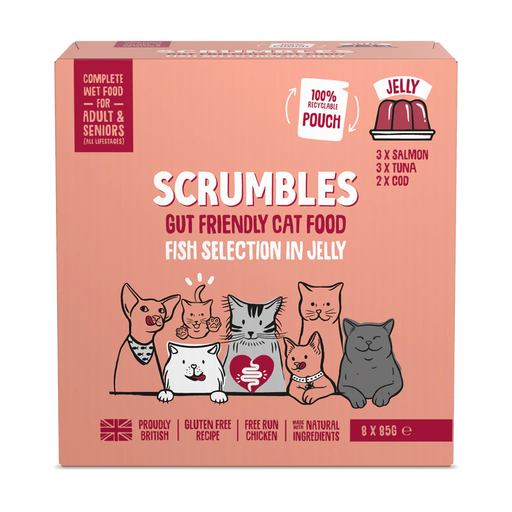
Why This Fits Their Persona: Suitable for kittens from 8 weeks and adult cats, this smaller fish selection suits owners who want a clearly detailed recipe and varied feeding options.
The product information identifies it as complete pet food and provides recipe-specific composition, analytical values and energy information.
Cod, salmon and tuna recipes; 85.3 kcal per 100g; recyclable pouches according to the listing.

Why This Fits Their Persona: A 3.4kg bulk pack is practical for multi-cat households or owners whose adult cats already accept poultry flavours.
Choosing a bulk multipack only after confirming flavour acceptance reduces the risk of storing food that your cat will not eat.
Four poultry varieties; 40 x 85g portions; feeding guidance for 3kg, 4kg and 5kg cats.

Why This Fits Their Persona: Designed for kittens aged 2–12 months, this compact selection gives growing cats four recipes while making portion management straightforward.
The clearly stated kitten age range avoids the common mistake of feeding an adult-only recipe during early growth.
Four flavours; 14.5% crude protein; 81 kcal per 85g pouch according to the listing.
We have compiled a complete, real-time list of products that fully satisfy these strict selection criteria and UK safety regulations.
Yes, if the packaging identifies the product as a complete pet food for your cat’s life stage. Complementary foods should not replace a complete diet unless advised otherwise.
The amount varies by weight, activity and whether dry food is also fed. Several adult recipes list around 3½–4 pouches daily for a 4kg cat. Use the individual product’s feeding table as the starting point and monitor body condition.
No. The high moisture content can contribute to daily fluid intake, but it does not remove the need to provide fresh drinking water. Always follow the storage instructions and discard food that has been left out or kept beyond the recommended period.