
24/7 Customer Support

Free returns

Same-day & Next-day Delivery

Quality Guaranteed

Unlock Your Welcome Offers: FREE Delivery | Up to 80% OFF | Free 30-day JoyPlus trial
Download the APP
Choosing the right wet dog food can feel overwhelming. The aisles are packed with tins and pouches, all promising complete nutrition and wagging tails. As a dog owner, you want to provide a healthy, enjoyable meal, but it's easy to fall into common purchasing traps driven by marketing buzzwords rather than solid nutritional value. This guide will help you navigate the options and understand what truly matters when selecting food for your companion.
As the Joybuy Product Recommendation Officer, my role is to help you see past the hype. Let's break down the common pitfalls and focus on the key factors that ensure you're buying a quality meal.
Many well-intentioned owners are swayed by clever packaging and popular claims. Here are three frequent traps to be aware of:
To make an informed choice, shift your focus from marketing claims to these three non-negotiable parameters.
The ingredients list is your most powerful tool. In the UK, ingredients must be listed in descending order by weight.
A dog's nutritional needs change dramatically throughout its life.
For convenience and value, buying a wet dog food multipack is often the most practical choice. This ensures you have a consistent supply and can often be more cost-effective. Whether you choose a canned dog food or pouches, ensure the packaging is intact and check the use-by dates.
Here are a few recommendations that align with different owner needs, based on the practical criteria we've discussed.

Why This Fits Their Persona: This is ideal for UK dog owners whose pets struggle with digestion. It's formulated to be gentle while providing complete nutrition, using ingredients sourced from British & Irish farms.
Instead of just being "grain-free," it uses wholegrain rice for fibre and slow-release energy. It clearly specifies its protein sources, avoiding the vague "derivatives" trap.
Contains prebiotics (MOS & FOS) to support gut health. Free from artificial colours, flavours and preservatives.
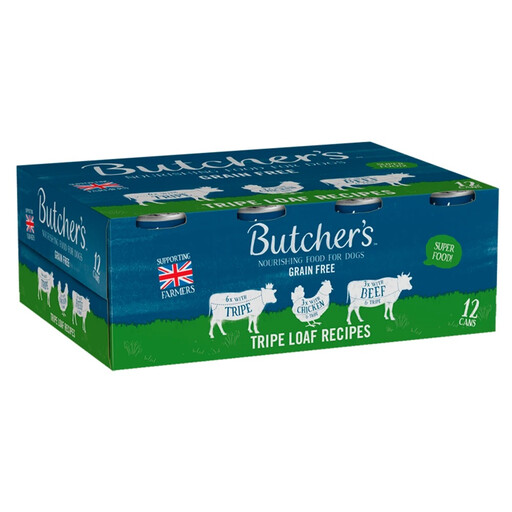
Why This Fits Their Persona: For the owner who prioritises a grain-free diet with clearly sourced, nutrient-dense ingredients. The inclusion of tripe is a major draw for those seeking natural, highly palatable food.
This food is explicitly grain-free for a reason—digestibility. It moves beyond vague meat descriptions by highlighting tripe, a specific and beneficial ingredient, and states its meat is from British & Irish farms.
Tripe is highly digestible and rich in nutrients. The formula is grain-free and contains no artificial additives, making it a clean choice.
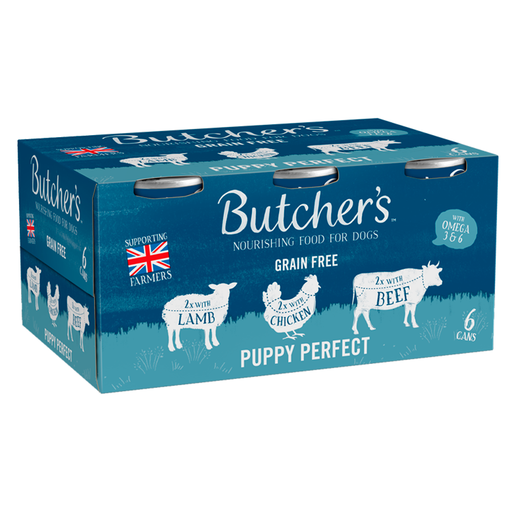
Why This Fits Their Persona: New puppy owners need a reliable, nutritionally complete food designed for growth. This formula provides all the building blocks for a healthy start in life, from brain development to digestion.
It avoids the "one-size-fits-all" trap by being specifically formulated for puppies, not just a generic adult food. It is also grain-free, which can be beneficial for the developing digestive systems of young dogs.
Enriched with Omega-3 (DHA) for brain and eye development and prebiotics to support a healthy gut from a young age.
We have compiled a complete, real-time list of products that fully satisfy these strict selection criteria and UK safety regulations.
The correct amount varies based on your dog's age, breed, weight and daily activity level. Every tinned dog food will have a feeding guide on its label, which is an excellent starting point. You can adjust the portion to maintain a healthy body condition. If you mix wet and dry food, remember to reduce the portion of each to avoid overfeeding.
It is not recommended to switch your dog's food abruptly, as this can cause digestive upset. A gradual transition over 7-10 days is much better. Start by mixing a small amount of the new food (around 25%) with their old food (75%), and gradually increase the proportion of the new food each day until you have fully transitioned.
From a nutritional standpoint, neither is inherently superior. The choice between dog food in jelly and dog food in gravy largely comes down to your dog's personal preference. Some dogs prefer the texture of jelly, while others are more enticed by gravy. The most important thing is to check the nutritional content of the meat and other core ingredients, as this is where the real value lies.