
24/7 Customer Support

Free returns

Same-day & Next-day Delivery

Quality Guaranteed

Unlock Your Welcome Offers: FREE Delivery | Up to 80% OFF | Free 30-day JoyPlus trial
Download the APP
Creating eye-catching displays, menus or classroom notes that are both vibrant and easy to update can be a challenge. Traditional chalk is dusty and prone to smudging, while permanent markers offer no room for error. This is where wet erase chalk markers come in, offering a clean, colourful and flexible solution for businesses and creatives across the UK.
These versatile liquid chalk pens provide the bold look of paint with the convenience of a marker, writing smoothly on non-porous surfaces and wiping away cleanly with just a damp cloth. This guide will walk you through the key features to consider when choosing the right erasable chalk markers for your needs and present some of our top recommendations for 2026.
Before you buy, a few key considerations will ensure you select the right tool for the job.
The most important factor is the surface you intend to write on. Wet erase chalk markers are designed specifically for non-porous surfaces. This includes materials like:
Avoid using them on porous materials such as paper, wood, painted MDF boards or vinyl chalkboards, as the ink can absorb into the surface and become difficult, if not impossible, to remove completely. Always test on a small, inconspicuous area first if you are unsure.
The nib of the marker determines the kind of line you can create. For detailed work, such as writing a cafe menu or creating intricate designs, a marker with a reversible tip (offering both a bullet and a chisel point) is highly versatile. For large-scale applications like shop window displays or bold classroom headings, jumbo chisel tip markers are more suitable, as they can cover a wider area quickly.
Consider where your sign or artwork will be displayed. Most standard chalkboard pens are designed for indoor use and erase with minimal effort. However, some formulations are semi-permanent, making them suitable for outdoor use. These inks are designed to resist running in a light shower once dry, yet can still be removed with a damp cloth and a bit of pressure, offering a practical solution for A-boards and outdoor menu board pens.
Here are a few standout options that cater to a range of common uses, from detailed menu writing to large-scale promotional displays.

Why It Stands Out: This set from Pentel is a versatile workhorse. The key feature is its reversible nib, which can be switched between a rounded bullet tip for consistent lines and a sharp chisel tip for varied strokes. The liquid chalk formula delivers opaque, vivid colour on glass, slate and metal. It’s also made from 69% recycled materials, offering a more sustainable choice.
Pros:
Who is it for: Ideal for cafe owners, teachers and home organisers who need to create detailed, colourful and easily changeable displays on chalkboards or glass board markers.
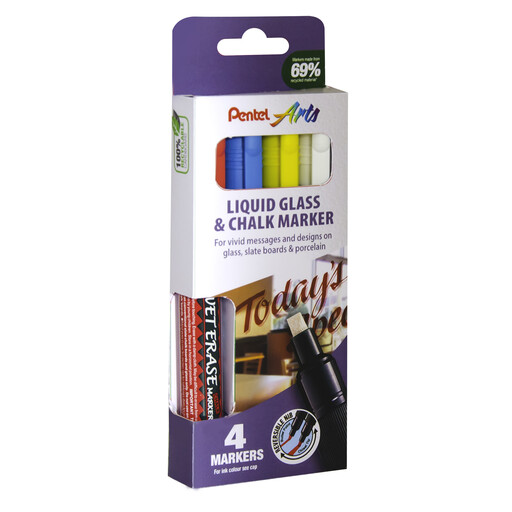
Why It Stands Out: When you need to make a big impact, these jumbo markers deliver. The large chisel tip (10-15mm) is designed for creating thick, bold lines that are visible from a distance. The semi-permanent ink is a significant advantage for outdoor use, as it won’t run in a light shower once it has dried. This makes it a reliable choice for pub A-boards and retail window markers.
Pros:
Who is it for: Perfect for retailers, publicans and event organisers who need to create large, durable signage on windows, glass doors and outdoor slate boards.
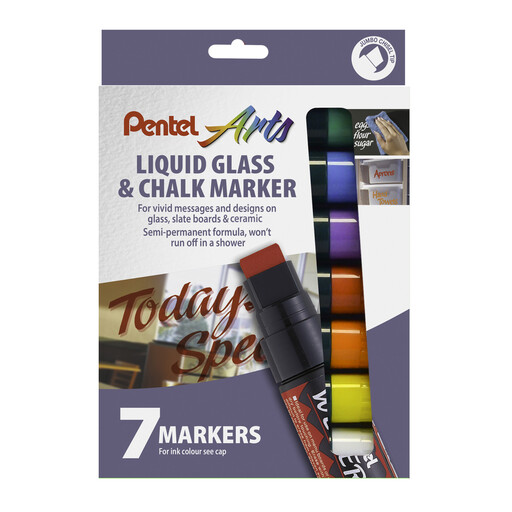
Why It Stands Out: This set offers all the benefits of the jumbo Pentel chalk markers—a broad 10-15mm chisel tip and weather-resistant semi-permanent ink—but with an expanded colour palette. With seven different colours, it provides greater creative freedom for producing vibrant, multi-coloured artwork and promotional messages that capture attention.
Pros:
Who is it for: Artists, designers and businesses looking to create dynamic, colourful and large-format displays that stand out and withstand the elements.
If these specific packs don't quite match what you're looking for, or if you need different colours or tip styles, there are many other options available.
Explore our full range of glass markers to find the perfect tool for your next project.
1. What is the difference between wet erase and dry erase markers? The primary difference is the removal method. Dry erase markers are designed for whiteboards and can be wiped away with a dry cloth or eraser. Wet erase chalk markers use a paste-based ink that, once dry, requires a damp cloth for removal. This makes them more resistant to accidental smudging.
2. Can you use liquid chalk pens on any chalkboard? No, it is crucial to use them only on non-porous chalkboard surfaces, such as traditional slate. Many modern "chalkboards" are made from painted MDF or other porous materials, which will absorb the ink and stain permanently.
3. How do you prime a new wet erase chalk marker? Before first use, you need to prime the marker to get the ink flowing. With the cap on, shake the marker well to mix the ink. Then, on a test surface, press the nib down several times until you see the ink saturate the tip. Once the tip is fully coloured, it is ready to use.