Single-portion dip makers
If you usually make one small bowl, look for a chopper explicitly intended to purée dips and check that your usual quantity will work in its bowl. A compact appliance also means fewer large parts to store and wash.


For one portion of white bean dip, start by looking at a mini chopper specified for dips or purées, provided your recipe quantity suits its bowl. Choose a compact processor with a small bowl if you will also slice or grate; a full-size processor makes more sense when larger batches and its additional attachments will be regular jobs. Bowl arrangement, controls and cleaning matter more to this decision than wattage alone.
If you usually make one small bowl, look for a chopper explicitly intended to purée dips and check that your usual quantity will work in its bowl. A compact appliance also means fewer large parts to store and wash.
If dip is only one of your jobs, a compact processor with a small bowl and the accessories you will actually use can also cover tasks such as slicing and grating. Check the exact accessory set rather than assuming those functions come with every model.
If you regularly make several portions or use a processor for larger preparation jobs, a main bowl and additional attachments may be worth the extra storage and washing-up.
Choose when: A small dip is the main job and the exact model is intended for dips or purées.
Trade-off: You give up the slicing discs and larger-batch capacity available with some processors.
Choose when: You want a bowl for dip alongside functions for other food preparation.
Trade-off: Extra bowls and accessories take more space and add parts to clean.
Choose when: Larger batches and its other preparation functions will be regular tasks.
Trade-off: A large bowl and multiple attachments can be cumbersome for one small portion.
| Concern | What to check | Who this matters to |
|---|---|---|
| Small-batch puréeing | Check that the exact model is intended for dips or purées, then compare your recipe quantity with its bowl instructions. Maximum capacity alone does not establish a workable minimum. | If I am making just one portion, I want the beans to move around the blade rather than rely on a large bowl's stated capacity. Roughly 50% of consumers would put a workable small-batch setup first. |
| Other preparation jobs | Check the included bowls and whether the exact accessory set has the slicing or grating functions you expect to use. | When I also prepare other meals, I need the appliance to do more than make dip. Around 30% of consumers would make those additional functions their primary concern. |
| Storage and cleaning | Compare appliance dimensions and check dishwasher guidance for the specific bowl, lid, blade and accessories. | With limited cupboard space, I want a quick dip to leave little equipment to put away or wash. About 20% of consumers would prioritise that smaller storage and cleaning burden. |
Motor ratings do not, by themselves, tell you how a particular white bean dip will process. Bowl design, intended tasks and controls differ between the manufacturer-described models.
Start with explicit dip or purée suitability, then check the bowl arrangement and controls before comparing wattage.
A full-size machine may provide bowls and attachments for larger jobs, but those parts also need storage and cleaning after a short recipe.
Choose that format when you expect to use its additional functions regularly; otherwise, consider a dip-capable mini chopper.
A capacity figure does not tell you whether your particular portion will circulate around the blade. Recipe volume also changes with the beans and liquids used.
Compare your usual quantity with the instructions for the exact model, especially if you make less than a typical tin-based batch.
GOV.UK guidance on the Electrical Equipment (Safety) Regulations 2016 sets out requirements for electrical equipment placed on the Great Britain market. A listing for a different model or market does not establish the details of the appliance you will receive.
Before ordering for use in Great Britain, check the exact model, seller, plug, instructions and safety information.
Cuisinart offers both a dip-focused mini chopper and a processor with a separate small bowl.
Magimix has a mini chopper for small batches and a broader-function Mini Plus processor aimed at one or two people.
The Easy Chop Mini Chopper CHP61.100WH is a compact option positioned by Kenwood for small quantities, dips and sauces.
The Desire Food Processor 27111 illustrates the full-size route for cooks who also prepare larger quantities.
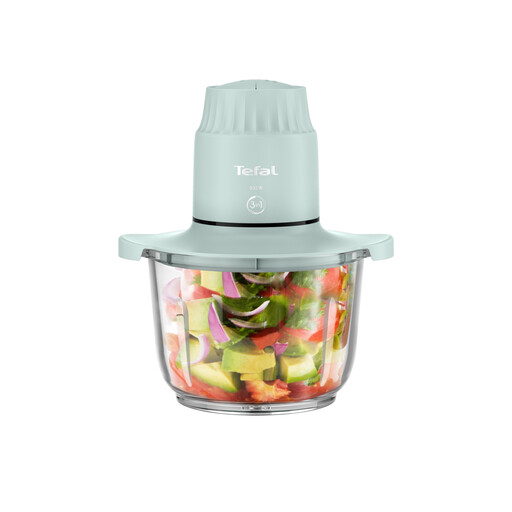
This mini-chopper option is relevant if you want to assess a compact appliance for a small dip. Check its instructions against your usual portion and puréeing method before deciding.
 No image available
Consider this chopper for a small dip if its instructions cover your puréeing method and your portion works in the bowl.
The listed capacity is 1 L, and the bowl is described as borosilicate glass. Check the instructions for the minimum workable quantity and for adding liquid during processing.
It can be, if the exact chopper is specified for dips or purées and your recipe quantity works in its bowl. Cuisinart describes its Mini Prep Pro as suitable for puréeing, while Magimix positions its Mini Chopper for small batches of dips and sauces. Choose a processor with more functions if slicing, grating or larger batches are also regular jobs.
Look for controls that let you process in short bursts, and check whether the model allows gradual liquid addition if your recipe calls for it. Cuisinart lists pulse control and lid drizzle holes for the Mini Prep Pro; Magimix lists pulse and continuous modes for its Mini Chopper. Those features do not guarantee a particular finished texture.
Follow the cleaning instructions for the exact bowl, blade, lid and accessories you buy. Dishwasher guidance varies by model and part, so check the product instructions before relying on machine washing.
Check the exact model, seller, plug, instructions and safety information for the appliance offered. GOV.UK guidance on the Electrical Equipment (Safety) Regulations 2016 describes requirements for electrical equipment placed on the Great Britain market; it does not establish whether a particular listing meets them.