What should you check before choosing?
Start with the main job: setting aside a portion, adding pieces to a recipe, or buying chocolate specifically sold for baking. Then check the current label and whether the shape suits the age of the children who will eat it.
Portioned multipack
Choose when: You want separate bags to set aside for occasional treats or small baking activities.
Trade-off: A fixed bag size gives you less freedom when a recipe calls for a different amount.
Button bag
Choose when: You want to measure pieces for mixing into bakes or adding to decorations.
Trade-off: A sharing bag does not provide separate, sealed lunchbox portions.
Cooking chocolate
Choose when: Baking or dessert decoration is the main purpose; M&S describes its 100 g white chocolate for those uses.
Trade-off: A single bar needs dividing if you want smaller amounts for several activities.
| Priority | What to check | Your needs |
|---|
| Pack format |
Compare separate bag sizes with the amount your recipe uses. Tesco lists its Milkybar multipack as 4 × 20 g; Cadbury describes a 100 g button bag, while M&S sells a 100 g white chocolate product for baking and decoration. |
I want to put an unopened portion aside, or I need to measure a different amount each time we bake. |
| Allergens |
Read the current ingredients and precautionary statements on the exact pack. The product examples list milk, and the Cadbury and M&S examples list soya; M&S also states that its product is unsuitable for people with nut or peanut allergy. |
Before a child handles or eats it, I need to check that the particular product fits their allergy requirements and the setting’s procedures. |
| Sugar and frequency |
Compare the pack’s sugars information per 100 g and per serving, paying attention to the stated serving size. Lancashire and South Cumbria NHS Foundation Trust advises having sugary foods with meals rather than as between-meal snacks. |
A sealed bag is convenient, but I do not want that convenience to turn chocolate into a routine between-meal lunchbox snack. |
| Age and supervision |
Check warnings about small sweets on the pack. Tesco’s Milkybar listing warns of choking risk for children under four; Department for Education guidance says younger children are at greater risk of choking. |
The youngest child eating the chocolate may need a different food choice, even if they can help with parts of the baking activity. |
Brand and product-line references
These examples illustrate different pack formats; a brand name alone does not establish the ingredients or suitability of another product in its range.
Milkybar
Tesco lists Milkybar White Chocolate Buttons 4 Pack as four 20 g bags, illustrating the separately portioned option.
- Separate bags can be put aside before the rest of a pack is used.
- Tesco’s listing warns that children under four could choke on small sweets.
Cadbury
Cadbury describes its White Chocolate Buttons Bag as 100 g of bite-sized buttons, a format for measuring pieces for baking or decoration.
- Pieces can be taken from the bag in the amount needed for an activity.
- The bag is not divided into sealed lunchbox portions; Tesco’s ingredient listing for this product includes milk and soya.
M&S
M&S describes its 100 g White Chocolate for home baking and dessert decoration.
- The stated uses make it a baking-focused alternative to a portioned multipack.
- It is a single product rather than separate portions; M&S says it is unsuitable for people with nut or peanut allergy.
Joybuy options for baking
These white chocolate chips and chunks are options for adding measured amounts to baking or decoration with children. They are 100 g baking packs, not individually portioned lunchbox multipacks.
 No image available
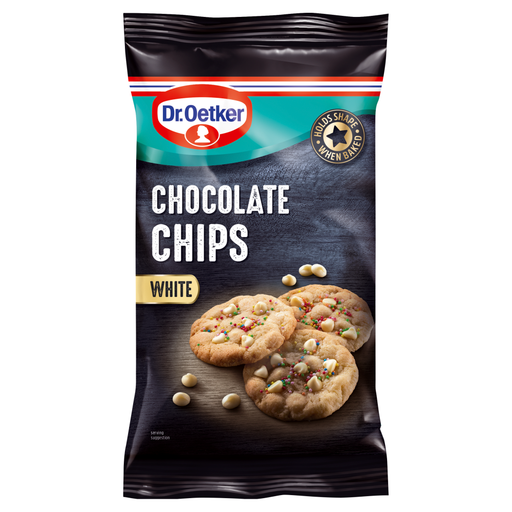
Dr. Oetker Chocolate Chips White 100g
For adding chips to bakes or preparing a melted decoration during a baking activity. The product description gives microwave and hob melting directions; an adult should manage the heat. This is a 100 g pack rather than separate lunchbox portions. The listed ingredients include milk and soya; check the current pack for full allergen and precautionary wording.
View on Joybuy
 No image available
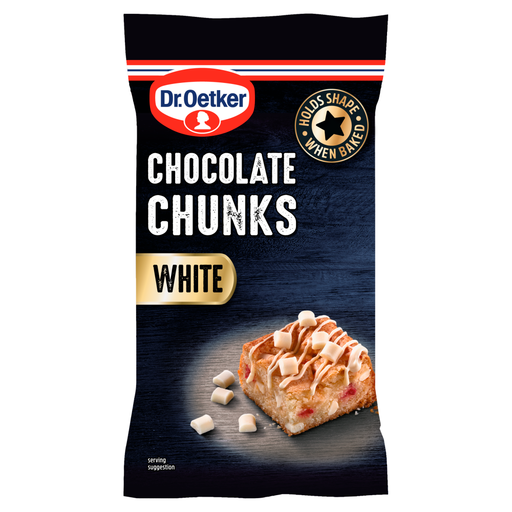
Dr Oetker White Choc Chunks 100g
For adding chunks to cakes, cupcakes, brownies or muffins. The product description says the chunks retain their shape during baking and describes melting them for drizzling. This 100 g bag is not divided into lunchbox portions. The listed ingredients include milk and soya; check the current pack for full allergen and precautionary wording.
View on Joybuy
 No image available
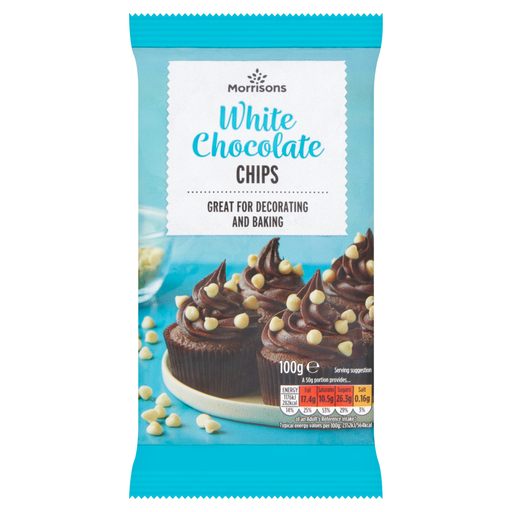
Morrisons White Chocolate Chips 100g
For measuring chips into baking or adding them to decorations. This is a 100 g pack, not a set of separate lunchbox portions. The listed ingredients include milk and soya; check the current pack for full allergen and precautionary wording.
View on Joybuy
Questions about baking and lunchboxes
Is a white chocolate multipack the right format for baking with children?
Choose one when separate portions are the main reason for buying. Tesco’s Milkybar example contains four 20 g bags; if the recipe needs a variable amount, a button bag gives you pieces to measure out, while M&S describes its white chocolate specifically for baking and dessert decoration.
Does individual wrapping make white chocolate an everyday lunchbox food?
No. Individual wrapping helps divide the chocolate, but it does not change its sugars content. Lancashire and South Cumbria NHS Foundation Trust advises having sugary foods with meals rather than between-meal snacks; also check the child’s school or setting policy before packing chocolate.
Which allergens should I check?
Read the ingredients and precautionary statements on the exact current pack. The Milkybar, Cadbury and M&S examples here list milk; the Cadbury and M&S examples list soya, and M&S states that its product is unsuitable for people with nut or peanut allergy.
Can preschool children eat white chocolate buttons?
Check the particular pack and the child’s age before offering small sweets. Tesco’s Milkybar multipack listing warns that children under four could choke on them, and Department for Education guidance says young children should not be left alone while eating.
How should I store white chocolate kept for baking?
Follow the storage instructions on the current pack. The Milkybar, Cadbury and M&S product information calls for cool, dry storage; M&S also specifies keeping its product away from sunlight, while Cadbury says to protect its buttons from heat.


