Revision snackers wanting a defined portion
An individually wrapped bar gives you a stated serving to check against the label, without dividing a larger bar during a break.


For a defined revision-break portion, an individually wrapped white-chocolate multipack is more straightforward than a larger bar that you must divide yourself. A breakable bar can work for snacks portioned at home, while boxed truffles suit sharing rather than a compact multipack. Check sugars and saturated fat per portion, the current allergen label and the rules for the setting: the Department for Education’s England guidance prohibits chocolate in school-provided food during the school day.
An individually wrapped bar gives you a stated serving to check against the label, without dividing a larger bar during a break.
Pack size and allergen statements matter, as does the distinction between a personally packed snack and food provided by a school in England. Check the school’s policy for personal food.
A bar multipack, a breakable bar and a truffle box call for different portioning and storage choices. Choose the format that fits where and how the snack will be used.
Decide how the chocolate will be portioned, then compare the label and the setting in which it will be eaten.
| Priority | What to check | Your needs |
|---|---|---|
| Portion format | Check the number of bars, their individual weights and whether they are wrapped separately. For a larger bar, check its stated servings and how you will store it after opening. | I want the amount for one revision break to be clear before I open the pack. Sainsbury’s lists four 25g bars in its Milkybar multipack; Waitrose lists 10 servings in its 180g Belgian White Chocolate bar, which needs dividing. |
| Nutrition label | Compare total sugars and saturated fat per 100g and per intended portion. The NHS describes more than 22.5g total sugars or more than 5g saturated fat per 100g as high on a food label. | If I choose a smaller bar, I still want to know what that bar contains. Sainsbury’s lists 13.1g sugars and 4.7g saturates per 25g Milkybar bar. |
| Allergens | Read the current pack’s ingredients and precautionary allergen statement; do not assume different white-chocolate products have the same ingredients. | Milk, soya or nuts may affect which pack I can use. Lindt Shop UK lists milk, lactose and soya in its LINDOR white truffles and warns that they may contain hazelnuts and other nuts. |
| School setting | Distinguish a personal snack from school-provided food. The Department for Education’s September 2026 England guidance says chocolate and confectionery must not be served as school-provided food across the school day; check the individual school’s policy for personal food. | I need to know whether this is for revision at home, a personally packed snack or food the school will provide. The England school-food restriction does not, by itself, establish a UK-wide rule for every personal lunchbox. |
Pack format does not change the England school-food rule. The Department for Education’s September 2026 guidance says chocolate and confectionery must not be served as school-provided food during the school day.
For food supplied by a school, follow the applicable school-food rules. For a personally packed snack, check the school’s own policy rather than assuming the same rule covers every lunchbox.
Four bars still means four separate servings to consider. Sainsbury’s lists 13.1g sugars and 4.7g saturates in each 25g Milkybar bar.
Check both the per-bar and per-100g panels, then decide what amount you intend for one break.
Waitrose’s 180g bar has 10 listed servings but needs dividing; Lindt’s 200g truffle box is a different format from individually wrapped bars.
Choose separate bars when a fixed wrapped portion matters, or plan how you will divide and store a larger product.
Ingredients and precautionary statements differ by product. Lindt Shop UK lists milk, lactose and soya in its white truffles, with a warning about possible hazelnuts and other nuts.
Read the physical pack before eating or packing it, particularly when an allergy is a concern.
These products illustrate different white-chocolate formats; the references do not imply that every product from a brand uses the same pack or ingredients.
Sainsbury’s lists a Milkybar multipack containing four 25g white-chocolate bars.
Waitrose & Partners lists a 180g Belgian White Chocolate bar with 10 servings.
Lindt Shop UK lists LINDOR White Chocolate Truffles in a 200g box, a format for sharing or keeping at home rather than a bar multipack.
Marks & Spencer presents its White Chocolate product for baking and dessert decoration rather than as a revision-snack multipack.
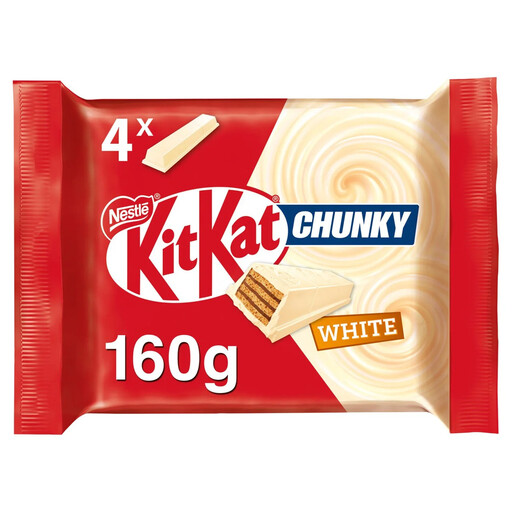
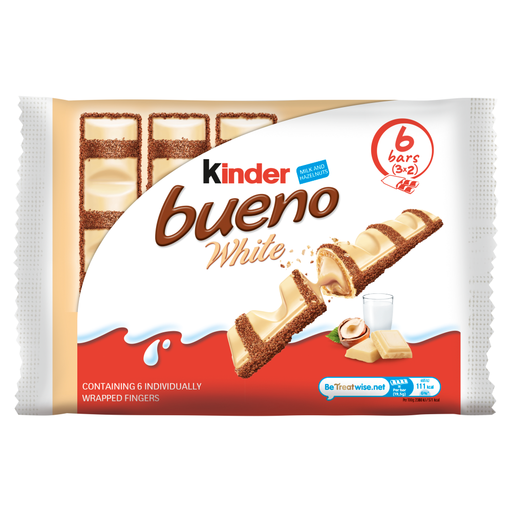
These options are multipacks for personal revision breaks. KitKat Chunky White and Kinder Bueno White are wafer confections with white chocolate or a white-chocolate coating, rather than plain white-chocolate bars; check the format and portion details that matter to you.
 No image available
Four individually wrapped 40g bars give you separate portions for personal revision breaks; this is a wafer confection rather than plain white chocolate.
The product information identifies milk and wheat. Check the pack’s per-bar sugars and saturates if one bar is your intended portion.
 No image available
Three individually wrapped bars offer separate snacks if a filled wafer with a white-chocolate coating is the format you want.
The product information identifies dairy, soya, wheat and hazelnuts, and says it may contain other nuts. Check the per-bar weight and nutrition on the pack when planning a portion.
 No image available
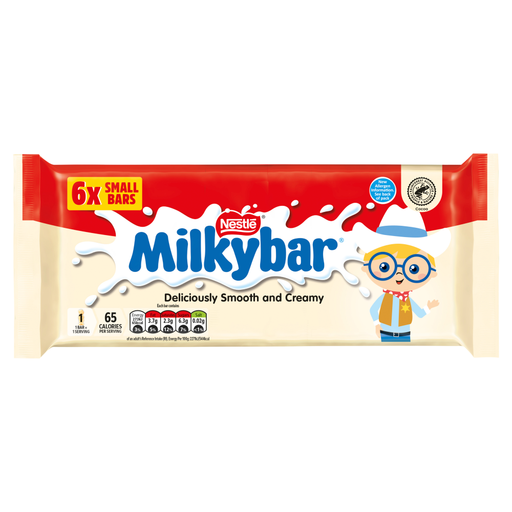
This white-chocolate six-pack has a stated total weight of 72g and may suit planned snacks at home.
Check the pack to see whether the units are individually wrapped and what one unit contains. The product information identifies milk and says it may contain gluten.
 No image available
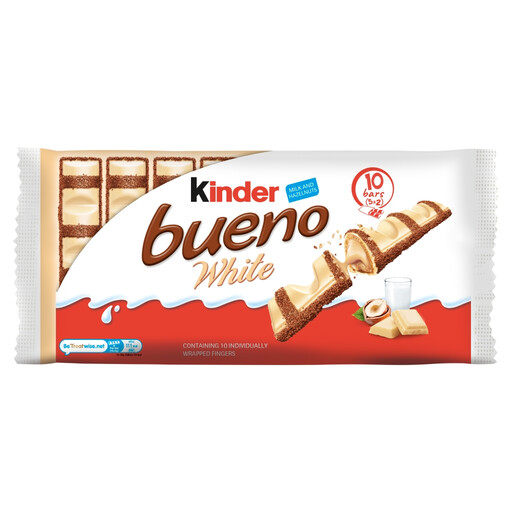
This is an individually wrapped white-chocolate-coated wafer option for personal snack breaks, but check how its portions are grouped.
The title says 5-Pack while the description refers to ten wrapped fingers; confirm the pack and its per-portion nutrition before choosing it for a fixed serving. The product information identifies wheat, milk, hazelnuts and soya.
No, not as school-provided food during the school day under the England school-food rules. The Department for Education’s September 2026 guidance says schools must not serve chocolate or confectionery across the school day; the Requirements for School Food Regulations 2014 include chocolate in the definition of confectionery, except hot chocolate. This does not establish a UK-wide rule for every personally packed snack.
The school-provided-food restriction identified in the Department for Education’s England guidance concerns chocolate and confectionery as food types. It does not require treating every product on this page as having an established, product-specific HFSS classification.
Compare total sugars and saturated fat per 100g and per serving, then check the number and size of the bars. The NHS describes more than 22.5g total sugars or more than 5g saturated fat per 100g as high on a food label. Use the portion you intend to eat when reading the per-serving figures.
A 25g wrapper defines a portion; it does not change the food’s per-100g nutrition. Sainsbury’s lists 13.1g sugars and 4.7g saturates in one 25g Milkybar bar, so check both the portion and per-100g figures rather than judging by bar size alone.
Read the current pack for ingredients and precautionary statements relevant to the person eating it. For example, Lindt Shop UK lists milk, lactose and soya in its LINDOR White Chocolate Truffles and says they may contain hazelnuts and other nuts; another product’s statement may differ.