Casual afternoon sharers
If people will take pieces from one pack at home, work or a get-together, a button bag offers individual pieces without dividing a bar. Pack weight and serving information still matter when deciding how much to bring.


For an informal afternoon share, a bag of individual white-chocolate buttons is easier to pass around than a bar; compare pack weight and the stated serving before deciding how many bags to buy. A box of truffles is a different format, with its own ingredient and allergen information to check. Chocolate must not be provided as food to pupils in state-funded schools in England under the Requirements for School Food Regulations 2014.
If people will take pieces from one pack at home, work or a get-together, a button bag offers individual pieces without dividing a bar. Pack weight and serving information still matter when deciding how much to bring.
Compare the exact pack’s ingredients, allergen statement and nutrition information before sharing. This matters especially when choosing between a plain button bag and filled truffles.
For food provided to pupils in state-funded schools in England, a different chocolate brand or portion size does not resolve the school-food restriction. The Requirements for School Food Regulations 2014 include chocolate in the definition of confectionery and state that confectionery must not be provided.
Start with the occasion and the people sharing, then compare the exact packs’ format, serving information and labels.
| Priority | What to check | Your needs |
|---|---|---|
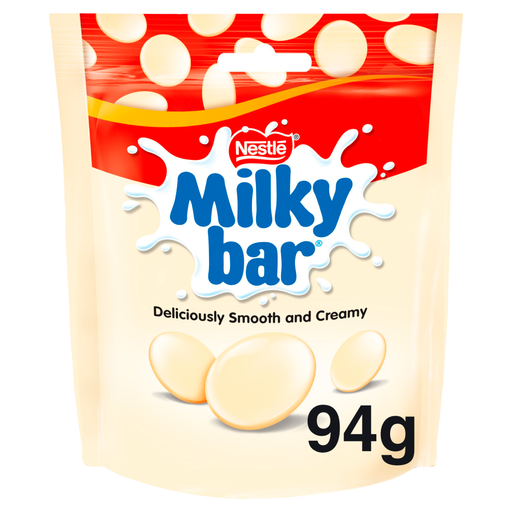
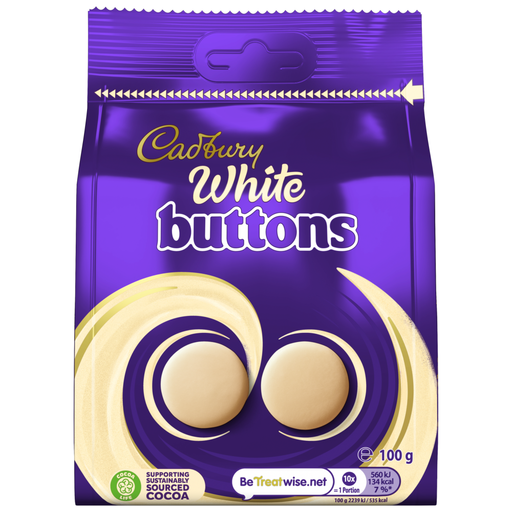
| Sharing format | Check whether the pack contains individual buttons or boxed truffles, and compare pack weights. Cadbury lists a 100g White Chocolate Buttons Bag; Nestlé Confectionery UK lists a 94g Milkybar Giant Buttons sharing bag. | I want pieces people can take without breaking up a bar. If the occasion calls for a box rather than a bag, I can compare truffles separately. |
| Servings | Read both the pack weight and the nutrition panel’s reference portion. Nestlé Confectionery UK gives values per 10 Milkybar Giant Buttons; ASDA describes the 94g bag as containing approximately three servings. | A bag may cover one afternoon gathering or more than one occasion. I need its stated serving information before deciding how many packs to buy. |
| Ingredients and nutrition | Check the exact pack’s ingredients, allergen statement and nutrition values on a consistent basis, such as per 100g or per stated serving. Lindt’s LINDOR White Chocolate Truffles Box is 200g and carries a warning that it may contain hazelnuts and other nuts. | If someone sharing has an allergy, the label for the product I actually buy matters more than the colour or style of chocolate. I also want to compare nutrition figures using the same stated basis. |
| School use in England | Establish whether the snack will be provided to pupils by a state-funded school in England. The Requirements for School Food Regulations 2014 define chocolate as confectionery and prohibit providing confectionery in that setting. | For that school-food use, I need a non-confectionery option rather than a different white-chocolate bag. Rules in other UK nations need to be checked separately. |
A sharing label describes the format, not the amount intended for one person. Nestlé Confectionery UK gives Milkybar Giant Buttons nutrition per 10 pieces, while ASDA describes the 94g bag as approximately three servings.
Compare the current pack’s weight and stated portion before buying bags for one gathering or several.
Milkybar Giant Buttons list whole milk powder, while Lindt’s white truffles carry a warning that they may contain hazelnuts and other nuts. An allergen statement for one product does not establish the status of another.
Read the ingredients and allergen statement on the exact pack before offering it to someone with a relevant allergy.
England’s school-food regulations prohibit providing confectionery to pupils in state-funded schools. The Department of Health and Social Care’s separate HFSS rules concern specified retail promotions and placement for businesses selling to England.
For school food in England, choose a non-confectionery snack; do not use a retail-promotion rule to decide whether chocolate may be served.
ASDA’s listing for the 94g Milkybar Giant Buttons bag warns that children under four could choke on small sweets because of limited chewing ability.
Check the pack warning when choosing food for young children; a sharing format does not establish that its pieces are suitable for every age.
These examples show different white-chocolate formats; the boxed option is not a substitute for a bag when the packaging format matters.
Nestlé Confectionery UK lists Giant Buttons White Chocolate in a 94g sharing bag.
Cadbury lists White Chocolate Buttons in a 100g bag of bite-sized pieces.
Lindt’s LINDOR White Chocolate Truffles come in a 200g box, offering a boxed sharing format rather than a button bag.
These two button bags are options for an informal afternoon share. Compare their current pack labels for serving information and allergens before choosing between them.
 No image available
A 94g button bag to consider when people will take individual pieces during an afternoon share. Check the current pack’s serving and allergen information before passing it around.
 No image available
A 100g bag of individual buttons for an informal share. Read the exact pack’s ingredients, allergens and serving information if those details affect your choice.
A bag of individual buttons lets people take pieces without dividing a bar. Cadbury lists a 100g White Chocolate Buttons Bag, while Nestlé Confectionery UK lists a 94g Milkybar Giant Buttons sharing bag; compare the exact pack weights, serving information and allergens for your group.
No. Nestlé Confectionery UK states nutrition per 10 Milkybar Giant Buttons, and ASDA describes the 94g bag as containing approximately three servings. Use the current pack’s stated serving information rather than treating its name as portion guidance.
No. The Requirements for School Food Regulations 2014 include chocolate in the definition of confectionery and state that confectionery must not be provided as school food. This answer concerns state-funded schools in England; check the applicable standards separately for Wales, Scotland or Northern Ireland.
No. The school-food restriction comes from the Requirements for School Food Regulations 2014. The Department of Health and Social Care’s HFSS rules separately address specified retail promotions and placement by businesses selling to England, including online equivalents.
Read the allergen statement on the exact product and pack. Nestlé Confectionery UK lists whole milk powder in Milkybar Giant Buttons, and Lindt states that its LINDOR White Chocolate Truffles may contain hazelnuts and other nuts; neither statement establishes the allergens in a different product.