Who is this choice for?
The useful distinction is whether you are choosing for cocoa content, creamy flavour or a setting with its own food rules.
Shoppers comparing dark bars
If you want a stated cocoa-solids percentage, look for it on the exact bar rather than relying on words such as “rich”. Lindt Shop UK, Waitrose & Partners and Marks & Spencer publish percentages for the dark bars discussed below.
Shoppers who prefer creamy chocolate
White chocolate is a distinct flavour choice, not an interchangeable high-cocoa dark bar. Marks & Spencer describes its white chocolate as creamy and its dark chocolate as having bitter undertones.
People planning food for maintained schools in England
The setting changes the decision: the Requirements for School Food Regulations 2014 include chocolate in the definition of confectionery, and the Department for Education’s England guidance applies the restriction throughout the school day.
What should you check?
Decide which flavour and cocoa-content route you want, then compare like-for-like nutrition figures and the label on the exact product.
| Priority | What to check | Your needs |
|---|
| Cocoa and flavour |
For a high-cocoa dark bar, find the declared cocoa-solids percentage on the exact product. Check the ingredients rather than treating “dark”, “rich” or “creamy” as a cocoa specification. |
I want to compare bars by a stated cocoa percentage; or I would rather choose white chocolate for its creamy flavour. Marks & Spencer describes dark chocolate as having bitter undertones. |
| Nutrition and portion |
Compare sugars per 100g on the same basis, then look for a stated serving and its nutrition figures. Lindt Shop UK lists 17g sugars per 100g for Excellence 78% and 29g for Excellence 70%; Waitrose & Partners lists 24.4g for its Belgian Dark 72%, and Marks & Spencer lists 27g for its Swiss Extra Fine Dark 72%. |
For a mid-morning snack, I want to know what the amount I plan to eat represents, rather than assuming the whole bar is one serving. |
| Allergens |
Read the current ingredients and allergen statement, including any “may contain” warnings. Lindt Shop UK lists milk fat in Excellence 78%, so its dark colour and cocoa percentage do not establish milk suitability. |
If milk, nuts, peanuts, soya or sesame matter to me, I need the warning for this particular bar, not an assumption about dark or white chocolate generally. |
| School setting |
Identify the UK nation and whether the food is being provided under maintained-school standards. The Requirements for School Food Regulations 2014 classify chocolate as confectionery, and the Department for Education’s England guide applies the restriction across the school day. |
I am choosing food to provide at a maintained school in England, so chocolate is not a school-day snack option under those standards. I would check the applicable rules separately for another setting or UK nation. |
Brand and product-line references
These examples show why the exact bar matters more than a brand-wide description; they do not indicate which products are available on Joybuy.
Lindt
Lindt Shop UK states cocoa-solids percentages for its Excellence 70% and 78% dark bars, allowing a comparison of those specific products.
- Excellence 78% lists 17g sugars per 100g, compared with 29g per 100g for Excellence 70%, according to Lindt Shop UK.
- Excellence 78% contains anhydrous milk fat and carries may-contain warnings for nuts, milk and soya; check its current label for allergy decisions.
Waitrose
Waitrose & Partners labels its Belgian Dark Chocolate 72% with both per-100g nutrition and an 18g serving.
- The 18g serving is listed as containing 4.4g sugars and 96kcal, giving a stated portion to compare with the per-100g figures.
- The product may contain milk and other nuts.
M&S
Marks & Spencer states at least 72% cocoa solids for its Swiss Extra Fine Dark Chocolate and describes a flavour distinction between its white and dark chocolate ranges.
- Swiss Extra Fine Dark Chocolate lists 27g sugars per 100g, enabling comparison on the same quantity basis as other labelled bars.
- Marks & Spencer says this specific dark bar is not suitable for people with milk, nut, peanut or soya allergies.
Cadbury
Cadbury describes Darkmilk as rich and creamy. That description may help with a flavour choice, but is not a cocoa-solids figure.
- The Darkmilk description makes its creamy style clear.
- If a stated cocoa percentage is essential, check the exact Cadbury product’s current label before comparing it with a percentage-labelled dark bar.
Chocolate options on Joybuy
These bars cover both sides of the snack choice: four percentage-labelled dark chocolates and one white chocolate. Compare each exact pack’s nutrition and allergen information before deciding.
 No image available
Green & Black's Dark Chocolate 85% 90g
A percentage-labelled dark bar for comparing cocoa content. Check the current pack’s serving information and nut and milk warnings when choosing your snack portion.
View on Joybuy
 No image available
Morrisons The Best Ecuador 85% Dark Chocolate 100g
Another percentage-labelled dark option. Compare its per-100g nutrition and the portion you intend to eat; check the current pack for milk, nut, peanut and gluten-containing cereal warnings if relevant.
View on Joybuy
 No image available
Morrisons The Best Dominican Republic 72% Dark Chocolate 100g
A 72% dark bar for shoppers comparing stated cocoa percentages. Read the exact pack for portion and sugar figures; check its soya ingredients and other allergen warnings where relevant.
View on Joybuy
 No image available
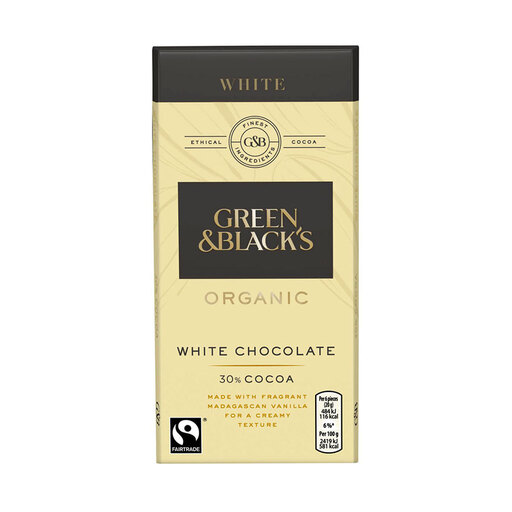
Green & Black's White Chocolate 90g
The white-chocolate option if creamy flavour is your priority rather than a high-cocoa dark bar. Check its per-100g and serving figures, along with milk, soya and nut information on the current pack.
View on Joybuy
 No image available
Lindt Excellence 85% Cocoa Dark Chocolate 100g
A percentage-labelled dark bar for a cocoa-content comparison. Decide on a portion using the current pack, and read its full allergen statement before choosing it if nuts, milk, soya or sesame matter to you.
View on Joybuy
Common questions
Can white chocolate replace a high-cocoa dark bar in this choice?
Not if a stated high cocoa-solids percentage is your requirement. Choose a dark bar that declares that percentage; choose white chocolate instead when its creamy flavour is what you want. Marks & Spencer describes white chocolate as creamy and dark chocolate as having bitter undertones.
Which figures help me compare dark bars?
Start with the stated cocoa-solids percentage and sugars per 100g, then check any declared serving. For the specific products described by Lindt Shop UK, Waitrose & Partners and Marks & Spencer, sugars per 100g are 17g for Lindt Excellence 78%, 24.4g for Waitrose Belgian Dark 72%, 27g for M&S Swiss Extra Fine Dark 72%, and 29g for Lindt Excellence 70%.
Is high-cocoa dark chocolate automatically suitable for a milk allergy?
No. Check the exact pack’s ingredients and allergen warnings: Lindt Shop UK lists anhydrous milk fat in Excellence 78% and says its Excellence 70%, although made to a vegan recipe, is not suitable for people with a milk allergy.
Can a maintained school in England provide chocolate at mid-morning break?
Not during the school day under the maintained-school food standards in England. The Requirements for School Food Regulations 2014 include chocolate in the definition of confectionery, and the Department for Education’s England practical guide applies the restriction throughout the school day. This is a school-food rule, separate from England’s retail HFSS promotion rules; check the applicable rules for other UK nations and settings.


