
24/7 Customer Support

Free returns

Same-day & Next-day Delivery

Quality Guaranteed

Unlock Your Welcome Offers: FREE Delivery | Up to 80% OFF | Free 30-day JoyPlus trial
Download the APP
A tidy kitchen is a happy kitchen. Yet, finding enough space for all your dry goods, cookware and small appliances can feel like a constant battle. A freestanding pantry cupboard often seems like the perfect solution, but choosing the right one can be tricky. Many options look good online but fall short in reality.
As the Joybuy Product Recommendation Officer, my role is to help you see past the marketing and focus on what truly matters for a lasting, practical purchase. Let's look at the common pitfalls to avoid when searching for that ideal white kitchen larder cupboard.
It's easy to be swayed by a stylish photo, but a few design shortcuts can turn a promising purchase into a wobbly regret. Here are the main issues to watch out for:
To ensure your new cabinet is a useful addition to your home for years to come, focus on these core parameters.
The foundation of a good freestanding pantry cupboard is its construction. Most are made from MDF (Medium-Density Fibreboard) or particleboard. MDF is generally denser and provides a smooth surface for painting, often used for doors. Particleboard is common for the main body. Both are perfectly suitable when properly engineered. The key is to look for a unit with a reinforced backboard and, crucially, an anti-tipping kit. This hardware secures the cabinet to the wall, preventing it from toppling over and providing essential stability.
Before you even start browsing, measure your space—height, width and depth. Remember to account for skirting boards and power sockets. Once you have your maximum dimensions, look at the internal layout of the cabinet. A quality kitchen organiser cabinet will feature adjustable shelves. This allows you to customise the space to fit everything from your stand mixer to your spice collection, ensuring no inch is wasted. If you have a lot to store, a 4 door kitchen cupboard can offer excellent organisation with separate compartments.
While you're searching for a white food storage cabinet, consider the specific style. A traditional larder unit with beadboard panelling and classic handles can add timeless charm, while a sleek, handle-less design fits a more modern aesthetic. Pay attention to the finish. A painted finish can sometimes be easier to touch up than a laminate one, but a high-quality melamine or veneer can offer superior resistance to moisture and scratches.
Instead of a one-size-fits-all approach, we've matched a few standout options to different household needs.
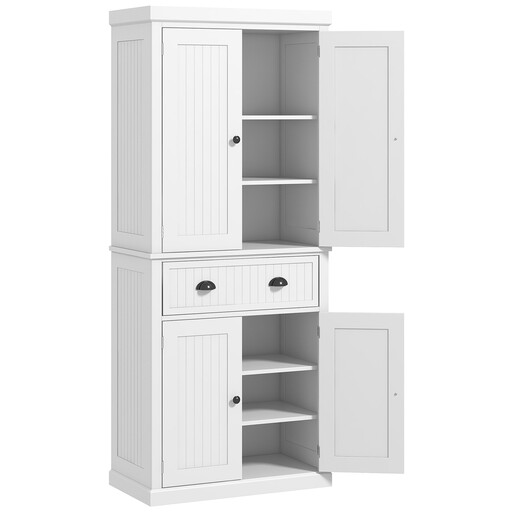
Why This Fits Their Persona: This is for the person who needs generous, straightforward storage. Its classic beadboard panel design fits beautifully into traditional or country-style UK kitchens, offering ample room for dry goods, preserves and extra crockery.
It directly counters the impracticality pitfall with three adjustable shelves. It also includes an anti-tipping strap to secure it to the wall, addressing the stability issue.
Features two separate 3-tier cabinets and a central drawer, providing excellent organisation. The traditional styling with brushed nickel handles offers a timeless look.
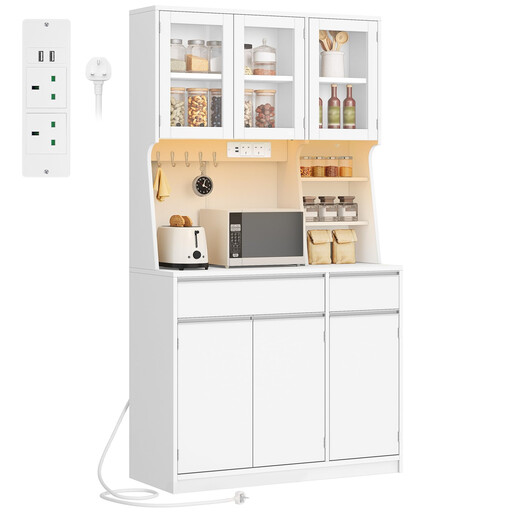
Why This Fits Their Persona: This is for someone who wants to create a dedicated coffee bar or appliance station. The integrated power and countertop space are perfect for housing a coffee machine, microwave and toaster, keeping the main kitchen worktops clear.
It solves a modern pitfall: cable clutter. The built-in power supply with UK sockets and USB ports eliminates messy extension leads. Its high-density particleboard construction and anti-tip device ensure it is sturdy.
The combination of a wide countertop, integrated power and LED lighting creates a highly functional, all-in-one station. It also offers huge storage capacity with both glazed and concealed cupboards.
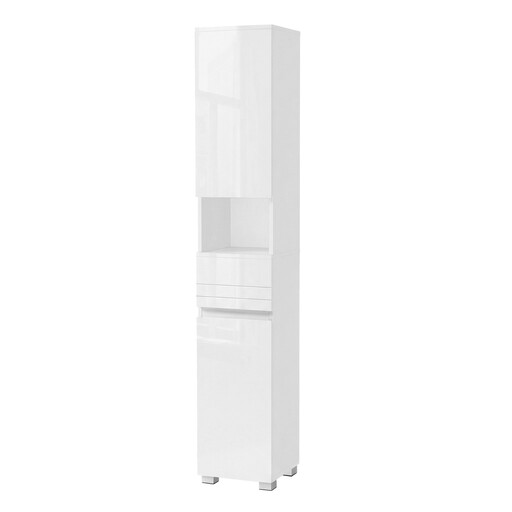
Why This Fits Their Persona: Ideal for renters or homeowners with compact kitchens. Its tiny 30x30cm footprint allows it to be tucked into a narrow gap or corner, providing valuable vertical storage for jars, tins and cleaning supplies without eating into precious floor space.
Even with its slim design, it includes adjustable shelves and an anti-tip kit. This ensures it is both versatile and safe, overcoming the common pitfalls of impracticality and instability often found in smaller units.
Its extremely space-efficient vertical design is its main benefit. The combination of open shelves, drawers and a cupboard offers surprisingly varied storage in a very small package.
We have compiled a complete, real-time list of products that fully satisfy these strict selection criteria and UK safety regulations.
1. How can I make my freestanding larder cupboard more stable? The most effective method is to use the anti-tip kit that should be included with the product. This secures the unit to the wall and prevents it from wobbling or falling. Additionally, always place the cabinet on a flat, level surface and load heavier items on the bottom shelves to lower its centre of gravity.
2. What is the difference between MDF and particleboard for a kitchen cabinet? Both are engineered wood products. MDF is made from fine wood fibres bonded with resin, creating a dense, smooth and strong material often used for doors that require shaping or painting. Particleboard is made from larger wood chips and is lighter, making it a common choice for the main cabinet structure or carcass. A well-constructed cabinet can use both materials effectively.
3. Can I paint a white larder cupboard a different colour? This depends entirely on the original finish. A cabinet with a matte painted surface is relatively easy to sand lightly and repaint. However, a unit with a high-gloss, laminate or melamine finish will require a specialist primer designed to adhere to shiny surfaces before you can apply a new colour. Always check the manufacturer's guidance first.