
24/7 Customer Support

Free returns

Same-day & Next-day Delivery

Quality Guaranteed
Download the APP
Categories
As a 3D printing enthusiast, you know that the filament you choose is just as important as the printer itself. When it comes to versatility, white PLA filament is a staple for everything from initial prototypes to finished decorative pieces. However, not all filaments are created equal. Poor quality material can lead to clogged nozzles, inconsistent layers and failed prints, turning a creative session into a frustrating one.
This guide is designed to help you navigate the options. We'll outline what to look for when purchasing a 1.75mm PLA filament and highlight a few standout choices that deliver on quality, finish and reliability for your FDM printer.
Before you add a spool to your basket, here are a few key factors to keep in mind. Understanding these will help you select a material that matches your printer's capabilities and your project's goals.
The diameter of your filament must be consistent for smooth and reliable printing. Look for a dimensional accuracy filament with a tight tolerance, typically specified as +/- 0.03mm or, even better, +/- 0.02mm. This precision prevents the filament from jamming in the extruder and ensures an even flow rate, which is critical for achieving clean, uniform layers—especially with white filament, where imperfections are more visible.
While all are based on Polylactic Acid (PLA), subtle differences in formulation can have a big impact on performance.
A neatly wound spool is non-negotiable. A tangle free spool ensures the filament feeds smoothly without snagging or knotting, which can ruin a long print. Additionally, many manufacturers are now moving towards eco friendly 3D printer filament spools made from cardboard. These are better for the environment and often include handy viewing holes to check how much material is left.
Here are our recommendations for white PLA filament, each catering to different printing needs and project types.
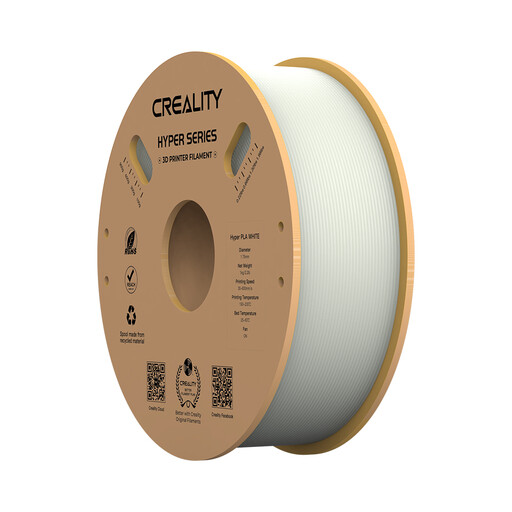
Why It Stands Out: This filament is engineered for pure speed. If you own a high-speed FDM printer, Creality's Hyper PLA is designed to keep up, enabling you to produce parts much faster than with standard PLA. Its formulation focuses on high fluidity and rapid cooling.
Pros:
Who is it for? Makers, prototypers and anyone with a high-speed 3D printer (like a Creality K1, Bambu Lab, or similar) who wants to maximise their machine's output without compromising on quality.
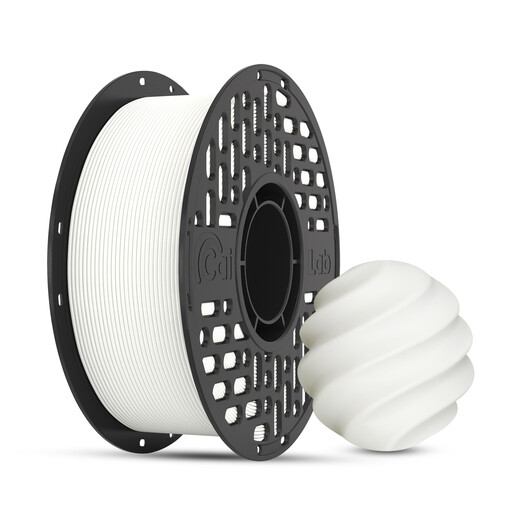
Why It Stands Out: For projects where aesthetics are paramount, this matte PLA filament is an excellent choice. Its non-glossy, textured finish diffuses light, which does a fantastic job of hiding layer lines and giving prints a sophisticated, almost stone-like appearance.
Pros:
Who is it for? Designers, artists and hobbyists creating architectural models, sculptures or any print where a professional, non-plastic finish is desired. It's also great for beginners due to its reliable bed adhesion and smooth flow.
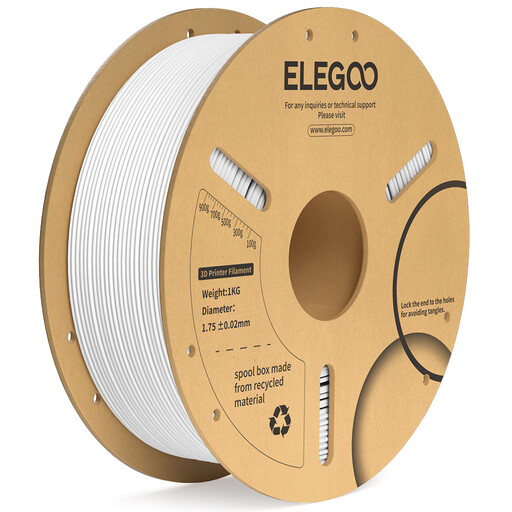
Why It Stands Out: Elegoo's PLA+ filament strikes a great balance between ease of use and mechanical performance. It's stronger and more durable than standard PLA, making it a reliable workhorse for a wide range of applications, from hobbyist prints to functional parts.
Pros:
Who is it for? This is a superb all-rounder for almost any user. It's perfect for hobbyists who want reliable results and for engineers or makers who need to print functional parts, brackets or tools that require a bit more durability than standard PLA can offer.
The world of FDM filament is vast, with countless variations in colour, finish and material properties. If the recommendations above don't quite fit your specific needs, or you're simply curious to see what else is available, there are many other high-quality options to discover.
Explore our full range of materials to find the perfect match for your next project.
️ Discover more white PLA filament options here
PLA+ is an enhanced version of standard PLA. It contains additives that increase its strength, durability and flexibility, making it less brittle. This makes PLA+ filament a better choice for printing functional parts that might be subjected to light stress or impact, whereas standard PLA is ideal for visual models and prototypes.
Achieving a smooth finish with white filament involves a few key steps. First, ensure your printer is well-calibrated, particularly the e-steps and flow rate. Print at a slightly lower temperature to reduce stringing and use a slower print speed for the outer walls. Finally, choosing a high-quality filament with excellent dimensional accuracy is crucial, as it ensures consistent extrusion, which is the foundation of a smooth surface.
While high speed PLA can technically be used in most FDM printers, you will only see its true benefits on a machine designed for high-speed printing. These printers have rigid frames, advanced motion systems and powerful hotends capable of melting the filament fast enough to keep up. Using it on a standard printer at normal speeds will work fine, but you won't be taking advantage of its primary feature.