People building a quick lunch around naan
If naan will carry toppings or accompany leftovers, decide how much bread you want alongside the rest of the meal. A mini naan or part of a larger one may fit that plan differently.


Choose plain or garlic naan if you want a quick bread to serve with toppings or leftovers, but do not assume it is a white-and-brown blend: the labelled examples from M&S and Sainsbury's use wheat flour, and added wheat fibre does not establish that a naan is wholemeal. If wholegrain is the priority, look for bread explicitly labelled wholemeal or wholegrain; if you prefer naan, compare the portion, fibre and salt figures on the same basis before choosing.
If naan will carry toppings or accompany leftovers, decide how much bread you want alongside the rest of the meal. A mini naan or part of a larger one may fit that plan differently.
Added wheat fibre gives you a figure to compare, but does not make a wheat-flour naan wholemeal. If wholegrain is the aim, check for an explicit wholemeal or wholegrain label, in line with the UK Eatwell Guide's advice to choose wholegrain starchy foods where possible.
Check the allergen statement on the exact pack. The labelled naan examples from M&S, Sainsbury's and Waitrose contain wheat, while the Humza Plain Tandoori Naan listing identifies cereals containing gluten.
Start with what you mean by “brown”: a stated fibre figure lets you compare naans, while an explicit wholemeal or wholegrain label addresses a wholegrain goal. Then compare the amount you would serve and how you would store the rest of the pack.
| Priority | What to check | Your needs |
|---|---|---|
| Wholegrain or fibre | Look for explicit wholemeal or wholegrain wording if that is the goal. For a fibre comparison, read the declared amount and its serving basis; M&S Mini Plain Naans list wheat flour and wheat fibre, with 4.8 g fibre per 100 g. | I want to know whether I am buying wholegrain bread, or simply choosing a naan with a stated fibre figure. The UK Eatwell Guide advises choosing wholegrain versions of starchy carbohydrates where possible. |
| Portion and format | Check the number and size of naans, then compare nutrition per 100 g or for the portion you plan to eat. Sainsbury's Plain Naan gives figures per half naan; Waitrose gives figures per whole garlic-and-coriander naan. | For a solo lunch, I might serve half a large naan or choose a smaller format, leaving room on the plate for the other food I have planned. |
| Salt | Calculate salt for your intended bread portion, using the unit printed on its label. Include the other components of the meal when considering the NHS guidance that adults should have no more than 6 g of salt a day. | If I am adding a sauce or ready meal, I want to count the naan's salt as part of the meal rather than overlook it because the bread is a side. |
| Ingredients and allergens | Read the current ingredient and allergen statements for the exact product. Do not use bread colour, flavour or the word “naan” to judge whether it contains wheat or gluten. | I need to check the pack itself if wheat, gluten or another listed allergen affects what I can buy. |
| Storage and heating | Check how long the pack keeps once opened, whether it can be frozen, and its chilled or frozen heating instructions. Follow any instruction not to reheat after cooling. | A multi-pack needs to fit the lunches I will actually make; otherwise, I would choose a smaller pack or follow its freezing instructions. |
M&S Mini Plain Naans list wheat flour and added wheat fibre. Neither that ingredient nor the bread's appearance establishes a wholemeal base.
If wholegrain is your reason for buying, choose a product explicitly labelled wholemeal or wholegrain. Otherwise, compare the naan's declared fibre figure without calling it wholemeal.
Waitrose gives nutrition for its garlic-and-coriander product per naan, while Sainsbury's plain naan gives it per half naan. The printed numbers therefore describe different amounts of bread.
Compare per 100 g figures where available, or calculate the values for the amount you intend to serve.
Opened-pack and freezing instructions differ between products, which matters when a multi-pack will cover several solo lunches.
Read the exact pack's opened-storage period, freezing guidance and heating instructions before planning later meals.
Bread left beyond its stated opened-pack period may go unused if the pack is larger than your lunch plans allow.
The labelled examples identify wheat or cereals containing gluten. Naan also contributes salt to a meal that may include sauce or other prepared food.
Check the current allergen statement and the salt in the portion you will eat. NHS guidance sets a maximum of 6 g of salt a day for adults.
Tesco Groceries lists plain, mini, garlic-and-coriander and Peshwari options in its naan category.
Its plain and Taste the Difference garlic-and-coriander naan labels provide figures per half naan.
Waitrose lists a two-pack of tandoori garlic-and-coriander naans with nutrition stated per naan.
M&S Mini Plain Naans provide a smaller format with fibre and salt declared per 100 g.
Asda has an online naan-bread category for browsing grocery options.
Lidl's bakery information directs shoppers to dietary and allergen details.
These Humza plain and garlic-and-coriander naans are options for a naan-based lunch, in four-piece and family-pack formats. Choose by flavour and pack size; the selection does not establish a wholemeal option.
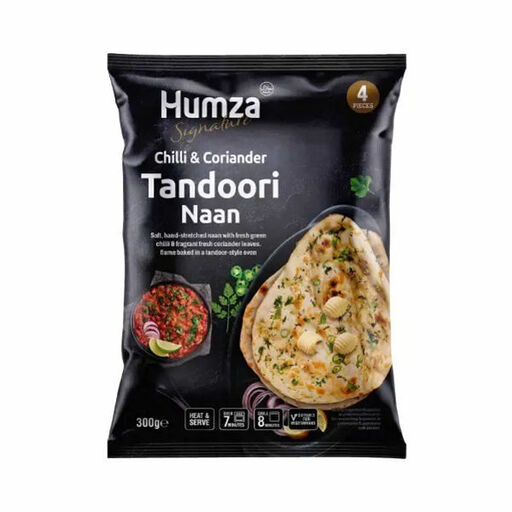 Image unavailable
A garlic-and-coriander option when you want flavoured naan with lunch. The 300g pack contains four pieces; check the pack's ingredients and nutrition for the portion you plan to serve rather than assuming it is wholemeal.
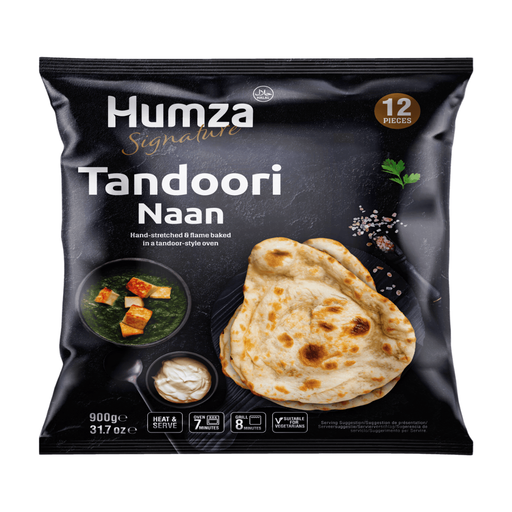 Image unavailable
Choose the plain version if you would rather add your own topping, dip or curry. The 300g pack contains four pieces; the Humza product listing identifies wheat and cereals containing gluten, so check the current allergen statement.
 Image unavailable
The twelve-piece plain pack is an option when several lunches or diners will use it. Check its opened-pack and freezing instructions before choosing this 900g format for a smaller household.
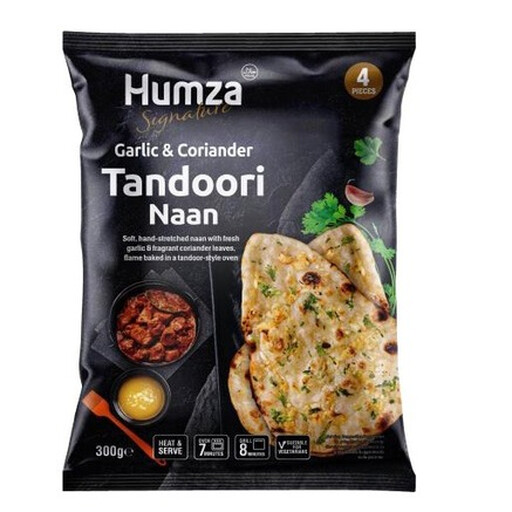 Image unavailable
This twelve-piece pack offers the garlic-and-coriander variant for multiple lunches or diners. For solo lunches, consider whether you can use or store the 900gm pack according to its instructions.
No: colour alone does not establish that it is wholegrain. Look for an explicit wholemeal or wholegrain label. M&S Mini Plain Naans list wheat flour and added wheat fibre, which gives a fibre figure to compare but does not establish a wholemeal base.
No. The labelled M&S, Sainsbury's and Waitrose examples contain wheat, and the Humza Plain Tandoori Naan listing identifies cereals containing gluten. Check the current allergen statement on the exact product you intend to buy.
Check the exact pack's freezing and heating instructions before planning later lunches. Waitrose states that its garlic-and-coriander naans are suitable for home freezing; instructions for another product should not be assumed to be the same.
Follow the period on that product's label. Sainsbury's Plain Naan says to use it within 24 hours after opening for best quality, while M&S Garlic and Coriander Naan Breads say to store the opened pack in an airtight container and eat it within two days.
Compare the salt in the amount of naan you will actually eat, rather than treating different serving sizes as equivalent. Sainsbury's garlic-and-coriander naan lists 0.58 g per half naan, while Waitrose lists 0.86 g per whole garlic-and-coriander naan. NHS guidance says adults should have no more than 6 g of salt a day, including salt from the rest of the meal.