Choose a white-and-wholemeal tortilla wrap only if its ingredients and precautionary advice suit the person eating it: the blends discussed here contain wheat. For coeliac disease, look for a gluten-free-labelled wrap instead; for wheat allergy, a gluten-free claim alone is not enough, because some gluten-free foods contain wheat starch. Once the relevant allergens have been checked, compare fibre using the figures per 100 g rather than assuming that wraps are the same size.
Who is choosing the wraps?
The right starting point depends on which ingredient or label matters to the person who will eat the wrap.
Shopping for someone with wheat allergy
Check the current pack for wheat ingredients, including wheat starch, before considering the grain blend or fibre figure. Cambridge University Hospitals NHS Foundation Trust cautions that a gluten-free product can still contain wheat starch. Read any precautionary advice for the person’s allergens as well.
Shopping for someone with coeliac disease
Look for a gluten-free-labelled wrap rather than an ordinary white-and-wholemeal wheat blend. Coeliac UK explains that the UK gluten-free label applies to foods containing no more than 20 parts per million of gluten; it does not answer every separate food-allergy question.
Comparing fibre alongside another allergy
If wheat is suitable, white-and-wholemeal and wholemeal wraps can be compared using their stated fibre per 100 g. The ingredients and precautionary advice still need to fit the person’s particular allergen requirements.
What should you check first?
Start with the allergen information on the pack being purchased. Compare ingredients and fibre only among wraps that meet that requirement.
| Priority | What to check | Your needs |
|---|
| Wheat ingredients |
Read the current ingredient list for wheat flour, wheat starch and wheat gluten. Check the exact variety: ASDA White & Wheat and Mission Wheat & White both identify wheat ingredients. |
If I’m buying for someone with wheat allergy, a white-and-brown appearance cannot settle the choice. I need to check the actual wrap before comparing its fibre. |
| Gluten-free labelling |
For coeliac disease, check for a gluten-free label on the purchased pack. Coeliac UK says this label applies at no more than 20 parts per million of gluten; Cambridge University Hospitals NHS Foundation Trust warns that gluten-free foods can still contain wheat starch. |
For someone with coeliac disease, I need a gluten-free-labelled alternative to a standard wheat blend. If wheat allergy is also relevant, I still need to read the ingredients. |
| Precautionary advice |
Read any ‘may contain’ or ‘not suitable for’ statement for the relevant allergen. ASDA lists possible rye, barley and oats contact on its White & Wheat wraps; Sainsbury’s gives additional allergy exclusions for its checked wholemeal wrap. |
An ingredient list may not answer my question about possible cross-contact. I need the pack’s advice for the particular allergen I’m shopping around. |
| Fibre comparison |
Compare declarations per 100 g, not per wrap unless the portions are comparable. The checked ASDA wholemeal listing states 6.9 g fibre per 100 g, while the checked Sainsbury’s wholemeal listing states 10.1 g per 100 g; these are figures for those specific products. |
Once the allergen check is settled, I can compare fibre without treating wholemeal or a larger-looking wrap as a measure of allergy suitability. |
Common shopping mistakes
-
Treating a grain blend as an allergy claim
A white-and-wholemeal description tells you about the type of wrap, not whether it avoids wheat. The checked ASDA and M&S mixed-flour wraps and Mission Wheat & White contain wheat.
Check the purchased pack against the person’s allergens before using its colour, grain description or nutrition figures to choose between wraps.
-
Using ‘gluten free’ or ‘vegan’ as a substitute for an allergen check
Cambridge University Hospitals NHS Foundation Trust notes that gluten-free products can contain wheat starch. The Food Standards Agency and Ipsos UK also caution that vegan labelling alone is not a proxy for allergen labelling.
Match the label claim to the person’s requirement, then read the full ingredients and relevant precautionary advice.
-
Comparing fibre per wrap without checking portion sizes
A per-wrap figure depends on the size of that wrap, so figures from different products may not be directly comparable.
Use the published per-100 g figures for a like-for-like nutrition comparison, after checking allergen suitability. Follow the chosen pack’s storage directions after opening.
Brand and product references
These are examples of specific UK listings to help distinguish mixed-flour, wholemeal, plain white and gluten-free wraps; the details do not apply to every product from each brand.
ASDA
Its checked White & Wheat wrap is a mixed-flour example, alongside a separate wholemeal wrap.
- The White & Wheat listing identifies wheat and states that rye, barley and oats may be present.
- Neither checked wrap is a wheat-free choice; check the current pack for the relevant allergen advice.
M&S
M&S describes its checked Wholemeal Tortilla Wraps as a blend of white and wholemeal flour.
- The product listing provides ingredients and a fibre declaration for comparison.
- The wrap contains wheat. M&S advises reading the pack because ingredients and allergens can change.
Mission
Mission Wheat & White uses wheat flour with added wheat fibre and wheat germ, rather than being described as a white-and-wholemeal flour blend.
- Mission identifies wheat fibre, wheat germ and wheat gluten in this product’s ingredients.
- The Wheat & White name does not make this wrap suitable when wheat must be avoided.
Old El Paso
Its checked gluten-free-labelled tortilla offers a different route from standard wheat wraps.
- Old El Paso lists tapioca starch and corn masa flour for its Gluten Free Regular Original Tortillas.
- A gluten-free label alone does not establish wheat-allergy suitability. Old El Paso says the pack takes precedence if its online details conflict.
Sainsbury’s
Its checked wholemeal tortilla provides a wheat-wrap example for comparing fibre when wheat is suitable.
- The listing states 10.1 g fibre per 100 g.
- The same listing says the product is not suitable for people allergic to soya, rye, barley, oats or spelt because of manufacturing methods.
Tesco
Its checked Plain White Tortilla Wraps offer a white-wheat reference point, not a white-and-wholemeal blend.
- The listing identifies wheat flour and wheat starch and states 3.7 g fibre per 100 g.
- Those details describe this plain white wrap, not other Tesco varieties or a wheat-free option.
A Joybuy wrap option
This gluten-free-labelled tortilla is an alternative to the wheat blends discussed above. Check the pack for the person’s particular allergens before choosing it.
 No image available
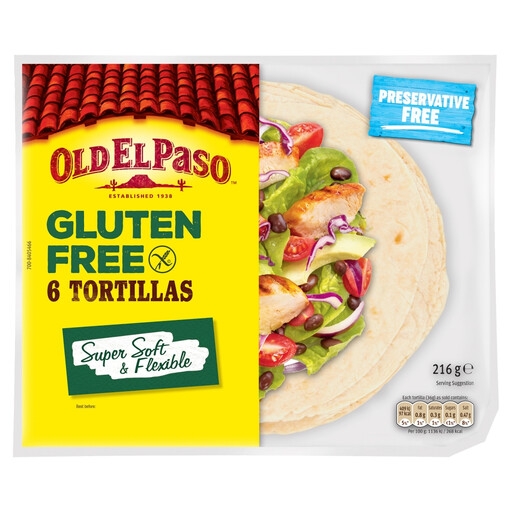
Old El Paso Gluten Free Tortilla Wraps 216g
A gluten-free-labelled tortilla option to consider instead of a standard wheat blend when shopping for someone with coeliac disease. The Joybuy listing identifies a 216 g pack of six tortillas. For wheat allergy or another food allergy, check the ingredients and precautionary advice on the pack received; do not rely on the gluten-free claim alone.
View on Joybuy
Questions about choosing wraps
Does ‘gluten free’ mean a wrap is suitable for wheat allergy?
No. Cambridge University Hospitals NHS Foundation Trust warns that gluten-free products can still contain wheat starch. For wheat allergy, read the purchased wrap’s ingredients and relevant precautionary advice rather than relying on its gluten-free label alone.
Can a vegan label answer an allergy question?
No. A vegan claim does not replace an ingredient and allergen check. The Food Standards Agency and Ipsos UK caution against using vegan labelling as a proxy for allergen labelling; ASDA’s checked White & Wheat wraps are labelled suitable for vegans but contain wheat.
How should I check storage and heating directions?
Follow the directions on the pack you buy, as they can differ between wraps. For example, ASDA’s checked White & Wheat listing gives oven, microwave and dry-pan heating directions and says to refrigerate and use the wraps within 24 hours after opening.
What if the pack’s allergen details differ from the online listing?
Use the purchased pack rather than the listing to check its ingredients and allergen advice: Old El Paso says its packaging is the primary resource when the two conflict, and M&S also advises reading the label. If there has been an allergy-related reaction or near miss, the Food Standards Agency advises contacting the food business in the first instance.


