Adults reducing dietary fat
If milk goes into your drinks, cereal or cooking, its fat content is worth comparing across milk types. The NHS suggests 1% or skimmed milk for people trying to cut down on fat.


For adults trying to cut down on fat, the NHS suggests swapping to 1% or skimmed milk rather than choosing whole milk as a lower-fat option. Semi-skimmed milk offers an intermediate choice; whichever type you buy, compare fat and saturates per 100ml on the pack. Filtered or lactose-free whole milk may meet other needs, but those features do not make it lower in fat.
The useful distinction is between reducing milk fat and choosing a whole-milk product for another reason, such as taste or storage.
If milk goes into your drinks, cereal or cooking, its fat content is worth comparing across milk types. The NHS suggests 1% or skimmed milk for people trying to cut down on fat.
If you prefer whole milk, compare that preference with the nutrition label before deciding. The whole milks listed by Sainsbury's, Asda and Waitrose contain 3.6–3.7g fat and 2.3–2.4g saturates per 100ml.
Lactose content and fat content are separate checks. Waitrose lists Arla LactoFREE Whole Milk Drink at 3.6g fat per 100ml and states that it is not suitable for people with a milk allergy.
Start with the fat level that fits your aim, then check the exact pack for the other details that matter in your household.
| Priority | What to check | Your needs |
|---|---|---|
| Fat and saturates | Compare both figures per 100ml, then consider how much milk you use. The NHS suggests 1% or skimmed milk when cutting down on fat; its guidance gives semi-skimmed milk as an example containing 1.8g fat per 100ml. | “I use milk regularly and want to reduce the fat it adds to my diet.” A smaller serving changes the amount consumed, not the milk's fat content per 100ml. |
| Nutrition information | Check protein and calcium on the particular pack alongside fat. For example, Sainsbury's lists 3.5g protein and 124mg calcium per 100ml for its West Country Whole Milk; values for another product need their own label. | “If I switch from whole milk, I still want to know what the milk provides.” Comparing labels keeps that question separate from the fat-level decision. |
| Taste and uses | Choose a fat level, then try it in the drinks, cereal or cooking where you use milk. Do not assume that a preference in one use settles the choice for every use. | “I'm used to whole milk in tea or cereal, so I want to see whether semi-skimmed, 1% or skimmed milk suits those uses.” |
| Storage | Read the unopened and once-opened instructions on the exact pack. Arla says its Cravendale filtered whole milk stays fresh for up to three weeks unopened and seven days after opening; Waitrose's listed standard whole milk says to refrigerate below 5°C and consume within three days of opening. | “Milk lasts longer in my household when I use it slowly.” Longer-life filtering may help with that concern, but the cited Cravendale whole milk still lists 3.6g fat per 100ml. |
| Lactose and milk allergens | Check both the lactose description and the allergen statement. Waitrose describes Arla LactoFREE Whole Milk Drink as containing less than 0.03% lactose, but states that it is not suitable for people with a milk allergy. | “I'm looking for lactose-free dairy milk.” I still need to check the fat level, and I must not mistake lactose-free for milk-free. |
A small serving contains less fat than a large one, but it does not change the product's per-100ml figure. Whole milks listed by Sainsbury's, Asda and Waitrose contain 3.6–3.7g fat and 2.3–2.4g saturates per 100ml.
Compare fat and saturates per 100ml first, then consider the amount you use. The NHS suggests trying 1% or skimmed milk when the aim is to cut down on fat.
Filtering and fat level describe different things. Asda lists Cravendale filtered whole milk at 3.6g fat and 2.3g saturates per 100ml, while Arla describes its extended freshness.
Choose a filtered product for its stated storage characteristics only if those suit your use. If reducing fat is the priority, check the fat level of the filtered milk itself.
Waitrose lists Arla LactoFREE Whole Milk Drink at 3.6g fat per 100ml and explicitly states that it is not suitable for people with a milk allergy.
Check the allergen label separately from the lactose and nutrition information. Do not rely on lactose-free dairy milk as a milk-free choice.
These examples show why a storage or sourcing preference needs its own check; it does not determine the milk's fat level.
Arla describes Cravendale whole milk as filtered for longer freshness.
Tesco separates whole, semi-skimmed, skimmed, filtered, long-life and lactose-free milk in its milk department.
Sainsbury's lists per-100ml nutrition for its West Country Whole Milk.
Asda lists a 2L Cravendale filtered fresh whole milk product.
M&S makes sourcing and farmer-payment claims for its whole-milk range.
Waitrose lists a British free-range whole milk and makes farming-related claims for the product.
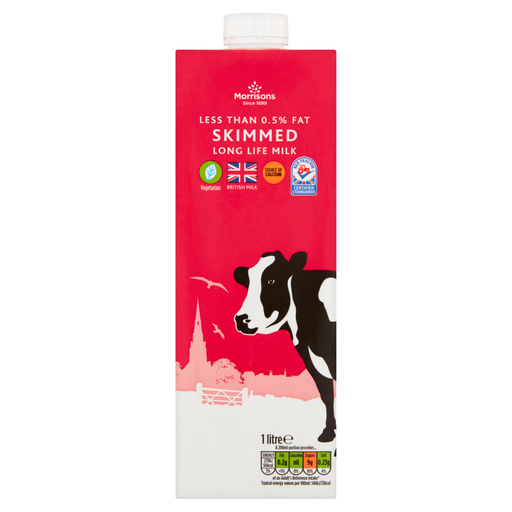
This Joybuy option is skimmed dairy milk for uses such as drinks, cereal and cooking when reducing milk fat is the priority.
 No image available
A skimmed milk option for drinks, cereal or cooking when you want to move away from whole milk. The product information says to refrigerate after opening and use within three days; it also states that the milk is not suitable for children under five.
The cited whole milks are not low-fat on their listed figures: Sainsbury's, Asda and Waitrose give 3.6–3.7g fat per 100ml, while the NHS describes low-fat liquids as containing 1.5g fat or less per 100ml. Check the exact product label rather than relying on a small serving size.
The NHS specifically suggests trying 1% or skimmed milk when cutting down on fat. Semi-skimmed milk is an intermediate choice if you want to move away from whole milk without switching straight to those options; compare the fat and saturates figures on the packs you are considering.
Not necessarily. Waitrose lists Arla LactoFREE Whole Milk Drink at 3.6g fat and 2.3g saturates per 100ml, and states that it is not suitable for people with a milk allergy. Check lactose, fat and allergens as separate parts of the label.
Follow the instructions on the particular pack. The cited Sainsbury's and Waitrose standard whole-milk listings say to consume the milk within three days of opening, while Arla states up to seven days after opening for its Cravendale filtered whole milk.