Adults and older children cutting down on fat
If milk is going into drinks, cereal or a lunchbox, compare the milk type before choosing a pack size. The NHS suggests 1% or skimmed milk for people trying to cut down on fat.


For an older child or adult trying to cut down on fat, choose the milk type before the multipack: NHS guidance suggests swapping to 1% or skimmed milk. A whole-milk pack may be convenient, but its format does not change its fat content. If the lunchbox is for a child under 5, check whether the milk will be their main drink before applying that lower-fat advice.
If milk is going into drinks, cereal or a lunchbox, compare the milk type before choosing a pack size. The NHS suggests 1% or skimmed milk for people trying to cut down on fat.
Check the volume of each carton or bottle, not just the number of units in the multipack. An unopened portion also needs to fit the day’s storage arrangements and the instructions on its pack.
Age matters when milk is a child’s main drink. NHS guidance says 1% or skimmed milk should not be used as the main drink for children under 5; seek individual advice if a young child has been prescribed a low-fat diet.
Decide which milk type suits the drinker, then check whether the individual packs and their storage instructions suit the lunchbox routine.
Consider when: An older child or adult is trying to cut down on fat, as advised by the NHS.
Age check: NHS guidance says these should not be the main drink for a child under 5.
Consider when: You want to compare a lower-fat variant with whole milk. Waitrose & Partners lists Cravendale semi-skimmed at 1.7g fat per 100ml, against 3.6g for its whole version.
Distinction: The NHS specifically suggests 1% or skimmed milk when the aim is to cut down on fat.
Consider when: Reducing fat is not the drinker’s goal and the milk choice suits their age and needs.
Check: A multipack or longer-life format does not make whole milk a lower-fat variant.
| Priority | What to check | Your needs |
|---|---|---|
| Milk fat | Compare fat and saturates per 100ml on the nutrition panels of whole, semi-skimmed, 1% and skimmed milk. Keep the serving basis the same when comparing packs. | I’m trying to cut down on fat, so the type of milk matters more to me than the convenience of a multipack. |
| Drinker’s age | Check the child’s age and whether milk will be their main drink. NHS guidance says 1% or skimmed milk should not be the main drink for children under 5. | If I’m packing milk for a young child, I need a choice that fits their age, not simply the lowest-fat carton. |
| Portion format | Read the number of units and volume per unit. Tesco Groceries lists a semi-skimmed UHT multipack of six 1-litre cartons; that format is different from individual lunchbox portions. | One unopened carton needs to fit in the lunchbox; several large household cartons would serve a different purpose. |
| Storage | Check whether the exact product needs refrigeration before opening, after opening, or both. Follow its use-by and post-opening instructions. | I need to know how the milk can be stored during the school day, rather than treating “long-life” as permission to leave an opened pack unrefrigerated. |
Waitrose & Partners lists its Essential whole milk at 3.7g fat and 2.4g saturates per 100ml. A smaller portion or multipack does not change those per-100ml values.
If the drinker is an older child or adult cutting down on fat, compare 1% and skimmed milk before choosing a pack format, in line with NHS guidance.
Tesco Groceries lists a six-pack of 1-litre semi-skimmed UHT cartons. It is a multipack, but each carton is a household-sized unit rather than an individual lunchbox portion.
Check both the unit count and millilitres per unit. If each lunch needs its own unopened pack, look specifically for that format.
NHS guidance says 1% or skimmed milk should not be a main drink for children under 5. A household’s low-fat goal does not settle the choice for every drinker.
Confirm the child’s age and how the milk will be used. Seek individual dietary advice if a low-fat diet has been prescribed for a young child.
Long-life and filtered describe product formats; they do not replace the storage directions for an opened carton.
Read the exact pack’s refrigeration and post-opening instructions before relying on it for a lunchbox.
A familiar brand name does not identify the milk’s fat level or the size of each pack; compare the specific variant and its label.
Arla Foods UK lists whole, semi-skimmed and skimmed Cravendale milk.
Tesco Groceries lists milk in several fat variants, including a semi-skimmed UHT multipack.
Marks & Spencer identifies skimmed, semi-skimmed and whole milk in its food range.
Waitrose & Partners lists Essential whole milk; its wider milk range also includes filtered semi-skimmed milk.
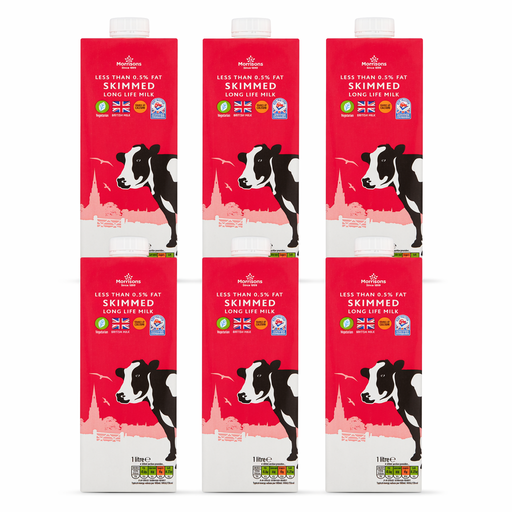
This skimmed-milk multipack represents the lower-fat route for older children and adults cutting down on fat. Its six 1-litre cartons suit stocking up rather than packing separate single-serve lunchbox portions.
 No image available
A skimmed-milk option for an older child or adult choosing milk while cutting down on fat. The pack contains six 1-litre UHT cartons, not individual lunchbox portions; check the carton’s storage instructions before use.
Not as the default choice for an older child or adult trying to cut down on fat. The NHS suggests swapping to 1% or skimmed milk; Waitrose & Partners lists one Essential whole milk at 3.7g fat and 2.4g saturates per 100ml. Compare the nutrition panels before deciding on pack size.
NHS guidance says it should not be their main drink. Check the child’s age and how the milk will be used; seek individual advice if a low-fat diet has been prescribed for a young child.
Compare the saturates figures on the same basis, such as per 100ml, alongside total fat. For example, Waitrose & Partners lists Cravendale whole milk at 2.3g saturates per 100ml and its semi-skimmed variant at 1.0g per 100ml. Check the figures on the exact cartons you are considering.
Those descriptions do not make a whole-milk product a lower-fat milk variant. Check its nutrition panel separately from its shelf-life and storage instructions, particularly if a carton will be opened before it goes into a lunchbox.