Breakfast shoppers reducing fat
If you use cow's milk on cereal or porridge, or in tea and coffee, compare semi-skimmed, 1% and skimmed cartons rather than looking for a low-fat whole milk.


If lower fat is the priority, choose semi-skimmed, 1% or skimmed milk rather than whole milk. Dairy UK lists 3.7g fat per 100ml for whole milk and 1.8g for semi-skimmed milk; if you prefer whole milk, it remains a different choice rather than a low-fat one. For a weekday routine, also choose a carton size and storage format you can use within its label instructions.
If you use cow's milk on cereal or porridge, or in tea and coffee, compare semi-skimmed, 1% and skimmed cartons rather than looking for a low-fat whole milk.
If a bottle often lasts beyond a few breakfasts, the pack size and instructions for use after opening matter as much as whether the milk is fresh, filtered or UHT.
If whole milk is your preference, you can choose it on that basis. Its fat content is higher than that of semi-skimmed or skimmed milk, so it does not meet a lower-fat goal.
Start with the milk-fat category, then check the carton's nutrition and storage information against how many breakfasts it needs to cover.
| Priority | What to check | Your needs |
|---|---|---|
| Fat level | Compare fat and saturates on the same per-100ml basis where the cartons provide it. Dairy UK lists 3.7g fat per 100ml for whole milk, 1.8g for semi-skimmed and 0.3g for skimmed. | I want less fat than whole milk in my usual breakfast drinks or cereal. The NHS advises lower-fat milks for older children and adults choosing to reduce saturated fat. |
| Nutrition label | Read the values for the exact carton rather than assuming all milks in one category match. Sainsbury's lists 3.5g protein and 124mg calcium per 100ml for its cited UHT semi-skimmed milk. | If protein or calcium figures matter to my comparison, I want to read them alongside fat on each product label. |
| Opened life | Check both the unopened date and the instructions after opening. Tesco lists seven days after opening for the cited Cravendale filtered semi-skimmed milk; Sainsbury's says three days for its cited fresh West Country semi-skimmed milk. | Our household uses a little milk each morning, so I need a carton we can finish within its own instructions. |
| Storage format | Check whether the carton is fresh chilled milk or UHT milk, and read its storage directions before and after opening. Do not assume an unopened UHT carton's storage conditions continue once it is opened. | I would like a cupboard carton for mornings when the fresh milk has run out, but I can refrigerate it after opening as directed. |
| Pack size | Compare the volume of each carton with how much milk your household uses during its stated opened-life period. For a multipack, check the size and instructions of each individual carton. | A smaller carton may suit me if I only use milk in tea; a household serving several breakfasts may get through a larger one. |
| Milk allergen | Read the current ingredients and allergen information. Cambridge University Hospitals NHS Foundation Trust distinguishes cow's-milk-protein allergy from lactose intolerance; a lactose-free dairy product can still contain milk protein. | If someone in my household has a milk-protein allergy, I cannot treat ordinary or lactose-free dairy milk as an allergy-safe substitute. |
Whole milk contains more fat than semi-skimmed or skimmed milk, so the two requirements point to different cartons.
Decide which matters more at breakfast. If it is lower fat, compare semi-skimmed, 1% and skimmed milk using the carton labels.
Milk left unused beyond the carton's instructions may need to be discarded, even if its unopened date looked suitable when you bought it.
Estimate how much your household uses between shops, then check the pack size and directions after opening.
Lactose intolerance and cow's-milk-protein allergy are different. Removing lactose from dairy milk does not establish that it is suitable for someone with a milk-protein allergy.
Check the allergen information on the current pack. Seek appropriate medical advice if a milk allergy is suspected.
The carton you receive carries the instructions and allergen information relevant to that product.
Before using it, read its current label, particularly the allergens, storage directions and date markings.
These examples show different milk-fat categories and storage formats; compare the current carton when choosing a particular product.
A filtered fresh-milk range with whole and semi-skimmed 2L cartons.
Its listed milk range includes conventional and filtered whole milk alongside branded options.
Its cited semi-skimmed products include both long-life UHT and chilled fresh milk.
Its milk range lists whole, semi-skimmed, filtered and lactose-free options.
The Essential range lists whole, semi-skimmed and skimmed milk, including long-life options.
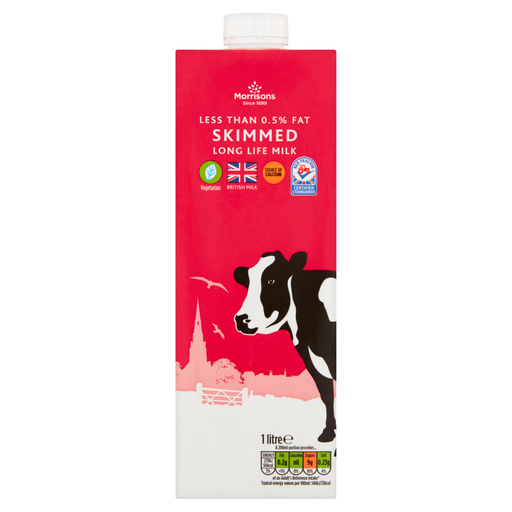
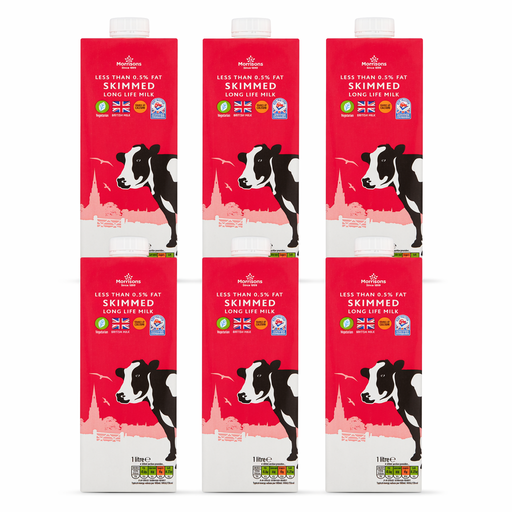
These Morrisons UHT skimmed milk cartons are options for a lower-fat weekday breakfast, particularly if you want an unopened carton to keep for later. Choose between a single 1-litre carton and six 1-litre cartons according to how much your household will use.
 No image available
A single UHT skimmed milk carton to consider if your household uses one litre across its weekday breakfasts. The listing says to refrigerate it after opening and use it within three days; it also says the product is not suitable for children under 5. Check the date and instructions on the carton.
 No image available
Six 1-litre UHT skimmed milk cartons suit a household that expects to use several cartons over time. The listing says to refrigerate each carton after opening and use it within three days; it also says the product is not suitable for children under 5. Check the dates and instructions on the cartons.
No. Dairy UK lists whole milk at 3.7g fat per 100ml, compared with 1.8g for semi-skimmed and 0.3g for skimmed milk. If reducing fat is your reason for changing your breakfast milk, compare the lower-fat categories rather than another whole-milk carton.
Semi-skimmed milk is one way to choose less fat than whole milk while continuing to use cow's milk; 1% and skimmed milk are other categories to compare. Choose fresh, filtered or UHT according to the particular carton's storage instructions and how quickly you will use it.
Follow the instructions on the carton, because they differ between products. Tesco states seven days after opening for the cited Cravendale filtered whole and semi-skimmed cartons, while Sainsbury's states three days for its cited fresh West Country semi-skimmed milk.
Do not assume it is. Cambridge University Hospitals NHS Foundation Trust explains that cow's-milk-protein allergy concerns milk proteins, whereas lactose intolerance concerns lactose digestion. Check the current allergen information and seek appropriate medical advice for a suspected allergy.