Adults choosing a lower-fat milk
If you use cow’s milk in tea, cereal, porridge or cooking and want to cut fat, compare semi-skimmed, 1% and skimmed varieties. The NHS specifically suggests 1% or skimmed milk when cutting fat is the aim.


If cutting fat is the priority, choose lower-fat milk rather than whole milk: semi-skimmed offers a middle ground, while the NHS suggests 1% or skimmed milk when the aim is to cut fat further. Whole milk remains an option when you prefer it and do not need a lower-fat choice; compare the nutrition label, use-by date and storage instructions for the exact product. The NHS advises against giving 1% or skimmed milk as a main drink to children under five.
The intended drinker and how quickly the milk will be used matter more than the time of day alone.
If you use cow’s milk in tea, cereal, porridge or cooking and want to cut fat, compare semi-skimmed, 1% and skimmed varieties. The NHS specifically suggests 1% or skimmed milk when cutting fat is the aim.
A small amount at supper may leave an open carton in the fridge for several days. Check the bottle size, use-by date and instructions for storage before and after opening; a longer unopened life does not extend the opened period.
Check who will drink the milk before switching everyone to the same type. The NHS advises against giving 1% or skimmed milk as a main drink to children under five.
Choose the milk type first, then compare labels and storage instructions for the pack size you will use.
| Priority | What to check | Your needs |
|---|---|---|
| Fat level | Compare fat and saturates on the same per 100ml basis. Tesco Groceries lists Cravendale semi-skimmed at 1.7g fat and 1.0g saturates per 100ml, against 3.6g and 2.3g for its whole version. | I want milk for supper while cutting fat. The NHS suggests 1% or skimmed milk when that is the main aim; its guidance differs for children under five having milk as their main drink. |
| Milk for drinks and food | Check whether the pack says whole, semi-skimmed, 1% or skimmed, rather than relying on the word “filtered”. Compare the exact products’ labels if their fat content matters to you. | For tea, cereal or cooking, I would choose semi-skimmed as a middle ground, or whole milk if I prefer it and am not seeking a lower-fat option. |
| Storage | Check the use-by date, refrigeration instructions and separate unopened and opened periods. Waitrose & Partners states up to one month unopened and seven days opened for its filtered semi-skimmed milk; follow the conditions on the pack. | I only use a little milk at night, so I need a carton size and opened period that fit how quickly I will finish it. |
| Milk allergens | Check the exact pack when someone needs to avoid milk or its constituents. The Food Standards Agency identifies milk as an allergen. | If I am buying for someone who must avoid milk, ordinary cow’s milk is not an appropriate substitute for a specifically labelled alternative. |
In Tesco Groceries’ Cravendale 2L listings, whole milk has 3.6g fat and 2.3g saturates per 100ml; the semi-skimmed version has 1.7g and 1.0g.
Start with the fat level on the label. If cutting fat is the main aim, the NHS suggests trying 1% or skimmed milk.
Cravendale’s filtered range includes both whole and semi-skimmed versions. Filtering does not tell you which fat level is in the carton.
Read the milk type and compare fat and saturates per 100ml on the products you are considering.
A stated unopened period does not apply once the bottle is open. For example, Waitrose & Partners states up to one month unopened but seven days after opening for its filtered semi-skimmed milk.
Match the size to your likely use and follow the pack’s refrigeration, use-by and opened-life instructions.
The Food Standards Agency identifies milk as an allergen, so ordinary cow’s milk does not meet a need for a milk-free product.
Check the exact pack and choose an appropriately labelled alternative where milk must be avoided.
These product-line examples show why milk type and storage claims need to be checked separately.
Tesco Groceries lists Cravendale filtered fresh milk in both whole and semi-skimmed 2L versions.
Tesco’s own-label filtered semi-skimmed 2L milk is another product to compare by its nutrition and storage label.
Waitrose & Partners lists a filtered British free-range semi-skimmed milk with separate unopened and opened storage periods.
Marks & Spencer lists a filtered British semi-skimmed milk with explicit refrigeration instructions.
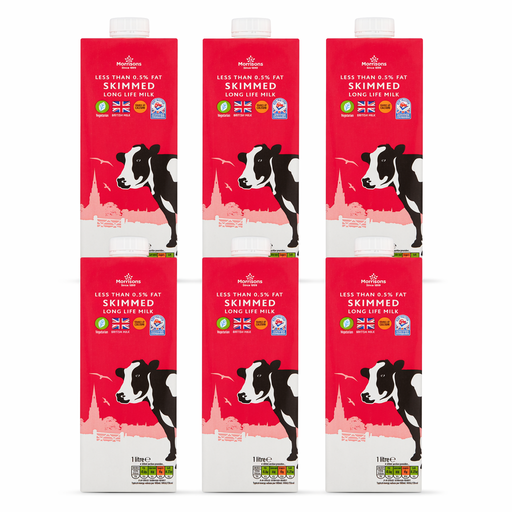
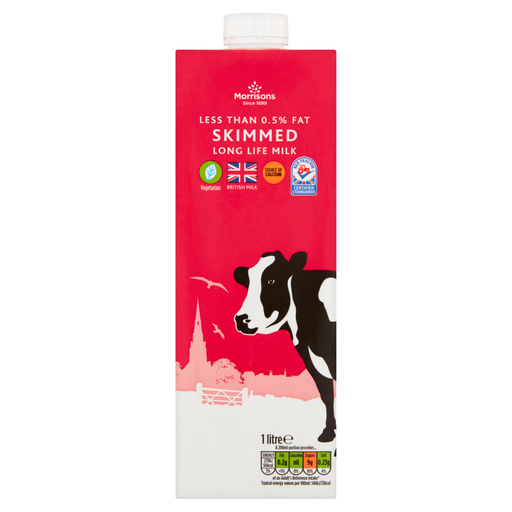
These Morrisons UHT skimmed milk cartons represent the lower-fat route for drinks or cereal at supper. They are not whole or semi-skimmed milk; choose between the six-pack and single carton according to how much you expect to use.
 No image available
The six-pack suits a household planning to use several cartons of skimmed milk. Refrigerate each carton after opening and use it within three days; check its best-before date before buying for occasional use. The NHS advises against skimmed milk as a main drink for children under five.
 No image available
The single carton is an option when you need one litre of skimmed milk for drinks or cereal. Refrigerate it after opening and use it within three days; check its best-before date if you plan to keep it for later. The NHS advises against skimmed milk as a main drink for children under five.
No. Tesco Groceries lists 3.6g fat and 2.3g saturates per 100ml for Cravendale whole milk, against 1.7g and 1.0g for its semi-skimmed version. If cutting fat is your main aim, the NHS suggests trying 1% or skimmed milk.
Semi-skimmed is a middle ground between whole and skimmed milk; choose 1% or skimmed if cutting fat further is the priority, in line with NHS guidance. The NHS advises against giving 1% or skimmed milk as a main drink to children under five.
Check the specific pack rather than relying on “filtered”. Waitrose & Partners states up to one month unopened but seven days opened for its filtered semi-skimmed milk, while Tesco Groceries states seven days after opening for its filtered semi-skimmed milk. Follow the use-by date and storage instructions too.
Return it to the fridge and follow its own pack instructions. Marks & Spencer specifies 0°C to +5°C and consumption within seven days of opening for its filtered semi-skimmed milk; do not apply that period to a different product without checking its label.
No: ordinary cow’s milk is not a milk-free alternative. The Food Standards Agency identifies milk as an allergen, so check the exact pack and choose an appropriately labelled alternative when milk must be avoided.