People changing their everyday milk
If you use whole milk in drinks, cereal or cooking, a lower-fat milk lets you change that ingredient without removing milk from your routine.


If you usually buy whole milk and want to cut down on fat, the NHS suggests 1% or skimmed milk as swaps. Semi-skimmed offers a less marked change; compare fat, saturates and energy per 100ml on the packs you are considering, then choose a format you can use and store as directed.
If you use whole milk in drinks, cereal or cooking, a lower-fat milk lets you change that ingredient without removing milk from your routine.
If fat and energy matter to your choice, compare whole, semi-skimmed, 1% and skimmed milk using the same per-100ml measures.
If you use milk less frequently, consider how a fresh, filtered or UHT pack must be stored before and after opening.
Start with fat, saturates and energy per 100ml, then check the nutrients and storage instructions on the particular pack.
| Priority | What to check | Your needs |
|---|---|---|
| Fat and saturates | Compare both values per 100ml across the milk types. The NHS names 1% and skimmed milk as swaps for people cutting down on fat; check the exact pack rather than relying on its colour. | I use milk regularly and want to reduce the fat in those servings without giving up milk altogether. |
| Energy | Compare kcal per 100ml alongside fat. Tesco lists 49kcal for its Semi-Skimmed Milk 1L, while Waitrose & Partners lists 37kcal for its Essential skimmed example; these figures describe those products, not every milk of each type. | Milk goes into my drinks or cereal often enough that I want to account for the amount I use. |
| Protein and calcium | Read both values per 100ml on the pack. Tesco lists 3.4g protein and 124mg calcium for its semi-skimmed example; Waitrose & Partners lists 3.6g and 130mg for its skimmed example. | I want to see what a lower-fat milk contributes as well as what changes in its fat content. |
| Storage | Check the unopened storage directions, date and instructions after opening. Waitrose & Partners states up to one month unopened and seven days opened for its filtered skimmed milk; the Joybuy-listed Morrisons UHT six-pack says to refrigerate after opening and use within three days. | If I use milk slowly or keep spare packs, the storage directions need to fit my routine. |
| Milk allergen | Check the ingredient and allergen declaration on every pack. The Food Standards Agency identifies milk as an allergen; a lower fat content does not make cow’s milk an alternative for someone avoiding milk. | Someone in my household needs to avoid milk, so fat content alone cannot settle the choice. |
Whole, semi-skimmed, 1% and skimmed describe different choices; the name alone does not give you all the nutrition values relevant to your purchase.
Compare fat, saturates and energy per 100ml on the packs you are considering. If cutting fat is the main aim, the NHS specifically suggests looking at 1% or skimmed milk.
Storage instructions are product-specific, particularly once a pack is open.
Read the unopened storage directions and date, then follow the refrigeration and use-within instructions after opening.
Changing the fat content does not remove the milk allergen. The NHS also distinguishes food intolerance from food allergy.
Check the pack’s allergen declaration if milk must be avoided; seek individual advice for symptoms rather than choosing a milk by fat content alone.
Tesco’s Semi-Skimmed Milk 1L is a label example for comparing a conventional semi-skimmed milk with skimmed options.
Waitrose & Partners provides examples of standard fresh and filtered skimmed milk, useful when storage matters alongside nutrition.
Cravendale is a filtered fresh semi-skimmed option for shoppers comparing that format with standard fresh milk.
These Morrisons UHT skimmed milk listings cover a single 1-litre pack and a six-pack of 1-litre packs for shoppers considering that lower-fat format.
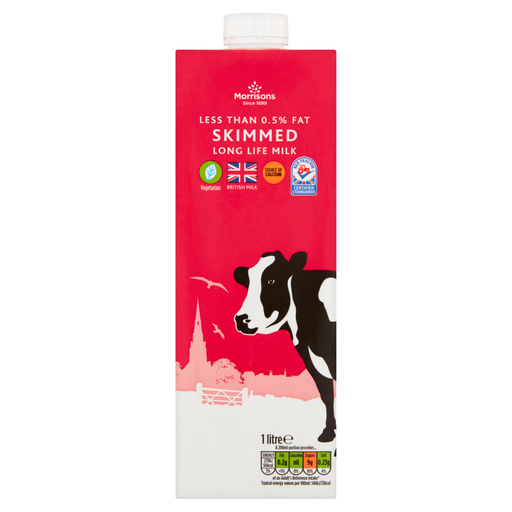 No image available
A 1-litre UHT skimmed milk option if you want one pack rather than a six-pack. Compare its per-100ml nutrition panel with your usual milk and follow the pack’s storage instructions.
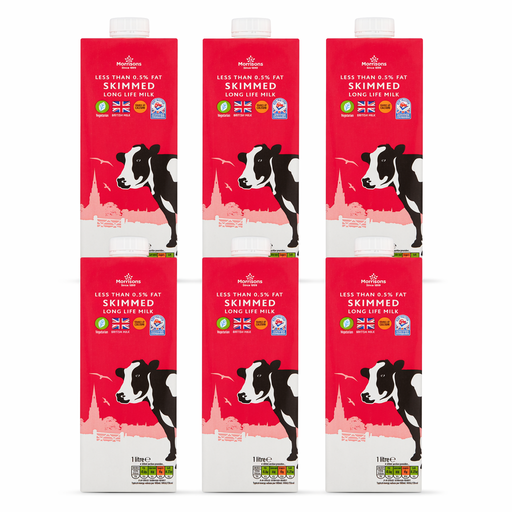 No image available
The six-pack suits shoppers who want several UHT skimmed milk packs on hand. The Morrisons listing gives 0.1g fat, 33kcal, 3.5g protein and 126mg calcium per 100ml; refrigerate after opening and use within three days.
No. If you are trying to cut down on fat, the NHS suggests swapping to 1% or skimmed milk. Compare fat, saturates and energy per 100ml on the exact packs you are choosing between.
Skimmed milk is the route to consider if cutting milk fat is your main priority; semi-skimmed offers a less marked change from whole milk. For specific examples, Tesco lists 1.7g fat and 49kcal per 100ml for its semi-skimmed milk, while Waitrose & Partners lists less than 0.5g fat and 37kcal for its Essential skimmed milk.
Follow the instructions on the particular pack rather than assuming all lower-fat milk has the same opened life. Waitrose & Partners states seven days after opening for its filtered skimmed product; the Joybuy-listed Morrisons UHT skimmed six-pack says to refrigerate after opening and use within three days.
No. The NHS distinguishes food intolerance from food allergy, and the Food Standards Agency identifies milk as an allergen. If someone needs to avoid milk, check the allergen declaration: choosing a lower-fat cow’s milk does not remove the milk allergen.