Holiday-cottage hosts stocking a shared breakfast cupboard
For hosts who need a straightforward breakfast option that guests can serve with milk, yoghurt or fruit, while keeping ingredient and allergen information visible.


For a shared cottage breakfast cupboard, choose a clearly labelled wholegrain-oat granola and compare its ingredients, fibre and sugars per 100g rather than treating “wholegrain” as a complete nutrition verdict. Keep explicitly gluten-free and lower-sugar-labelled options separate where required, and check the exact pack before serving guests with allergies or dietary restrictions.
For hosts who need a straightforward breakfast option that guests can serve with milk, yoghurt or fruit, while keeping ingredient and allergen information visible.
For guests who want a wholegrain breakfast choice as part of a balanced diet and want to compare actual ingredients, fibre and sugars rather than relying on pack wording alone.
For hosts who need to distinguish an explicitly gluten-free product from a standard oat-and-grain granola, then check milk, soya, nut and precautionary allergen statements on the exact pack.
Choose it when: You want an everyday granola for guests without relevant oat, gluten or nut allergies.
Check first: Wholegrain cereals do not remove added sugars, and standard products can carry nut-related precautionary statements.
Choose it when: A guest specifically wants a nutty granola with a lower-sugar positioning and has no relevant allergen restrictions.
Check first: Nuts, wheat, barley and precautionary allergen statements can make this unsuitable as the only shared option.
Choose it when: A guest requires a product explicitly labelled gluten free rather than an ordinary oat granola.
Check first: Gluten-free status addresses gluten only; milk, soya, peanut and tree-nut information still needs checking.
| Priority | What to check | Your needs |
|---|---|---|
| Wholegrain cereal and fibre | Read the ingredient list for wholegrain oats, rye or other cereals. Where shown, compare fibre on the same per-100g or per-serving basis. | I want to see which cereals make up the granola rather than assume every oat-based product has the same wholegrain content. The NHS notes that choosing wholegrain versions of starchy foods can help increase fibre intake. |
| Sugars and sweetness | Compare sugars per 100g and check for ingredients such as sugar or golden syrup. Use the current nutrition panel when comparing products. | I want a granola that fits the level of sweetness my guests prefer. Wholegrain examples can still contain added sweeteners: Jordans lists 17g sugars per 100g for Simply Granola, while Dorset Cereals lists golden syrup in Oaty Granola. |
| Allergens and dietary requirements | Look for an explicit gluten-free label where needed, then read declared allergens and any “may contain” statement on the current pack. | I need to avoid presenting a standard granola as suitable for every guest. GOV.UK states that prepacked foods containing any of the 14 regulated allergens must identify them in the ingredients list. |
| Supply plan | Confirm the exact product and pack size with your intended retailer before making it a regular cottage staple. Keep packaging available for guests to inspect. | I want a breakfast option I can replenish without relying on one specialist shop. Lizi’s says its direct online shop is unavailable while naming several UK supermarkets that stock its granola. |
A granola can use wholegrain oats while also containing sugar or syrup. Choosing from the word “wholegrain” alone can miss the sweetness level a guest wants.
Compare the current ingredients list and sugars on a consistent basis, such as per 100g. Only use a lower-sugar claim where the current pack makes that claim and its nutrition information supports your comparison.
Several granolas contain nuts, gluten cereals or precautionary allergen statements. For an allergic guest, “may contain” information is relevant safety information, not a minor preference detail.
Ask about dietary requirements before arrival where appropriate, retain original packaging for guest inspection and use a separately checked product when needed. Do not decant granola into unlabelled jars for allergy-sensitive guests.
Nature’s Path Nice and Nobbly is labelled gluten free, but its listed ingredients include milk and soya and it may contain peanuts and tree nuts.
Match each dietary claim only to the requirement it explicitly addresses, then check every declared ingredient and precautionary statement on the current pack.
A direct shop may not be the only place to obtain a granola. Lizi’s says its online shop is unavailable and names Tesco, Sainsbury’s, Asda, Morrisons and Waitrose as stockists.
Confirm the exact product and pack size with the intended retailer before making it a regular cottage staple, and keep a comparable alternative in mind.
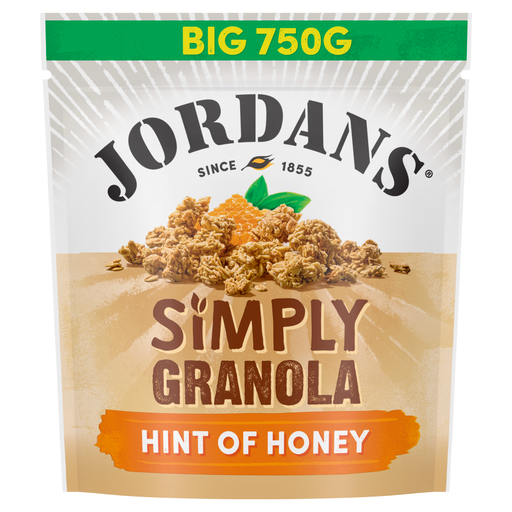
A wholegrain-oat granola option for a conventional shared breakfast cupboard, including Simply Granola as an oat-forward base product.
A wholegrain oat-and-rye option for guests who prefer a simple sunflower-seed granola profile.
A range with nutty wholegrain granola choices for guests who actively want that flavour profile.
A brand to consider when an explicitly gluten-free granola route is required.
A UK granola brand with toasted oats, seeds and nuts, alongside specialist nutritional options in parts of its range.
Joybuy product options for a shared holiday-cottage breakfast cupboard, including wholegrain-oat granolas with different flavour profiles and stated allergen considerations.
 No image available
A straightforward wholegrain-oat base for a general shared breakfast cupboard where guests have no relevant dietary restrictions.
81% wholegrain oat flakes; 6.3g fibre and 17g sugars per 100g; resealable 750g pack.
Contains oats and may contain nuts and other cereals containing gluten. Check the current pack before serving guests with dietary requirements.
 No image available
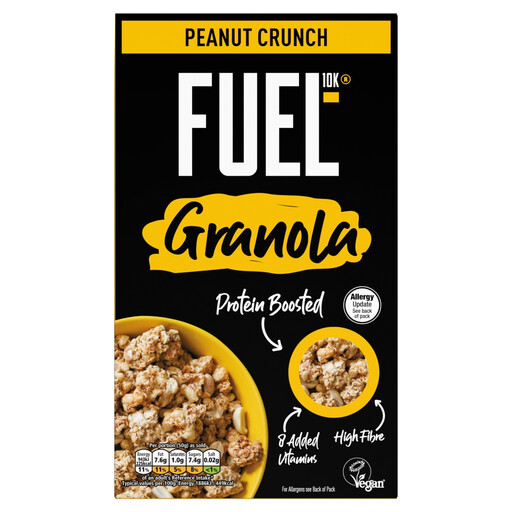
A wholegrain oat-and-wheat granola for guests who can eat peanuts and want stated protein and fibre values for comparison.
17.2g protein and 6.1g fibre per 100g; wholegrain oats and wholegrain wheat flakes; resealable 400g pack.
Contains oats, peanuts and wheat; may contain milk, nuts, sesame and soya. Check the current nutrition panel if serving-size values matter.
 No image available
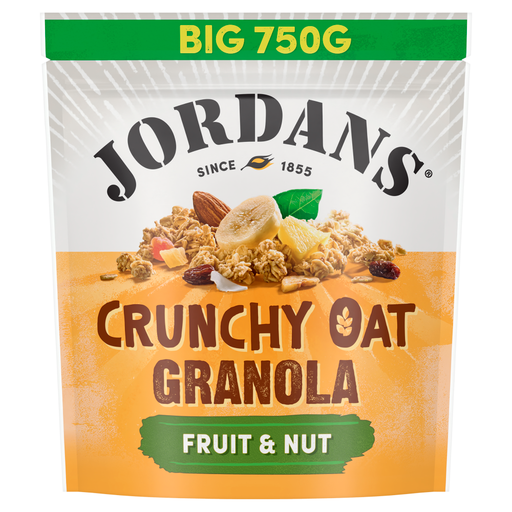
A fruit-and-nut wholegrain option for guests without relevant nut or gluten-cereal restrictions.
66% wholegrain oat flakes; 6.1g fibre and 24g sugars per 100g; resealable 750g pack.
Contains oats and almonds and may contain peanuts, other nuts and cereals containing gluten. Hard nut-shell or fruit-stone pieces can occasionally occur.
 No image available
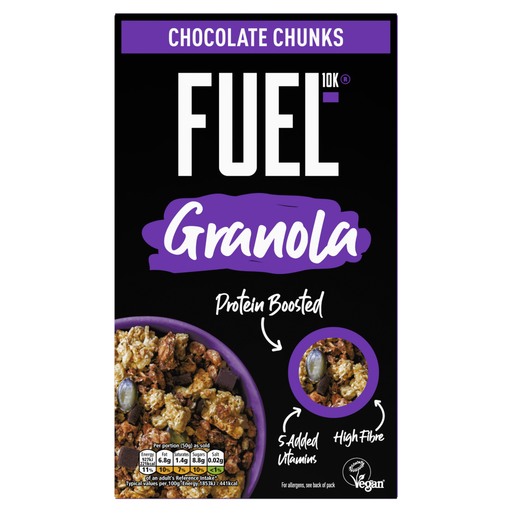
A chocolate-cluster alternative for ordinary breakfast or snacking where guests can eat oats and the stated allergens.
55% wholegrain oats; 7g fibre and 20g sugars per 100g; resealable 400g pack.
Contains oats and may contain nuts, milk and soya. It is not an explicitly gluten-free option, so check the current pack for guest-specific requirements.
No. Check both the ingredients and nutrition table. Jordans Simply Granola lists 81% wholegrain oat flakes but also lists sugar and 17g sugars per 100g, while Dorset Oaty Granola lists 66% wholegrain oat flakes and golden syrup at 22% of its ingredients.
Check the exact current pack, not only the product name or an online category. GOV.UK says prepacked food containing any of the 14 regulated allergens must clearly label them in the ingredients list; also read any precautionary “may contain” statement before serving.
No. Choose a product explicitly labelled gluten free when that is required. Nature’s Path Nice and Nobbly is labelled gluten free, whereas standard Jordans and Dorset examples include oat, rye or other gluten-cereal considerations; gluten-free status does not establish milk-, soya- or nut-free suitability.
Not where guests have different dietary requirements. A conventional wholegrain granola can be practical for general use, but a separate explicitly gluten-free product may be needed for a gluten-free guest, and neither should be represented as suitable for a guest with a food allergy without checking the precise label and avoiding cross-contact.