Who this is for

Weekend breakfast shoppers comparing fibre

For people who want a more substantial cereal bowl and want to compare fibre per serving alongside wholegrain ingredients. The NHS says adults should aim for 30g of fibre a day and identifies higher-fibre breakfast cereals and oats as practical options.

Lower-sugar granola buyers

For shoppers who enjoy crunchy granola but want to compare declared sugars rather than assume that wholegrain, natural or no-added-sugar wording means the same thing. Manufacturer panels for the examples discussed here range from 4.4g to 16.5g sugars per 100g.

Allergy-conscious and dietary-restriction households

For households needing a vegan, gluten-free or allergen-aware option. Granolas can contain oats, wheat, rye, barley and nuts, while precautionary allergen statements vary by exact product.

What to check before buying

Start with the ingredients list and nutrition table, compare products on the same per-100g basis, then check the serving size and the exact pack’s allergen information.

Priority What to check Your needs
Fibre and wholegrain ingredients Compare declared fibre per 100g and per serving. Check which cereals lead the ingredients list and whether a wholegrain percentage is stated. The NHS identifies higher-fibre breakfast cereals and oats as useful ways to increase fibre intake. I want a weekend bowl that makes a meaningful fibre contribution, without treating one cereal as a complete diet.
Sugars in the bowl Compare sugars per 100g before looking at serving sizes. Check the declared portion: Eat Natural lists 2.2g per 50g, Jordans No Added Sugar Triple Nut 4.3g per 45g, and Dorset Oaty 7.4g per 45g. I want a sweetness level that suits me, while recognising that dried fruit, syrups and honey can contribute sugars.
Allergens and gluten-containing cereals Read the full ingredients list, emphasised allergen text and any “may contain” statement. GOV.UK guidance says pre-packed foods must emphasise the 14 legally declarable allergens in the ingredients list. I need a cereal that works with my household’s allergy, coeliac requirement or ingredient exclusion.
Dietary format and breakfast role Confirm vegan or gluten-free status on the exact flavour, not the wider brand range. If protein matters, compare protein per actual serving and consider what you add to the bowl, such as yoghurt, milk or fruit. I am choosing for a vegan bowl, a protein-led breakfast or a more indulgent weekend serving, so the full bowl matters as much as the dry granola.

Common buying mistakes

  • Treating “wholegrain” as proof of low sugars or high fibre

    Wholegrain recipes can have very different nutrition profiles. Manufacturer panels for the examples here range from 4.4g to 16.5g sugars per 100g and from 5.0g to 18g fibre per 100g.

    Compare sugars and fibre per 100g first, then work out what your usual serving provides.

  • Ignoring nuts, gluten-containing cereals and precautionary statements

    Granola often combines oats with nuts and cereals such as rye, wheat, barley or spelt. Some products also carry statements about possible traces from the production environment.

    For an allergy or coeliac requirement, use the current pack’s ingredients, emphasised allergens and precautionary statement as the decision point rather than a product photo, retailer category or previous recipe.

  • Reading “no added sugar” as a reason to skip the nutrition panel

    A no-added-sugar granola can still contain declared sugars from ingredients such as dried fruit. Jordans No Added Sugar Triple Nut lists 9.5g sugars per 100g.

    Use the claim as a starting point only, then compare the total-sugars row and portion size with alternatives.

  • Using a brand-level dietary claim to choose a specific flavour

    Range-level statements do not establish the nutrition, allergen status or wholegrain content of every product variation.

    Choose the exact flavour and pack size first, then check its current ingredients, nutrition table, vegan or gluten-free status and any “may contain” wording.

Relevant granola brand references

Dorset Cereals

A wholegrain-oat granola range with oat, fruit, berry, honey and nut-led flavour directions.

  • Dorset Cereals lists 66% wholegrain oat flakes and toasted wholegrain rye flakes in Oaty Granola, with 5.0g fibre per 100g.
  • Oaty Granola lists 16.5g sugars per 100g and contains oats and rye; the pack also warns that it may contain nuts and other gluten-containing cereals.

Lizi's

A specialist granola range covering vegan, fibre, lower-sugar and protein-focused product directions.

  • Lizi's states that its granola range is suitable for vegans and vegetarians and includes high-protein and low-sugar options.
  • Lizi's states that its High Protein Granola provides 13.5g protein and 3.4g fibre per 50g portion; compare the current label of the exact flavour before comparing it with other products.

Jordans

Wholegrain-oat granola with simple and no-added-sugar nut-and-fruit routes.

  • Jordans No Added Sugar Triple Nut lists 18g fibre and 9.5g sugars per 100g. Simply Granola lists 81% wholegrain oat flakes.
  • No Added Sugar Triple Nut contains cashews, almonds and hazelnuts, while the manufacturer says its production location handles a variety of nuts.

Rude Health

A granola range with wholegrain, nutty and lower-sugar flavour routes.

  • Rude Health labels Nutty Low Sugar Granola as whole grain and high fibre, with 55% oats alongside spelt, barley, rye and nuts.
  • It is unsuitable for people avoiding gluten-containing cereals or nuts, and the pack warns of possible traces including milk, soya and mustard.

Eat Natural

Wholegrain oat, seed and nut granola with a verified lower-sugar option.

  • Eat Natural Low Sugar Granola lists wholegrain oats, almonds and seeds, with 12.8g fibre and 4.4g sugars per 100g. The product is labelled vegan.
  • It contains oats and almonds, and the manufacturer lists possible traces of other nuts, peanuts, soya, sesame seeds and cow’s milk.

Nature's Path

A UK organic granola range with gluten-free, grain-free and protein options.

  • Nature's Path states that its UK granola range includes gluten-free, grain-free and protein options.
  • Check each product label, as range-level wording does not establish that every variety is wholegrain, gluten-free or suitable for a particular allergy.

Joybuy product options

Joybuy granola option for a vegan or protein-focused weekend breakfast route.
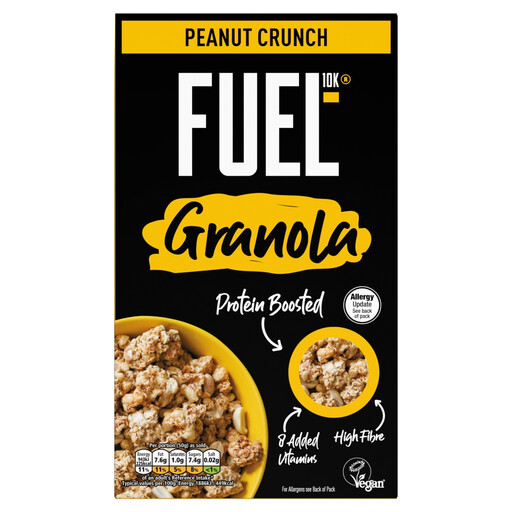
Fuel10K Peanut Granola 400g

Fuel10K Peanut Granola 400g

A granola option for a flexible weekend bowl where vegan suitability or protein is a priority.

The product listing states wholegrain oat flakes and wholegrain wheat flakes, 17.2g protein per 100g and vegan suitability.

It contains oats, peanuts and wheat, and may contain milk, nuts, sesame and soya. The listing gives 14.9g sugars per 100g; check the current nutrition panel if sweetness is important.

Joybuy

Frequently asked questions

Does “wholegrain” automatically mean a granola is high in fibre?

No. Compare declared fibre on a consistent basis, preferably per 100g and then per your likely bowl size. Manufacturer panels list 5.0g fibre per 100g for Dorset Oaty, 12.8g for Eat Natural Low Sugar and 18g for Jordans No Added Sugar Triple Nut; the NHS says adults should aim for 30g of fibre a day as part of a balanced diet.

Does “no added sugar” mean a granola contains no sugar?

No. Check the nutrition panel for total sugars and the ingredients list for ingredients such as dried fruit. Jordans No Added Sugar Triple Nut includes sultanas and declares 9.5g sugars per 100g.

Can I assume oat granola is gluten-free?

No. Granola may combine oats with rye, wheat, barley or spelt, so gluten-free suitability must be confirmed on the exact product. Nature's Path states that its UK range includes gluten-free options, but this does not mean every product in the range is gluten-free.

What allergen information should I check on a UK granola pack?

Check the full ingredients list and emphasised allergen text, then read any “may contain” statement. GOV.UK guidance says that pre-packed food labels must emphasise the 14 legally declarable allergens in the ingredients list; granola can involve nuts, peanuts, sesame, milk, soya and gluten-containing cereals.

Can a vegan shopper choose any wholegrain granola?

No. Some granolas use honey, while Lizi's states that its granola range is suitable for vegans and vegetarians. Check the exact flavour and current pack because ingredients can differ across a range.