Buying priorities
Plain wholegrain oats or sachets
Choose this when: You want oats to remain a neutral, customisable part of a cooked breakfast.
Consider: You may need a bowl, liquid and microwave or hob access, and standard oats are not automatically suitable for a gluten-free diet.
Wholegrain porridge pots
Choose this when: Having only hot water available matters more than keeping the ingredient list minimal.
Consider: Wholegrain pots can include milk and sugar, so check the exact ingredient and allergen panel.
Explicitly gluten-free oats
Choose this when: You need an oat product labelled gluten free for a gluten-free diet.
Consider: Terms such as “100% oats” or “wholegrain” do not establish gluten-free suitability.
Start with the oat format, then check the ingredient list, preparation instructions and current pack labelling for the needs that matter in your breakfast setting.
| Priority |
What to check |
Your needs |
| Wholegrain and fibre |
Look for wholegrain oats on the pack. Compare fibre per 100g or per serving only when the serving and preparation basis are clear. A plain ingredient list can make the rest of the meal easier to tailor. |
For a cooked breakfast, I want the oats to be a clearly wholegrain component rather than assuming all instant formats are equivalent. NHS guidance advises choosing wholegrain varieties where possible. |
| Added sugar and ingredients |
Read the ingredient list for sugar, dried milk and flavour additions. Check whether sugars are shown for the dry product or for the prepared serving. A no-added-sugar claim applies to the oat product, not necessarily to milk or toppings added later. |
I may prefer plain oats when the plate already includes several cooked items, rather than choosing a sweetened porridge recipe by default. |
| Preparation facilities |
Check whether the exact product needs a microwave, hob or only boiling water. Follow the stated method and preparation time on the pack. A pot format can be useful where a kettle is available. |
I need a format that works where breakfast is being made, whether that means a microwave at home or hot water away from home. |
| Allergen and gluten-free suitability |
For a gluten-free choice, look for an explicit gluten-free label. Read the allergen statement and precautionary wording on the pack bought, including milk and possible cross-contact with cereals, nuts or soya. |
If I am buying for a gluten-free diet or relevant allergy, I need product-specific labelling rather than relying on wholegrain oats as the main ingredient. The Food Standards Agency states that food labelled gluten free must contain no more than 20 mg/kg gluten. |
Joybuy product options
Joybuy product options for a wholegrain instant-oat component alongside a cooked breakfast, including one plain original sachet option and one sweetened wholegrain sachet option.
 Image unavailable
Quaker Oat So Simple Big Bowl Original 6 Pack 231g
A portioned, plain wholegrain option for a savoury or rich cooked breakfast. The supplied product information describes wholegrain rolled oats as the sole ingredient and a 2½-minute microwave preparation; check the pack if gluten-free suitability or kettle-only preparation is important.
Joybuy
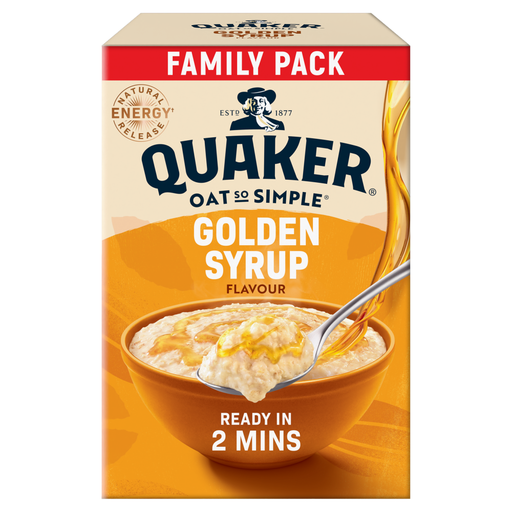 Image unavailable
Quaker Oat So Simple Family Pack Golden Syrup 20 Sachets 720g
A microwaveable wholegrain-oat sachet format for a quick breakfast, with a stated two-minute method. The supplied information lists 81% wholegrain rolled oats alongside sugar and salt, so it is less suited to shoppers seeking a plain oat component; check current allergen and preparation information on the pack.
Joybuy
Frequently asked questions
Does “wholegrain” mean an instant oat product has no added sugar?
No. Wholegrain describes the oat grain, not the complete recipe. Tesco Instant Oats Original is described as wholegrain, but its listed ingredients include dried skimmed milk and sugar, so check the ingredients and nutrition panel on the exact pack.
Is a wholegrain oat pot suitable for someone with coeliac disease?
Not necessarily. Coeliac UK says many standard oats can be contaminated with wheat, barley and rye, so choose an explicitly gluten-free labelled product where this is required. The Food Standards Agency states that foods labelled gluten free must contain no more than 20 mg/kg gluten when sold.
Can I use water instead of milk for instant oats with a cooked breakfast?
It depends on the product instructions and recipe. Tesco’s Original pot is prepared with approximately 170ml boiling water, while Quaker Original sachets are listed with 180ml semi-skimmed milk in their preparation information. Follow the pack instructions and compare nutrition using the stated preparation basis.
Are all quick oats ready with just boiling water?
No. Pots may be designed for boiling water, while sachets and bags can require a microwave or hob. Tesco’s Original pot uses boiling water and stands for two to three minutes; Flahavan’s Quick Oats Drum gives a two-minute microwave instruction, and M&S traditional sachets are microwaved for three minutes.
Do oats have a role in a balanced diet?
NHS guidance identifies porridge and oats as a fibre source and advises choosing wholegrain varieties where possible. That does not make every instant-oat recipe the same choice: added ingredients, serving size and the rest of the meal still matter.


