Who this is for

Weekday breakfast shoppers seeking more fibre

For people choosing a quick bowl-based breakfast who want to prioritise fibre and wholegrain ingredients rather than flavour or pack wording alone. NHS guidance recommends higher-fibre breakfast cereals and advises adults to aim for 30g of fibre a day as part of a healthy balanced diet.

Shoppers comparing no-added-sugar muesli

For people who want to limit added sugar but need to distinguish this claim from total sugars, particularly when raisins or other dried fruit are part of the recipe.

People managing cereal, milk or nut allergens

For people who need to assess the exact pack because muesli recipes can contain wheat, oats, barley, milk, almonds and hazelnuts, and may include precautionary allergen statements.

What to check before buying

Compare the grain base and nutrition per 100g first, then check whether the serving size, ingredients and allergen information work for your usual weekday bowl.

Priority What to check Your needs
Wholegrain content Look for named wholegrain oats, wheat, barley or rye in the ingredients list. Where a percentage is stated, compare it with other packs; product wording alone is not enough. I want the grain base to be clear, rather than assuming that “multigrain” means predominantly wholegrain.
Fibre and portion size Compare fibre per 100g before comparing bowl values. Check the stated serving size against the amount you normally pour. A weekday cereal should fit into a varied diet, not be treated as my only source of fibre. NHS guidance advises getting fibre from a variety of foods.
Total sugars Read the total-sugars line per 100g and per serving. Check whether raisins, dates or other dried fruit are prominent ingredients. I want to limit added sugar without mistaking a no-added-sugar claim for an absence of total sugars.
Allergens and dietary fit Read the full ingredients list, emphasised allergens and any “may contain” statement. Check the current pack for product-specific gluten, milk, soya and nut information. I need a convenient breakfast that matches my dietary requirements, rather than relying on a fruit-led or plant-based description.

Common buying pitfalls

  • Treating “wholegrain”, “multigrain” or “no added sugar” as a complete nutrition assessment

    Wholegrain wording needs checking against the ingredient list, while no-added-sugar muesli can still contain total sugars from dried fruit. Front-of-pack claims alone can hide meaningful recipe differences.

    Read the named grains and compare fibre and sugars per 100g first, then consider the portion you normally serve.

  • Ignoring nuts, milk and gluten cereals because a muesli looks fruit-led or plant-based

    Muesli commonly contains or may contain wheat, barley, oats, milk, almonds, hazelnuts and other nuts. A fruit-and-oat recipe can still carry precautionary allergen wording.

    For an allergy, intolerance, coeliac disease or strict dietary exclusion, assess the current product-specific pack rather than relying on a brand description.

  • Comparing bowl values without noticing different serving sizes

    Nutrition panels can use different portions, including 45g and 50g, so serving-size differences can make fibre or sugars appear unlike-for-like.

    Compare per-100g nutrition first, then use the serving size that reflects your normal bowl.

  • Assuming an online listing is the final authority on ingredients or availability

    Food recipes, nutrition information and allergen declarations can change, while availability can also change between browsing and checkout.

    Before checkout, check the retailer page and the physical pack for current ingredients, allergen declarations and storage information.

Relevant brand references

Alpen

A mainstream wholegrain muesli range with Original and No Added Sugar options for shoppers looking for rolled oats, wheat flakes, raisins and roasted nuts.

  • Alpen Original is manufacturer-described as wholegrain and lists 7.7g fibre and 21g sugars per 100g.
  • It contains wheat, milk, almonds and hazelnuts and may contain other nuts.

Dorset Cereals

A wholegrain muesli range focused on toasted flakes, fruit, nuts and seeds for shoppers who value flavour and texture combinations.

  • Tasty Toasted is labelled no added sugar and high fibre by the manufacturer, with 7.1g fibre per 100g.
  • It lists 19g sugars per 100g and contains wheat, barley and nuts.

Jordans

A wholegrain cereal brand with a Natural Muesli made with oats, wheat flakes, barley, dried fruit and nuts.

  • Natural Muesli states 67% wholegrain cereals, no added salt or sugar, and 9.2g fibre per 100g.
  • It contains gluten cereals and nuts; the manufacturer advises people with a nut allergy not to eat it.

Rude Health

An organic and plant-based-positioned range that includes a complex Ultimate blend and a simpler fruit-led Bircher option.

  • The Ultimate Muesli is manufacturer-labelled organic, plant based, high fibre and whole grain, with oats, barley, rye, fruit, nuts and seeds.
  • Soft & Fruity Bircher may contain milk, soya and nuts, so neither option should be assumed allergen-free.

Tesco

An own-label option for shoppers comparing large-pack muesli alongside branded alternatives in a UK supermarket.

  • Swiss Style No Added Sugar Muesli lists 8.5g fibre and 13.3g sugars per 100g.
  • It contains oat, wheat, barley, milk and nuts, and Tesco advises checking the pack because recipe and allergen information can change.

Lizi's

A functional-cereal brand presenting muesli and granola made with whole grains, oats, nuts, seeds and fruit.

  • Lizi's says it uses whole grain in its cereals and describes its cereals as high in fibre.
  • These are brand-level claims; check the current pack for nutrition, ingredients and dietary information for a specific muesli variety.

Joybuy product options

Joybuy product options for a straightforward wholegrain fruit-and-nut muesli weekday breakfast.
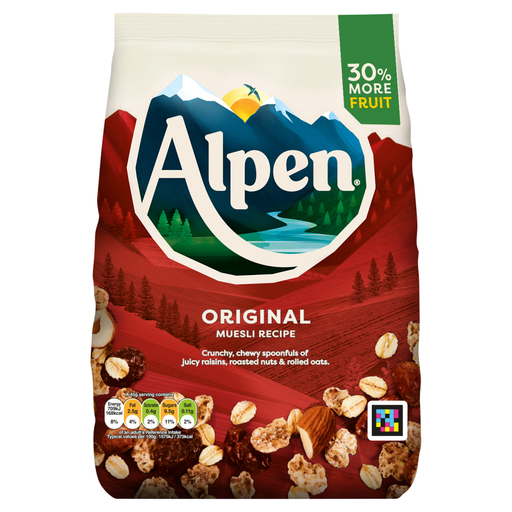
Alpen Original Muesli 950g

Alpen Original Muesli 950g

A ready-to-serve option for a weekday bowl when a wholegrain wheat-and-oat base with fruit and nuts suits your needs.

Wholegrain wheat (39%) and wholegrain rolled oats (35%) are listed in the ingredients. The manufacturer information lists 7.7g fibre and 21g sugars per 100g. Contains wheat, oats, milk, almonds and hazelnuts, and may contain other nuts.

Joybuy

Frequently asked questions

How can I tell whether a muesli is genuinely wholegrain?

Check the ingredients list for named wholegrain cereals, such as wholegrain oats or wholegrain wheat, and use any stated percentage where available. My Diabetes My Way Scotland NHS guidance notes that terms such as “wholewheat”, “granary” and “multigrain” are not a guarantee by themselves and gives 51% or more wholegrain ingredients as its classification threshold.

Does “no added sugar” mean a muesli is low in sugar?

No. Dried fruit can still contribute total sugars even when a product is labelled no added sugar. Tesco Swiss Style No Added Sugar Muesli lists 13.3g sugars per 100g, while Dorset Tasty Toasted lists 19g per 100g; compare the total-sugars line on the same basis before choosing.

How much muesli counts as one wholegrain serving?

The My Diabetes My Way Scotland NHS wholegrain resource gives 30g of muesli as one serving. Product nutrition panels may use 45g or 50g servings, so check how much you actually pour as well as the label serving.

Can I choose ordinary wholegrain muesli if I need gluten-free food?

Do not assume that an ordinary wholegrain muesli meets a gluten-free requirement. Products such as Jordans Natural Muesli and Tesco Swiss Style No Added Sugar Muesli contain cereals including wheat or barley; choose only a product whose current pack specifically meets your requirement.

What allergen information should I check on a muesli pack?

Check declared ingredients, emphasised allergens and any precautionary “may contain” wording. Alpen Original lists wheat, milk and nuts, while Rude Health Soft & Fruity Bircher may contain milk, soya and nuts; always use the current pack for the final check.