Late-night takeaway households planning breakfast
For shoppers who want an uncomplicated wholegrain breakfast option the morning after a takeaway. Choose by preparation time and preferred texture rather than an assumed pairing with Chinese food.


Chinese takeaway night does not by itself determine which oats to buy; choose the format for the breakfast or recipe you plan to make afterwards. Jumbo rolled oats suit a thicker, textured bowl, plain rolled oats provide a flexible base, quick-cook oats suit faster preparation, and wheat-bran-added oats need an ingredient and allergen check before they are chosen for their listed fibre content.
For shoppers who want an uncomplicated wholegrain breakfast option the morning after a takeaway. Choose by preparation time and preferred texture rather than an assumed pairing with Chinese food.
For people choosing between a thick, chewy bowl and a smooth, creamy one. Mornflake describes jumbo oats as giving more texture, while its quick-cook oats are made for faster absorption and a smoother result.
For people with coeliac disease, gluten intolerance, or wheat, barley or nut allergies. Check the exact pack label and manufacturing warnings rather than relying on terms such as wholegrain, organic or 100% oats.
Start with the bowl you want to make, then check the ingredients and allergen information on the exact pack. Fibre figures are most useful when compared on the same per 100g basis.
| Priority | What to check | Your needs |
|---|---|---|
| Texture and preparation time | Check whether the oats are jumbo, standard rolled or quick-cook. Jumbo flakes are intended for a thicker texture; smaller quick-cook flakes absorb liquid faster. | I want a thick bowl with noticeable flakes, or I need a smoother porridge ready with less preparation. |
| Plain wholegrain base | Look for wholegrain oat flakes or 100% wholegrain rolled oats in the ingredient list. Check whether bran, flavours, fruit, nuts or other ingredients have been added. | I want to choose my own sweet or savoury toppings and use the oats in more than one recipe. |
| Fibre information | Compare fibre declarations per 100g where the labels use the same basis. Waitrose lists 9.9g fibre per 100g for Essential Porridge Oats and 13.8g per 100g for its oats with wheat bran. | I want to compare the fibre listed on similar packs without assuming that a higher figure makes every option suitable for me. |
| Gluten and allergen suitability | Check the full ingredients, allergen statement and any manufacturing warning. If gluten-free suitability is required, choose oats specifically labelled gluten-free. | I need the oat format to fit my dietary requirements, not simply the texture or cooking time I prefer. |
Coeliac UK explains that standard oats can be contaminated with wheat, barley or rye. Wording such as 100% oats, pure oats or organic does not establish gluten-free suitability.
Choose a product specifically labelled gluten-free where that is required, and check the current pack for allergen information.
Quick-cook oats are cut before rolling so that they absorb liquid faster and make a smoother porridge, while jumbo flakes are intended to create a thicker texture.
Decide whether speed or a more noticeable oat texture matters most before choosing the flake format.
Waitrose Porridge Oats with Wheatbran contain 12% wheat bran. Its listed fibre figure does not make it suitable for shoppers avoiding wheat or requiring gluten-free oats.
Compare the fibre declaration alongside the complete ingredient and allergen list rather than using fibre alone as a suitability check.
Flake size, ingredients, fibre values and allergen warnings can differ within a brand. Jordans, for example, gives nut and other-gluten-source warnings on its verified porridge pages.
Read the exact product pack each time, particularly after a recipe or packaging change.
Relevant when comparing jumbo rolled oats with quick-cook wholegrain oats.
Relevant for plain Irish wholegrain rolled oats, including an organic option.
Relevant for chunky or organic wholegrain rolled-oat porridge.
Relevant for a mainstream plain rolled-oat option made with 100% wholegrain oats.
Relevant for comparing a plain rolled-oat staple with a wheat-bran-added alternative.
An adjacent wholegrain-oat breakfast brand rather than a plain porridge-oat route in this guide.
Joybuy product options for plain oats, quicker portions, textured porridge and gluten-free-labelled oat needs around this topic.
 No image available
A plain organic oat option for shoppers who want to add their own toppings.
100% organic whole grain oat flakes; 8.3g fibre per 100g.
Contains oats listed as gluten. Check the pack instructions if preparation time or flake texture matters.
 No image available
A single-bag plain oat choice for everyday porridge with separately chosen toppings.
100% organic whole grain oat flakes; 8.3g fibre per 100g.
Contains oats listed as gluten. Check the pack preparation guidance if you need a particularly quick bowl.
 No image available
A portioned option for a quick breakfast after a late evening.
Six 38.5g sachets of wholegrain rolled oats; stated microwave preparation time of 2½ minutes; 9.0g fibre per 100g.
Fixed sachets may not suit shoppers who prefer to measure a different portion. Check the exact pack if gluten-free suitability is relevant.
 No image available
An option to consider where gluten-free and wheat-free oat flakes are required.
Listed as 100% gluten-free oat flakes; 8.6g fibre per 100g and 3.4g per 40g portion.
Check the current pack if wholegrain wording, cooking time or finished texture is important.
 No image available
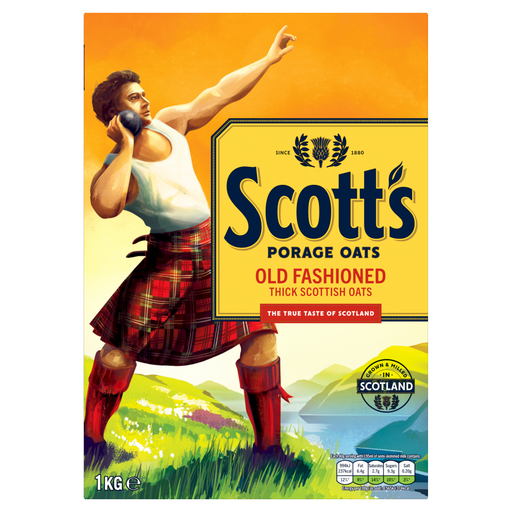
A thicker rolled-oat option for shoppers who can allow a few minutes to make porridge.
100% rolled oats; stated stovetop preparation time of 4–5 minutes or microwave preparation time of 2–3 minutes.
May contain wheat and barley. Check the current pack if gluten-free suitability, wholegrain status or fibre information is essential.
Choose oats according to the breakfast or recipe you want the next day, rather than the takeaway itself. Jumbo oats suit a textured bowl, quick-cook oats suit faster preparation, and plain rolled oats offer a flexible base for toppings or recipes.
No. Coeliac UK says standard oats can be contaminated with wheat, barley or rye, and descriptions such as 100% oats, pure oats or organic do not establish gluten-free suitability. Choose a product specifically labelled gluten-free when that is required and check the current allergen information.
Choose jumbo oats if you want a thick porridge with noticeable oat texture. Choose quick-cook oats when you want flakes that absorb liquid faster for a smoother, creamier bowl.
Yes, plain wholegrain rolled oats can provide a neutral base for sweet or savoury toppings and recipes such as flapjacks. Check the ingredient list and allergen statement for the specific product before using it in a shared meal.
Not necessarily. A bran-added product can list more fibre per 100g, but it may introduce wheat and so may not suit every shopper. Compare the fibre declaration, ingredients and allergen information together.