Make-ahead office lunch preparers
Prepare overnight oats at home with a plain wholegrain oat base, milk or a dairy-free alternative, fruit and toppings. Standard rolled oats are the most flexible format, while jumbo oats suit a firmer texture.


Choose plain wholegrain rolled oats for the most flexible base for overnight oats or hot porridge at work, checking that the ingredients are simply wholegrain oats and that the preparation method suits your facilities. Jumbo oats suit a firmer, more distinct texture, while quick-cook oats or plain sachets are more practical when you only have a kettle or microwave. For coeliac disease, choose oats explicitly labelled gluten free rather than relying on terms such as “pure”, “organic” or “100% oats”.
Prepare overnight oats at home with a plain wholegrain oat base, milk or a dairy-free alternative, fruit and toppings. Standard rolled oats are the most flexible format, while jumbo oats suit a firmer texture.
Choose a format that can become a hot lunch with minimal workplace preparation. Quick-cook oats or plain portioned oats are more practical than coarse oatmeal, which can need 10–15 minutes of cooking.
Look for oats explicitly labelled gluten free rather than assuming that organic, pure or 100%-oat wording is sufficient. Individual clinical advice may be needed if oats cause symptoms.
Start with the way you will prepare and eat the oats, then compare the ingredient list, texture and any allergen requirements.
| Priority | What to check | Your needs |
|---|---|---|
| Wholegrain oat base | Check for “wholegrain rolled oats” or “wholegrain oat flakes” in the ingredients; compare fibre on the same per-100g basis; check flavoured products separately. | I want a plain oat base so I can choose my own milk, fruit, sweeteners and toppings. |
| Texture after soaking | Jumbo flakes absorb moisture more slowly and retain more oat definition; smaller rolled or quick-cook oats soften faster; coarse oatmeal can need overnight soaking or longer cooking. | I want the texture to remain pleasant after travelling to work and standing in liquid. |
| Workplace preparation | Check the stated cooking method and time; confirm whether you have a kettle, microwave, bowl and liquid; consider overnight soaking if refrigeration is available. | My lunch needs to fit the equipment and time available during a work break. |
| Gluten and allergens | For coeliac disease, look for an explicit gluten-free label; read allergen and may-contain statements; check the full pack if wheat, barley, nuts or other allergens matter. | I need oats that fit an established coeliac-disease or allergy plan, not an assumption based on a simple ingredient list. |
These terms do not confirm that gluten contamination has been controlled, even when the ingredient list appears simple.
For a coeliac-safe choice, select oats explicitly labelled gluten free. Coeliac UK also notes that some people can be sensitive to oat avenin, so seek individual clinical advice if symptoms occur.
Jumbo oats retain a firmer texture, while coarse or steel-cut oatmeal can take 10–15 minutes to cook. A short break and a kettle may not be enough.
Match the format to the equipment available: choose rolled or quick-cook oats for faster preparation, and reserve coarse oatmeal for home soaking or longer cooking.
Granola, muesli, flavoured sachets and porridge pots can include sweeteners, fruit, nuts, seeds, milk ingredients or other cereals, so they are not interchangeable with plain rolled oats.
For a controllable packed-lunch base, start with a product whose ingredients are explicitly wholegrain oat flakes or wholegrain rolled oats, then add toppings yourself.
The cited Waitrose product advises against storing or reheating it once prepared. Safety also depends on the instructions for milk, yoghurt, fruit and other perishable additions.
Prepare and transport make-ahead oats according to the storage guidance for every ingredient, and keep perishable additions appropriately chilled.
A UK oat miller with plain wholegrain jumbo, traditional, quick-cook, organic and gluten-free oat formats for shoppers comparing texture and preparation time.
An Irish oat brand offering wholegrain rolled oats, jumbo oats, organic oats and quick-oats pots for traditional and faster workplace preparation.
A mainstream UK porridge-oat brand with plain rolled oats and portioned Oat So Simple formats for shoppers prioritising availability and convenience.
A brand offering traditional and organic wholegrain rolled-oat products, including a chunky option for shoppers who prefer a more substantial bowl.
A UK retailer own-label option with plain Essential Porridge Oats and an oats-with-wheat-bran alternative for a straightforward rolled-oat base.
A brand relevant to wholegrain-oat breakfast products, particularly granola and muesli rather than a confirmed plain porridge-oat option.
Joybuy product options for wholegrain, quick-cook, jumbo and gluten-free oat routes in an office packed-lunch routine.
 No image available
Individual sachets suit an office microwave lunch when a fast, plain wholegrain oat base is the priority.
The listing states six 38.5g sachets, 2½-minute microwave preparation, wholegrain rolled oats as the sole ingredient and 9.0g fibre per 100g.
It is not a kettle-only method and is not explicitly labelled gluten free; check workplace equipment and the pack if coeliac disease or wheat/barley allergy is relevant.
 No image available
A plain oat base for make-ahead lunches where you want to choose the liquid and toppings separately.
The listing states 100% organic wholegrain oat flakes and 8.3g fibre per 100g.
It is not explicitly labelled gluten free, and preparation time for office use should be checked on the pack.
 No image available
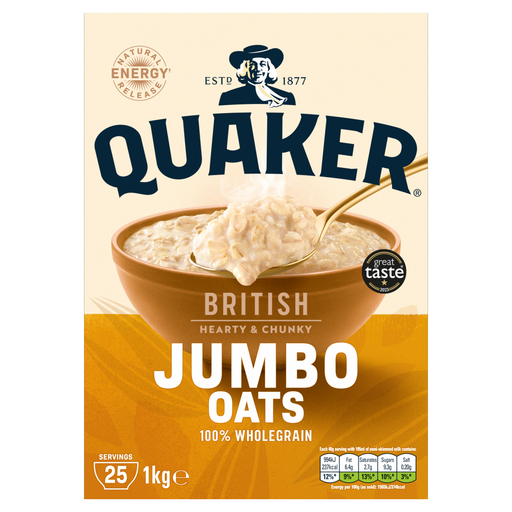
This jumbo format is for a more textured, home-prepared porridge or overnight-oats lunch.
The listing identifies jumbo rolled oats made from 100% wholegrain oat flakes, with 9.0g dietary fibre per 100g.
It may contain traces of wheat and has no stated office cooking time, so check the pack for allergy suitability and your preferred soaked texture.
 No image available
A microwave-friendly plain oat option for workers who can bring liquid and a microwave-safe bowl.
The listing gives a 2–3-minute microwave method for 40g oats with water or milk, and states 100% rolled oats with no artificial flavourings, colourings or preservatives.
It may contain wheat and barley. Check the physical pack if wholegrain status or fibre per 100g is essential to your choice.
 No image available
A plain gluten-free oat route for shoppers who include oats within a coeliac-disease dietary plan.
The listing states 100% gluten-free oat flakes, wheat-free positioning and 8.6g fibre per 100g.
Confirm that the on-pack gluten-free label remains present and check the pack for wholegrain status and workplace preparation instructions.
Choose standard rolled oats for a softer, more uniform make-ahead texture, or jumbo oats for larger flakes and more distinct oat texture. Mornflake states that jumbo oats absorb moisture more slowly than smaller flakes, so they retain more oat definition after soaking.
Yes, if your workplace equipment matches the pack instructions. Waitrose Essential Porridge Oats gives a 4–5-minute hob method for 40g oats with 300ml water, while the cited Flahavan's quick-oats pot can be prepared with boiling water or microwaved in 2 minutes; that pot is stated to be available only in Tesco Northern Ireland.
No. Coeliac UK states that “100% oats”, “pure oats” and “organic” do not establish gluten-free status because oats can be contaminated with wheat, barley or rye. For coeliac disease, choose oats labelled gluten free; seek individual health-professional advice if gluten-free oats cause symptoms.
Check the ingredient list rather than assuming from the product category. The cited Waitrose Essential product lists wholegrain oat flakes, and Mornflake Jumbo Oats list 100% whole jumbo rolled oats. Flavoured sachets, pots, granolas and mueslis are separate recipes that should be checked individually.
Not necessarily. Plain wholegrain oats can provide fibre: the cited Waitrose Essential product lists 9.9g fibre per 100g, while NHS guidance identifies porridge oats as a good source of fibre. Choose added-bran products for a specific preference after checking the full ingredients and allergen information.