If wholemeal flour is essential for a Mother’s Day breakfast, choose only a croissant whose own label or ingredients clearly identify wholemeal flour or wholegrain content. An all-butter or premium croissant can still suit a traditional pastry breakfast, but those descriptions do not establish that it is wholemeal; the Department for Environment, Food & Rural Affairs and Food Standards Agency define wholemeal flour as flour made from the whole grain, including bran, germ and endosperm.
Who this is for
Hosts seeking a genuinely wholemeal breakfast choice
For shoppers planning a Mother’s Day breakfast who specifically want wholemeal or wholegrain flour and need to distinguish that requirement from buttery, premium, seeded-looking or reduced-fat pastries.
Traditional croissant buyers checking ingredients
For shoppers happy with a conventional croissant who need to check the exact product information for wheat, milk, egg and possible cross-contact information before serving guests.
Supermarket breakfast shoppers needing a fallback
For shoppers using M&S, Tesco, Sainsbury’s, Waitrose, Asda or Lidl who may choose another clearly labelled wholemeal breakfast item when a traditional croissant does not meet their flour requirement.
Buying priorities
Clearly labelled wholemeal alternative
Choose this when: wholemeal or wholegrain flour matters more than serving a classic laminated croissant.
Trade-off: the breakfast item may be wholemeal bread, rolls or another bakery product rather than a traditional croissant.
Conventional all-butter croissant
Choose this when: a familiar flaky, buttery breakfast pastry is the priority.
Trade-off: an all-butter description does not confirm wholemeal flour, so check the individual ingredients and allergen information.
| Priority |
What to check |
Your needs |
| Wholemeal evidence |
Check the individual label or ingredients for wholemeal flour. Where relevant, compare any stated wholegrain content rather than relying on colour, seeds or bakery-range wording. |
I want the flour itself to support a wholemeal or wholegrain choice, not simply a darker-looking pastry. |
| Traditional croissant format |
Look for an all-butter or butter-led recipe description if a classic croissant is the aim. Check pack quantity and the exact product information for the item you plan to serve. |
For this occasion, I may prefer a flaky butter croissant even if it is not a wholemeal option. |
| Ingredients and allergens |
Read the current ingredients, highlighted allergens and any cross-contact wording on the pack or bakery information. Check again when buying from an in-store counter. |
I need product-specific information for guests who avoid particular ingredients or have food allergies or intolerances. |
Pitfalls to avoid
-
Mistaking all-butter, reduced-fat or premium for wholemeal
These descriptions refer to recipe style, fat positioning or range positioning rather than confirming the flour used.
When wholemeal is the priority, buy only after the individual label or ingredient list identifies wholemeal flour or an applicable wholegrain claim. Otherwise, choose a clearly labelled wholemeal breakfast alternative.
-
Skipping an allergen check for an in-store bakery croissant
Conventional croissants can contain wheat, milk and egg, while bakery handling may also matter for some guests.
Check the current pack, shelf information or ask staff before purchase, and choose an item only when its information is suitable for the person being served.
-
Assuming a product will be available at every store
Store selection, delivery slots and bakery ranges can differ, which matters when planning a breakfast for a specific date.
Check the chosen store, delivery slot or product page shortly before buying rather than relying on an earlier listing.
Relevant brand references
M&S
Relevant for shoppers considering in-store bakery croissants, including all-butter, reduced-fat and filled options.
- M&S lists all-butter and reduced-fat croissants as well as filled varieties.
- Its all-butter croissant ingredients include wheatflour, butter and egg; check the individual label if wholemeal flour is required. M&S notes that formulations and allergen information can change.
Tesco Finest
Relevant for shoppers considering Tesco’s premium own-label all-butter croissant pack.
- Tesco Groceries lists Tesco Finest All Butter Croissants 4 Pack alongside standard Tesco and branded options.
- “Finest” and “all butter” do not themselves confirm wholemeal flour, so use the product label and ingredients to make that check.
Sainsbury’s
Relevant for comparing standard and Taste the Difference all-butter croissants with clearly labelled wholemeal breakfast alternatives.
- Sainsbury’s Taste the Difference butter croissant listing describes a pack of four all-butter croissants and states 1.7 g fibre per croissant.
- A butter croissant description does not establish a wholemeal flour claim; compare it with the label of any wholemeal bread or breakfast alternative considered instead.
Waitrose
Relevant for shoppers comparing everyday, No.1 and all-butter croissant formats.
- Waitrose lists everyday croissants, No.1 butter croissants and all-butter croissants in its croissant and pastry range.
- Check the individual product label for flour and allergen information rather than assuming a format or range name indicates wholemeal flour.
Lidl
Relevant for shoppers considering an in-store bakery all-butter croissant alongside Lidl’s separate wholemeal bakery products.
- Lidl highlights a wholemeal seeded farmhouse loaf in its bakery range and separately lists an all-butter croissant.
- These are different products: the wholemeal loaf does not establish that the croissant is wholemeal. Lidl identifies milk, wheat and egg allergens for its all-butter croissant.
Joybuy products
Joybuy product option for the conventional all-butter croissant route, where a traditional breakfast pastry is acceptable rather than a verified wholemeal croissant.
 No image available
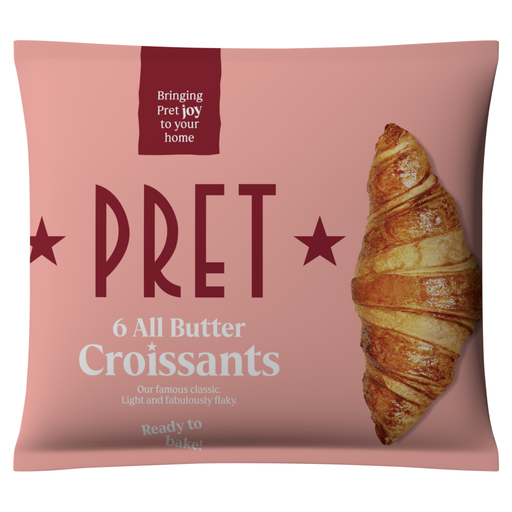
Pret A Manger Butter Croissants 330g
For a planned Mother’s Day breakfast when a conventional all-butter croissant is acceptable rather than a verified wholemeal option.
Frozen croissants designed to bake from frozen in approximately 20 minutes, with a stated 24% butter content and 27 layers.
Contains wheat/gluten, milk and egg; may contain nuts, sesame and soya. Requires frozen storage; do not defrost or refreeze once thawed.
Joybuy
Frequently asked questions
Can I assume a buttery or premium croissant is wholemeal?
No. Descriptions such as all-butter, reduced-fat, filled or premium describe recipe style or range positioning, not the flour used. Treat wholemeal as a separate product-level requirement and check the exact label or ingredients.
What should I look for if wholemeal is essential?
Look for a label or ingredient list that specifically identifies wholemeal flour or clearly states wholegrain content. The Department for Environment, Food & Rural Affairs and Food Standards Agency define wholemeal flour as flour made from the whole grain after milling or grinding, including the germ, endosperm and bran.
How should I check croissants for allergies when serving Mother’s Day breakfast?
Check the exact current package or bakery information before serving. M&S lists wheatflour, butter and egg in its all-butter croissant, while Lidl identifies milk, wheat and egg allergens and possible traces of other allergens for its all-butter croissant.
Are supermarket availability details fixed for a Mother’s Day shop?
No. Store selection, delivery slots and bakery ranges can vary, so check the selected store and exact product information close to purchase.


