Families looking specifically for wholemeal
If wholemeal is the requirement, check the flour named on the pack. “Fruit loaf” describes the product, but does not establish that it uses wholemeal flour.


Do not assume a fruit loaf is wholemeal because it contains wheat. If wholemeal matters for the packed lunch, look for wholemeal flour on the exact loaf’s label; otherwise, a clearly labelled wholemeal bread or home-baking route may fit the requirement better. Before packing any option, check its current allergen information and the school’s own arrangements.
If wholemeal is the requirement, check the flour named on the pack. “Fruit loaf” describes the product, but does not establish that it uses wholemeal flour.
Sliced fruit loaf and malt loaf offer different formats for a lunchbox. Compare their labelled portions and sugars figures on the same basis rather than assuming the products are alike.
Read the current pack’s allergen statement for the pupil’s needs and check the individual school’s arrangements before packing a wheat- or barley-containing loaf.
Decide whether wholemeal flour is essential before choosing between a ready-to-eat loaf and something you would need to bake.
Consider it: When a sliced, fruity bread meets the lunchbox need and its allergens are suitable.
Trade-off: Warburtons Raisin Loaf with Cinnamon lists wheat flour, not wholemeal flour; check another loaf’s own label rather than assuming it differs.
Consider it: When a portable malt-and-fruit snack is the priority rather than a wholemeal loaf.
Trade-off: Soreen Original Malt Loaf lists fortified wheat flour and barley ingredients, so its name does not establish a wholemeal choice.
Consider it: When the flour must be identified as wholemeal on the finished loaf or in the recipe.
Trade-off: Wholemeal flour is an ingredient, not a ready-to-pack fruit loaf; baking takes preparation time and needs a suitable recipe.
| Priority | What to check | Your needs |
|---|---|---|
| Wholemeal flour | Look for an explicit wholemeal-flour ingredient on the exact pack. Do not treat “wheat” or “fruit loaf” as equivalent to wholemeal. | I need the loaf itself to meet a wholemeal requirement, not just to contain wheat or fruit. |
| Sugars and portion | Read the sugars figure alongside its declared serving weight. If comparing products, use a comparable basis rather than treating a slice and a quarter loaf as equal portions. | The amount I pack matters as much as the figure printed for one labelled serving. |
| Allergens | Check the current ingredients and allergen statement for wheat, barley and any other relevant ingredients. Check the individual school’s policy as well; the Department for Education says schools in England must publish an allergy safety policy. | Before the loaf goes into the lunchbox, I need to know whether it suits the pupil and the school’s arrangements. |
| Preparation | Confirm whether you are buying a finished loaf or flour for baking. Allow for the recipe, preparation and storage if making the loaf at home. | A ready-to-pack item suits a different routine from baking a loaf in advance. |
Warburtons Raisin Loaf with Cinnamon lists wheat flour, while Soreen Original Malt Loaf lists fortified wheat flour and barley ingredients. Neither ingredient description establishes that the finished loaf is wholemeal.
Look for wholemeal flour on the exact pack. If it is essential and the label does not confirm it, choose a loaf that does.
A figure per slice cannot be compared directly with one per quarter loaf as though the portions were identical.
Check the serving weights and compare the amount you would actually pack, using a consistent basis.
The Warburtons and Soreen examples contain cereals containing gluten. In England, the Department for Education says schools must publish an allergy safety policy, but arrangements for a particular pupil must be checked with their school.
Read the current product label and follow the individual school’s arrangements before packing the loaf.
Flour still needs a recipe and preparation; Allinson’s cited recipe makes wholemeal bread, not a ready-to-eat fruit loaf.
If baking fruit bread, choose a suitable recipe and check the finished loaf’s ingredients, storage and suitability for the lunchbox.
For a sense of the time involved, Allinson’s published wholemeal-bread recipe states a total of 3 hours.
These examples illustrate what to check on a fruit-loaf label or in a baking recipe; a brand name alone does not establish that a product is wholemeal.
Its ready-to-eat Raisin Loaf with Cinnamon is a sliced fruit-bread example.
Original Malt Loaf is a malt-and-fruit alternative to sliced fruit bread.
Its wholemeal flour and bread recipe are relevant to families considering home baking rather than a ready-to-eat fruit loaf.
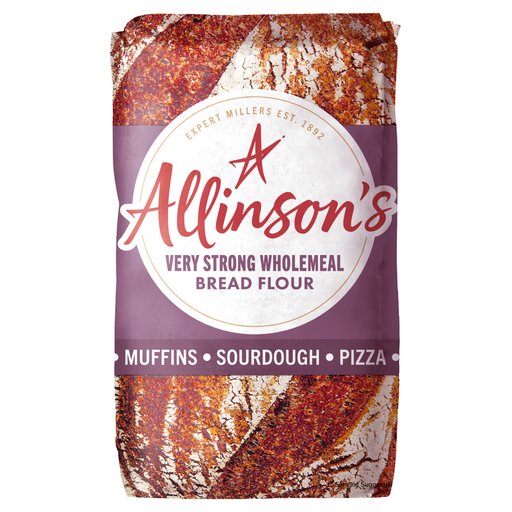
This wholemeal flour is an option for baking bread at home, not a ready-to-eat fruit loaf for tomorrow’s lunchbox.
 No image available
For a family prepared to bake a wholemeal loaf, this is bread flour rather than a finished packed-lunch item. It contains wheat; choose a suitable recipe and check the finished loaf’s ingredients and the school’s arrangements before packing.
No. The name does not tell you whether the flour is wholemeal. Warburtons Raisin Loaf with Cinnamon, for example, lists wheat flour; look for an explicit wholemeal-flour ingredient on the current pack if that is your requirement.
Only if the particular fruit loaf meets what you need from the bread. When wholemeal flour is essential, check the fruit loaf’s label rather than assuming it qualifies; a clearly labelled wholemeal bread is another option.
Yes, particularly when the pupil has relevant dietary needs. The Warburtons fruit-loaf and Soreen malt-loaf examples contain cereals containing gluten. The Department for Education says schools in England must publish an allergy safety policy; check that school’s arrangements alongside the current product label.
No. The Department for Education’s guidance says schools in England must publish an allergy safety policy, but the individual school’s policy sets out its arrangements. Check it before deciding what to pack; do not assume it describes schools elsewhere in the UK.