Wholewheat-focused meal preppers
If the pasta itself needs to be wholewheat, check its description and ingredients rather than choosing by the sauce name. The NHS identifies wholewheat pasta as a wholegrain option.


Choose the wholewheat pasta first: a tomato or bolognese sauce does not make the pasta wholewheat. For the sauce, a ready-made jar reduces preparation, while passata gives you more control over seasoning; in either case, check the ingredients and opened-pack instructions against your batch plan.
If the pasta itself needs to be wholewheat, check its description and ingredients rather than choosing by the sauce name. The NHS identifies wholewheat pasta as a wholegrain option.
If you want a bolognese-style starting point without developing a sauce recipe, a ready-made jar can simplify preparation. You still need to choose the wholewheat pasta and any other ingredients for the meal.
If you plan to vary the seasoning or use a tomato base in several dishes, passata lets you build the sauce yourself. Allow for the additional ingredients and follow the carton’s instructions once opened.
Establish the wholewheat component from the pasta pack, then choose a sauce or tomato base that fits the preparation and storage plan for your batch.
| Concern | What to check | Who this matters to |
|---|---|---|
| Wholewheat pasta | Check the pasta description and ingredient list for wholewheat or wholegrain durum semolina; read any fibre figure on its stated serving basis. | If I want wholewheat pasta in every portion, the sauce label cannot establish that for me. About 42% of consumers put verifying the wholewheat pasta first. |
| Batch preparation | Check the sauce pack size and whether its recipe calls for additional ingredients; plan the pasta quantity separately. | When I have limited time to assemble several meals, a ready-made sauce gives me a starting point with fewer recipe decisions. Making the batch straightforward is the primary need for about 33% of consumers. |
| Recipe control | Distinguish passata from a finished sauce, and check the ingredients and opened-pack storage instructions. | If I want to season a tomato base myself or divide it between recipes, I need room to adapt it and a plan for any remainder. Roughly 25% of consumers prioritise that flexibility. |
Tomato and bolognese describe sauce options, not the grain used in the pasta. The NHS identifies wholewheat pasta, rather than pasta sauce, as a wholegrain choice.
Choose pasta explicitly described as wholewheat, then select the sauce independently.
A plain tomato base and a finished, flavoured sauce leave different amounts of preparation to you. Ingredients and allergens also need checking on the particular product you intend to use.
Compare the exact labels and decide whether you want to season the batch yourself or start with a prepared sauce.
Storage instructions differ. Sainsbury’s listing for Napolina Tomato Passata says to refrigerate it and use it within two days of opening; Marks & Spencer’s listings for its Tomato and Basil and Classic Tomato Everything sauces specify three days.
Plan how much you will use, follow the instruction on your chosen pack and note when you opened it.
An unused remainder may go to waste if it cannot be used within that product’s stated period.
Wholewheat pasta made from durum wheat is not suitable for someone who needs to avoid wheat or gluten.
If you need to avoid either, choose a product specifically suitable for that requirement and check its current label rather than substituting standard wholewheat pasta.
An own-label option for wholewheat pasta when you are planning multiple portions.
A choice of wholewheat spaghetti and passata for cooks who want to build the finished sauce.
A ready-made bolognese-style sauce option to pair with wholewheat pasta bought separately.
An own-label route for selecting pasta and sauce as separate parts of the batch.
A sauce-focused option for pairing a chosen tomato sauce with wholewheat pasta.
These fusilli options supply the wholewheat pasta for a batch-cooked meal. Choose a sauce or tomato base separately to suit your recipe and portions.
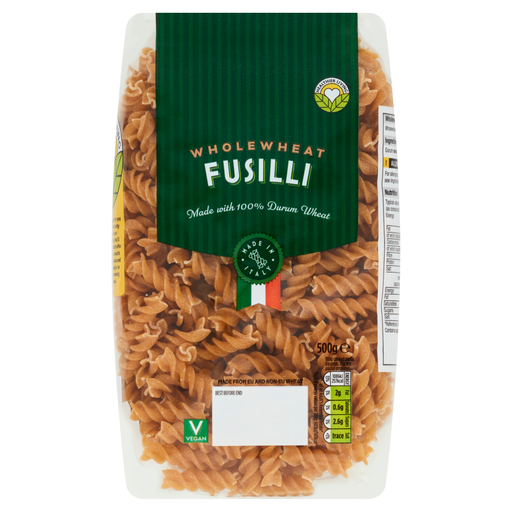 Image unavailable
Use this wholewheat fusilli as the pasta component of a batch, with a sauce chosen separately. The pack is labelled 500g; check its serving instructions when deciding how many portions to prepare.
It contains wheat, so it is not suitable if you need to avoid wheat or gluten.
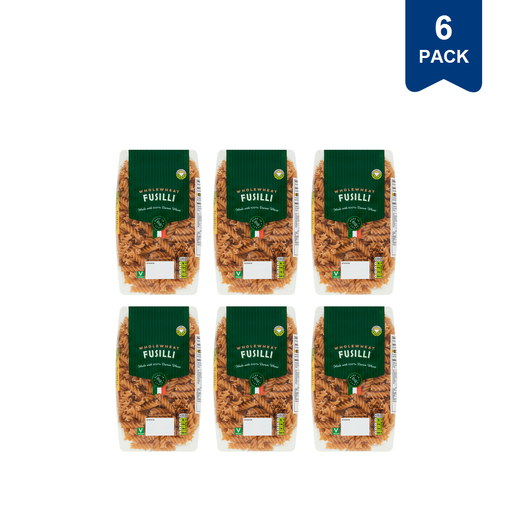 Image unavailable
Consider this listing for a larger wholewheat fusilli batch, with sauce chosen separately. It is described as six 500g packs, but the quantity information conflicts; confirm the bundle count and net contents before planning portions.
It contains wheat and is not suitable if you need to avoid wheat or gluten.
For this meal, check the wholewheat requirement on the pasta, not the sauce. The NHS identifies wholewheat pasta as a wholegrain choice; select the sauce separately for its ingredients, flavour and preparation needs.
Use the serving instructions on the pasta pack you choose, then work out how much of that pack your planned portions require. Do not use another product’s cooked weight as though it were an instruction for your dry pasta.
No: durum wholewheat semolina is wheat. Choose pasta specifically suitable for your requirement and check the current pack label rather than assuming that wholewheat means wheat-free or gluten-free.
Follow the instruction on the exact product you open. Sainsbury’s listing for Napolina Tomato Passata specifies refrigeration and use within two days of opening, while Marks & Spencer’s listings for its Tomato and Basil and Classic Tomato Everything sauces specify three days.