People planning lower-fat pasta meals
If you want to keep pasta on the menu, the NHS advises paying attention to fats added during cooking and serving. Your choice of sauce and toppings matters alongside the pasta.


Choose plain wholewheat pasta if you want a fibre-containing base for a lower-fat meal, but do not judge the finished dish by the word wholewheat. Compare fat values only when labels use the same dry or cooked basis, and account for sauce, cooking oil and toppings. Choose spaghetti or a shaped pasta according to the sauce you plan to use.
If you want to keep pasta on the menu, the NHS advises paying attention to fats added during cooking and serving. Your choice of sauce and toppings matters alongside the pasta.
If fibre is your reason for switching, check the ingredients and fibre declaration on the pack. Wholewheat describes the grain used; it does not establish the fat content of a prepared meal.
If you have a particular sauce in mind, choose a shape that works with it, then check the exact pack for cooking instructions, nutrition values and allergens.
Start with the finished meal, then check why you want wholewheat pasta and which shape suits the sauce. A pasta label describes the pasta, not everything added to the plate.
| Concern | What to check | Who this matters to |
|---|---|---|
| Fat in the finished meal | Read the pack’s fat declaration and consider the sauce, cooking oil and toppings separately. | If my aim is to limit fat across the dish, choosing the pasta is only part of the decision; about 50% of consumers put the finished meal’s fat content first. |
| Wholewheat and fibre | Check for wholewheat semolina in the ingredients and compare fibre values on the same dry or cooked basis. | When I switch from my usual pasta for its wholewheat and fibre content, I want the pack to tell me what I am buying; about 30% of consumers make that their primary concern. |
| Shape and routine | Choose a shape for the sauce you use, and follow that pack’s cooking instructions. | For a familiar weeknight meal, I need a pasta shape that works with my usual sauce; roughly 20% of consumers prioritise shape and cooking routine. |
Wholewheat describes the pasta’s grain. The NHS advises watching fats added when starchy foods are cooked and served, so oil, cheese, cream and other toppings still affect the meal.
Check the pasta label, then consider the ingredients and portions in your planned sauce and toppings.
Tesco gives values for its Whole Wheat Penne per 100g cooked, while the cited Barilla and M&S spaghetti values are for dry pasta. Water absorbed during cooking changes the per-100g basis.
Before comparing fat or fibre figures, establish whether each declaration refers to dry or cooked pasta.
Wholewheat pasta contains wheat; the Food Standards Agency identifies wheat as a cereal containing gluten. Product details can change, and M&S also states that its Wholewheat Spaghetti is not suitable for people with an egg allergy.
Read the allergen declaration on the current pack rather than relying on the product name or an older listing.
These examples refer to specific wholewheat pasta lines, not to every product sold under each brand. Check the current pack when choosing between them.
Barilla Whole Wheat Spaghetti is a dry spaghetti made with whole wheat semolina.
Tesco Whole Wheat Penne is an own-label option for shoppers who prefer a hollow, ridged pasta shape.
M&S Wholewheat Spaghetti is an option for shoppers comparing labelled dry-pasta nutrition and allergens.
These Morrisons wholewheat fusilli listings are for shoppers considering a spiral-shaped pasta with a sauce. They are not a comparison of every wholewheat shape: whichever pasta you choose, assess the sauce and toppings separately when planning a lower-fat meal.
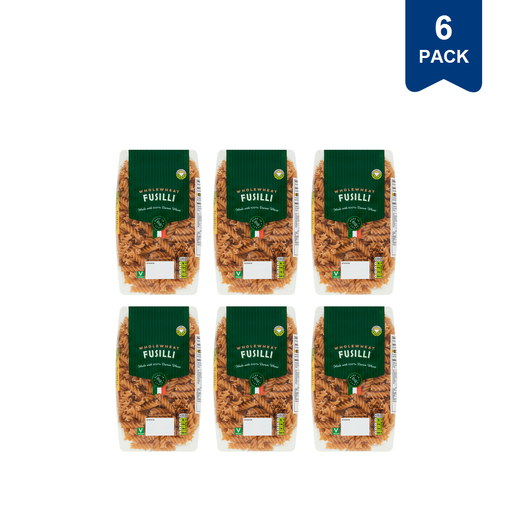 Image unavailable
Consider this listing if you want wholewheat fusilli for meals with sauce. The title describes six 500g packs, but the listed weight information is inconsistent; confirm the delivered pack count and total quantity before ordering. Check the current pack for allergens, and assess any added sauce and toppings separately.
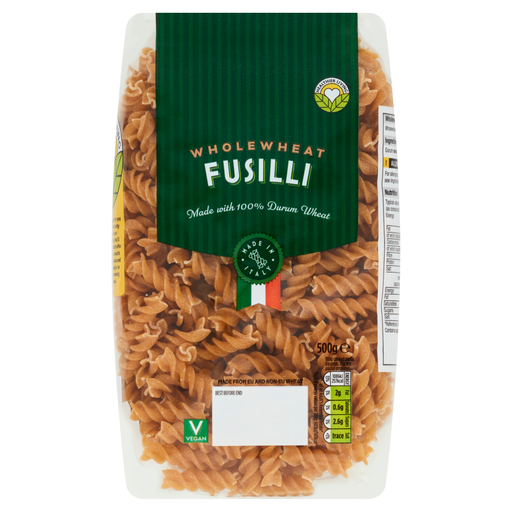 Image unavailable
Consider this listing if a 500g wholewheat fusilli pack fits your cooking plans. Follow the current pack’s cooking and allergen information; the pasta’s nutrition declaration does not include the sauce, oil or toppings you add.
No. Wholewheat describes the grain used, not the fat content of the finished dish. Read the pasta’s nutrition declaration and include cooking oil, sauce and toppings when assessing your meal; the NHS advises watching fats added to starchy foods during cooking and serving.
Wholewheat pasta offers a fibre-containing pasta option, but choosing it does not determine how much fat is in the meal. If fibre is part of your decision, check the exact pack; if fat is your concern, check the ingredients you will serve with it too.
Compare values stated on the same preparation basis. Tesco’s cited Whole Wheat Penne values are per 100g cooked, whereas the cited Barilla and M&S spaghetti values are for dry pasta, so their per-100g figures should not be compared directly.
Ordinary wholewheat pasta is wheat-based, and the Food Standards Agency identifies wheat as a cereal containing gluten. If you need a gluten-free pasta, look for one specifically labelled for that requirement and check its current allergen declaration.
Not necessarily: the recipe and portion determine the result. A tomato- and vegetable-led sauce with limited added oil is one approach; check the sauce and any cheese or other toppings rather than assuming all tomato sauces have the same fat content.