Fibre-focused lunch planners
If fibre is a priority, compare the ingredients and nutrition panel rather than relying on the product name alone. The NHS includes wholewheat pasta among the wholegrain or higher-fibre starchy foods people can choose.


Choose a clearly labelled wholewheat pasta if you want a wholegrain base for lunch, and compare ingredients and fibre values on the same cooked or uncooked basis. Match the shape and cooking instructions to the meal you plan to make; check the rest of the lunch separately, and do not treat wheat-based wholewheat pasta as a gluten-free alternative.
If fibre is a priority, compare the ingredients and nutrition panel rather than relying on the product name alone. The NHS includes wholewheat pasta among the wholegrain or higher-fibre starchy foods people can choose.
If you prepare lunches ahead, choose a shape that works for your planned salad or sauced dish, and check the pack’s cooking instructions before preparing portions.
If you need to avoid wheat or gluten, wholewheat pasta is not a substitute for a product specifically labelled to meet that need. Read the current ingredients and allergen statement.
For a wholewheat-pasta lunch, start with the requirement that matters most to you: the pasta’s composition, how you will prepare it, or whether its ingredients are suitable.
| Concern | What to check | Who this matters to |
|---|---|---|
| Ingredients and fibre | Look for wholewheat semolina in the ingredients. Compare fibre per 100g only when the cooked or uncooked basis matches; Sainsbury’s lists 4.5g per 100g cooked for its Wholewheat Fusilli. | I want to know whether the pasta itself is wholewheat and how much fibre the stated portion provides. About 42% of consumers put composition and fibre first. |
| Lunch preparation | Choose a shape for your planned dish and check its cooking time and serving guidance. Sainsbury’s lists 9–11 minutes for its wholewheat fusilli; Barilla lists 9 minutes for its Whole Wheat Spaghetti. | If I am making pasta salad or preparing lunches ahead, shape and cooking instructions affect which pack I choose. Preparation is the main concern for about 33% of consumers. |
| Allergen suitability | Read the current ingredients and allergen statement. Wholewheat pasta contains wheat; check a specifically labelled gluten-free product if you need to avoid gluten. | I need to establish whether the ingredients are suitable before considering shape or fibre. Roughly 25% of consumers make allergen suitability their primary concern. |
Wholewheat pasta contains wheat. The Food Standards Agency identifies wheat and pasta as relevant when checking for gluten.
If you need to avoid wheat or gluten, choose a product labelled for that requirement and read its current ingredients and allergen statement.
A wholewheat base does not describe the other ingredients in the meal. NHS guidance considers the balance of foods eaten across a day or week.
Plan the pasta alongside the vegetables and other ingredients you intend to use, rather than judging the finished lunch from the pasta label alone.
Nutrition figures stated for cooked pasta cannot be compared directly with figures stated for uncooked pasta. Sainsbury’s Wholewheat Fusilli, for example, gives fibre values for cooked pasta.
Check the preparation basis and serving size on each pack before comparing per-100g values.
A prepared sauce contributes its own nutrients to the meal. According to Dolmio’s product information, its Smooth Tomato Sauce for Bolognese contains 0.67g salt per 100g.
Check the sauce’s nutrition panel and the amount you will use as well as the pasta label.
Its Wholewheat Fusilli is an example for comparing cooked-basis nutrition and preparation instructions.
Whole Wheat Spaghetti is a long-shape option for shoppers planning a spaghetti lunch.
Its listed pasta includes Wholewheat Spaghetti and a distinct High Fibre Fusilloni blend.
Its own-label wholewheat listings include spaghetti, penne and fusilli in different pack sizes.
Its prepared sauces are relevant when the lunch includes more than pasta alone.
These wholewheat fusilli listings suit a lunch planned around a short pasta shape. Compare the single 500g listing with the six-pack listing, and confirm the latter’s total quantity before ordering.
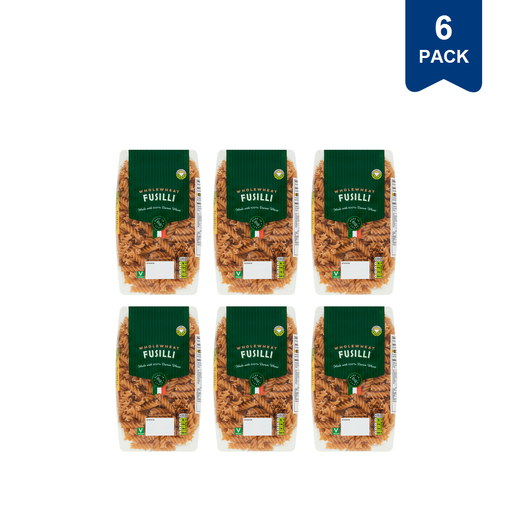 No image available
Consider this listing if you are planning several wholewheat fusilli lunches. The title states 500g and six packs, but confirm whether 500g refers to each pack or the bundle. Wholewheat pasta contains wheat; check the current allergen information if you need to avoid wheat or gluten.
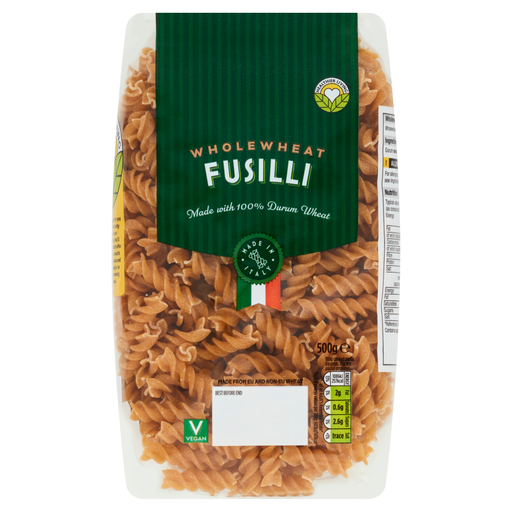 No image available
Consider this 500g listing if you want wholewheat fusilli for a lunch dish without choosing the six-pack listing. Wholewheat pasta contains wheat; check the current allergen information if you need to avoid wheat or gluten.
The pasta alone does not determine the balance of the meal. NHS guidance recommends considering different food groups across the day or week, so consider what vegetables and other ingredients will accompany it.
Compare per-100g values on the same cooked or uncooked basis, then check the serving size you plan to use. Sainsbury’s Wholewheat Fusilli lists 4.5g fibre per 100g cooked and 8.9g per 200g cooked serving; a dry-pasta figure is not directly equivalent.
No: wholewheat pasta is wheat-based, and the Food Standards Agency identifies wheat and pasta as relevant when checking for gluten. If you need to avoid gluten, read the current label of a specifically labelled gluten-free product.
Check the cooking time and serving guidance for the exact pasta you choose, then select a shape that fits your planned dish. Sainsbury’s lists 9–11 minutes for its Wholewheat Fusilli; follow the instructions on your own pack.
Yes. Check its nutrition panel and the amount you will use, because the pasta label does not describe the finished meal. According to Dolmio’s product information, its Smooth Tomato Sauce for Bolognese lists 0.67g salt per 100g.