Wholegrain-focused breakfast cooks
If you want a wholegrain base for a savoury breakfast, start with the pasta’s ingredients and fibre declaration. The NHS advises choosing wholegrain starchy foods where possible for more fibre.


For a weekend breakfast with sauce or chopped additions, choose short wholewheat fusilli or penne; choose spaghetti if you want a long-strand dish instead. Check the ingredients, cooking directions and allergen label on the exact pack, and compare fibre figures only when they use the same cooked or uncooked basis.
If you want a wholegrain base for a savoury breakfast, start with the pasta’s ingredients and fibre declaration. The NHS advises choosing wholegrain starchy foods where possible for more fibre.
If breakfast means pasta stirred through sauce and small additions, a short shape may be easier to mix and eat than long strands. Check the individual pack’s hob time before planning the meal.
If you are serving someone with an allergy or dietary restriction, read the exact product label. Wholewheat pasta is wheat-based; M&S also cautions that its Wholewheat Penne is not suitable for someone with an egg allergy.
Choose it when: You want spirals for a bowl with stirred-through sauce and small additions; Barilla describes its fusilli as designed to hold sauce.
Bear in mind: Hob times differ between products, so follow the directions on your pack.
Choose it when: You prefer short tubes; Barilla suggests its penne for fish or vegetable sauces, while M&S describes its penne with tomato sauce or vegetables.
Bear in mind: Those pairings are manufacturer suggestions, not a comparison of how the products taste.
Choose it when: You specifically want a long-strand breakfast dish rather than a bowl of short pasta and chopped additions.
Bear in mind: Long strands may be less convenient to mix with small additions; check the chosen pack’s cooking directions.
Whichever shape suits the dish, check the grain, allergen and cooking information on the exact pack before choosing a quantity.
| Concern | What to check | Who this matters to |
|---|---|---|
| Wholegrain and fibre | Look for durum wholewheat semolina or whole wheat in the ingredients. Compare fibre values on the same cooked or uncooked basis. | If I am choosing wholewheat pasta for its grain and fibre information, I want both details to be clear on the pack. About 37% of consumers put that need first. |
| Cooking and mixing | Check the pack’s hob time and whether its shape works with your planned sauce and additions. | When breakfast needs to be a quick bowl with sauce and chopped additions, the preparation time and format drive my choice. That is the primary need for about 27% of consumers. |
| Allergen suitability | Read the exact pack’s wheat, gluten and other allergen statements; choose a specifically labelled gluten-free product if gluten avoidance is required. | Before serving pasta to someone with an allergy or dietary restriction, I need to know whether that particular pack is suitable. About 18% of consumers place this check first. |
| Pack quantity | Confirm the quantity and serving guidance, particularly when a listing describes a multipack. | If I am trying wholewheat pasta for an occasional breakfast, I want an amount my household can use; regular use may call for a different pack size. For about 18% of consumers, quantity is the main consideration. |
Wholewheat pasta uses wheat, which the Food Standards Agency identifies as a cereal containing gluten.
If gluten avoidance is required, choose a specifically labelled gluten-free product and read the current ingredients and allergen statement for that pack.
Cooking changes the pasta’s weight as it absorbs water. A figure per 100 g cooked should not be treated as equivalent to one per 100 g uncooked.
Check how each nutrition panel defines its portion before comparing products.
A stir-in sauce has its own ingredients, allergens and nutrition; it does not establish the grain content of the pasta beneath it.
Check the pasta and sauce labels separately if you plan to serve them together.
Tesco lists wholewheat fusilli, penne and spaghetti for shoppers choosing among familiar pasta shapes.
Sainsbury's offers own-label wholewheat short-pasta options, including fusilli.
Barilla describes wholewheat fusilli and penne with shape-specific sauce suggestions.
M&S lists wholewheat penne and spaghetti alongside separate pasta ranges for other ingredient needs.
Dolmio is relevant here for a stir-in sauce to accompany cooked pasta, not as a wholewheat pasta choice.
These Morrisons fusilli listings are short-shape options for a weekend breakfast with sauce or chopped additions. Check the pack details before deciding which quantity suits your plans.
 No image available
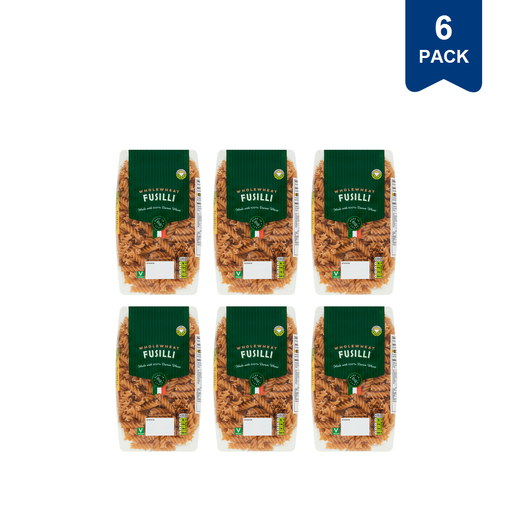
The fusilli shape suits a breakfast bowl mixed with sauce or chopped additions. The title describes six 500 g packs, but the listing’s quantity details differ; confirm the bundle contents before ordering.
 No image available
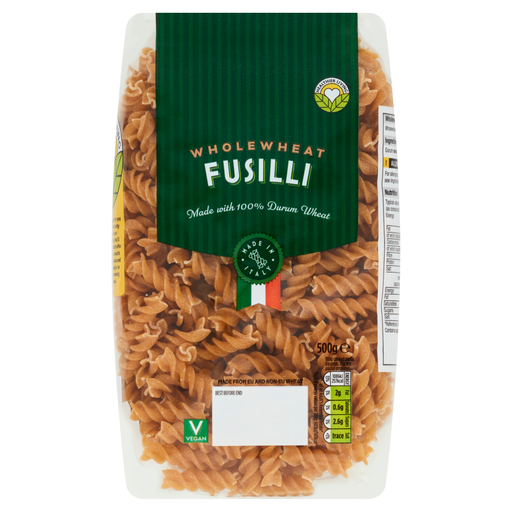
This 500 g fusilli is a short-shape choice for a breakfast bowl with sauce or chopped additions. Check the current ingredient and allergen label if serving someone with a dietary restriction.
No. Wholewheat pasta is wheat-based, and the Food Standards Agency identifies wheat as a cereal containing gluten. Choose a specifically labelled gluten-free product and check the exact pack’s current allergen information.
Read the ingredient list as well as the front of the pack. Product examples from Sainsbury's identify durum wholewheat semolina, while Barilla describes its wholewheat pasta as made with whole wheat.
Fusilli or penne gives you a short shape to mix with sauce and chopped vegetables. Barilla describes its fusilli as designed to hold sauce and suggests vegetable sauces for its penne; these are manufacturer pairing suggestions rather than comparative tests.
Use the webpage while shopping, but check the label on the exact pack before serving. M&S notes that product ingredients and allergen information can change.
Use the serving guidance on your chosen pack as a planning aid. Sainsbury's wholewheat fusilli gives 90 g per person, while Tesco’s fusilli suggests approximately 75 g; the amount you prepare can also depend on what else is in the breakfast.