Regular garage or workshop users
If you work in the building regularly or have several connected devices there, assess the connection between buildings first. Strengthening Wi-Fi only inside the house may leave that link unchanged.


Choose how the connection will cross the gap between the house and outbuilding before choosing Wi-Fi equipment for inside it. A permanent cable and access point are worth investigating where an appropriate installation is practical; a point-to-point wireless bridge is an alternative when the buildings have a clear path but laying cable is impractical. Powerline depends on the electrical circuit, while mesh or an extender needs a usable signal at its relay position.
A detached building needs a workable link back to the house network before local Wi-Fi can help devices inside it.
If you work in the building regularly or have several connected devices there, assess the connection between buildings first. Strengthening Wi-Fi only inside the house may leave that link unchanged.
If you would rather not lay a data cable between buildings, a wireless bridge is worth considering where two outdoor mounting positions have a clear, alignable view of each other.
If the building is close to the house and the connection needed is modest, powerline, mesh or an extender may be practical. Check the electrical circuit or the signal at the proposed relay position before choosing one.
Work out what can carry the connection across the gap; then choose how to provide Wi-Fi or Ethernet inside the outbuilding. The four routes depend on different features of the property.
Consider it when: A permanent cable route is practical and the outbuilding needs a local connection for regular use or several devices.
Trade-off: It takes planned installation work, but the access point does not depend on wireless backhaul across the gap.
Consider it when: Laying cable is impractical and the buildings offer clear, alignable outdoor mounting positions.
Trade-off: Trees, structures, interference and alignment can affect the link; a quoted range is not a promise for your garden. TP-Link’s outdoor bridge guidance calls for clear line of sight.
Consider it when: You want to use existing wiring and can confirm that the intended sockets meet the electrical-circuit condition.
Trade-off: TP-Link says its powerline adapters must be on the same electrical circuit; wiring conditions can also affect the resulting connection.
Consider it when: A relay position near the outbuilding still receives a usable signal, or a practical wired backhaul reaches a mesh unit.
Trade-off: An indoor unit placed beyond the usable signal cannot repair that weak link; outdoor exposure also calls for equipment suited to the location.
| Concern | What to check when buying | Who this matters to |
|---|---|---|
| A dependable link | Can you plan an appropriate permanent cable route? If not, is there clear line of sight for a bridge? | I need to work in the detached building or keep connected equipment online, so the link back to the house comes before local Wi-Fi. Around 36% of consumers put that link first. |
| Avoiding a cable run | Check possible bridge mounting positions, obstructions, outdoor suitability and the planned power method. | Running a data cable between buildings would be disruptive for me, but I have somewhere to align outdoor equipment. Roughly 29% of consumers prioritise avoiding that cable run. |
| Using existing wiring | Confirm the intended sockets are on the same electrical circuit; allow for wiring conditions to affect performance. | I would rather use the sockets already in place, provided they can carry a useful connection to the outbuilding. Around 21% of consumers make existing wiring their primary concern. |
| A simple nearby extension | Test the signal at the relay position and check whether the unit would be exposed outdoors. | My outbuilding is nearby, and I want to try a relay without installing a separate link—but only where it can still receive a usable signal. About 14% of consumers put this lower-intervention route first. |
An extender repeats the connection it receives. Walls, insulation, metal and placement can weaken that connection before it reaches a detached building.
Test the proposed relay position first. If it cannot receive a usable signal, assess a cable and access point, an outdoor bridge or a suitable powerline route instead.
TP-Link’s guidance calls for both adapters to be on the same electrical circuit. Electrical noise and wiring conditions can affect the connection even when that condition is met.
Identify the two sockets you intend to use and confirm their circuit arrangement before choosing a kit. If testing beforehand is impractical, check the retailer’s return terms for that purchase.
TP-Link’s outdoor bridge guidance calls for clear line of sight; obstacles and alignment can change what works between two particular buildings.
Choose possible mounting points before buying, check the view between them and select equipment with an outdoor rating and power arrangement suitable for those positions.
An obstructed path may mean moving the mounting points or changing the planned installation.
Exposure to rain and damage changes the equipment and installation needed. Electrical Safety First advises using outdoor-suitable cables, leads and connectors that are correctly rated and protected from damage.
Check the intended mounting environment. Have fixed electrical work or changes to an outdoor supply assessed against the requirements applicable where you live; Electrical Safety First notes that these differ across UK nations.
Look at the relevant product line rather than assuming every device from a brand can connect two buildings.
Offers outdoor bridge equipment, outdoor mesh units, indoor mesh and extenders for different connection plans.
Makes powerline equipment that uses existing electrical wiring to carry a network connection to another socket.
Offers dedicated wireless bridging equipment for locations where a cable route is difficult.
Offers outdoor access-point equipment relevant where a suitable network link already reaches the mounting position.
These powerline and mesh options are worth comparing if your property meets their link conditions. Confirm the circuit for either powerline kit, or a usable wireless or practical wired backhaul for the mesh system, before deciding what will serve the outbuilding.
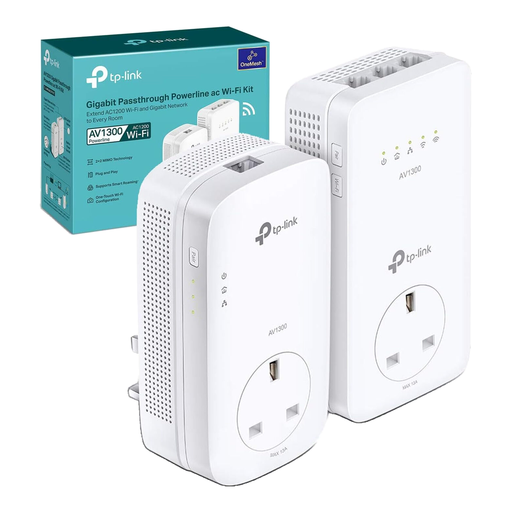 No image available
Consider this kit if you want Wi-Fi at the outbuilding through existing wiring and can confirm that the intended sockets meet the circuit requirement.
AV1300 is a product-class label, not a prediction of the connection you will get across your wiring. Keep the adapters in suitable indoor locations; the product guidance advises against moisture-prone placement.
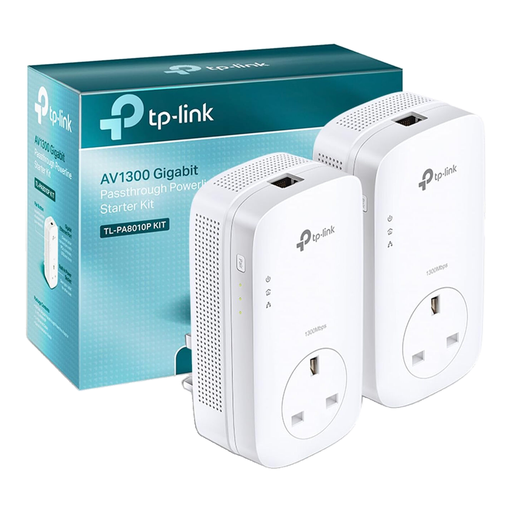 No image available
Consider this kit for an outbuilding device that can connect by Ethernet, provided the intended sockets meet the circuit requirement.
The title identifies AV1300 and Gigabit capability, neither of which guarantees the rate across your wiring. If you need local Wi-Fi, check whether you will also need a separate access point.
 No image available
Consider this three-unit mesh system for a nearby outbuilding only if a unit can retain a usable connection to the house network or a practical wired link reaches it.
BE3600 is a product-class label, not a guarantee through external walls. The product guidance says to keep the units away from rain and moisture, so do not plan an exposed outdoor position for one.
They are worth considering only after you confirm that the intended house and garage sockets meet the circuit condition. TP-Link says both adapters must be on the same electrical circuit, while wiring conditions and electrical noise can affect the connection you get.
It may do so if its proposed relay position still receives a usable connection from the house network. Test that position rather than putting a unit inside a dead zone; TP-Link’s mesh placement guidance also makes clear that walls, materials and placement affect wireless backhaul.
Check the requirements applicable to the work and your part of the UK before installation. Electrical Safety First notes that electrical-installation requirements differ across UK nations; arrange for a competent electrician to assess fixed supply work where appropriate.
Choose equipment and connections suitable for the intended outdoor exposure instead. Electrical Safety First advises that outdoor cables, leads and connectors should be correctly rated and protected from damage; also check the network unit’s own mounting and moisture guidance.
Check the chosen model’s intended frequency and configuration against the applicable UK requirements before installing it. Ofcom publishes fixed-wireless-access information and radio-equipment interface requirements; do not assume that a condition applying to one band or setup covers every bridge.