Choose a camera setup around the photographs you want to make, particularly the lens you will use. A dedicated macro lens suits fine floral detail; a zoom is a more flexible starting point for flowers in their surroundings. For close work, also consider shallow depth of field, low-angle framing and whether you can steady the camera without the flower moving.
Who each setup suits
Close-detail photographers
If you want petals, stamens or small blooms to fill the frame, consider a compatible dedicated macro lens. At close distances, expect to spend more time focusing and, for suitable still subjects, consider a tripod or focus stacking.
Meadow and walking photographers
If you want to show a flower within its surroundings, a camera with a general-purpose zoom may suit your walks. An interchangeable-lens system leaves open the option of adding a compatible macro lens later.
Occasional close-up beginners
If you want to photograph flowers without carrying separate lenses, a compact camera with a macro mode is another starting point. Check what its close-focus setting actually allows before expecting frame-filling detail.
What to check when choosing
Decide whether magnified detail, flexible walking photography or a simpler setup is your main priority; then check the lens and handling features that serve it.
| Concern |
What to check |
Who this matters to |
| Close-up detail |
Check the lens mount and stated maximum magnification. For close focusing, consider how you will control the narrow area that appears sharp. |
If fine structures need to fill my photograph, a compatible macro lens matters more to me than choosing a body by megapixels alone. Around 42% of consumers put close-detail capability first. |
| Walking and low-angle use |
Compare the weight of the body and lens together, screen movement for ground-level framing, and where any stabilisation is provided. |
When photographing flowers along a walk, I want to frame them in their habitat without making ground-level composition awkward. Portability and handling come first for around 33% of consumers. |
| A simple start |
Compare a compact camera's macro mode with an interchangeable-lens kit, including whether you may want to add a compatible lens later. |
For occasional flower photographs, I would rather learn with minimal kit than start with a specialist close-up workflow. Roughly 25% of consumers prioritise that simpler approach. |
Common buying pitfalls
-
Choosing the body before the close-up lens
A standard zoom can frame a flower in its surroundings, but it does not automatically provide the magnification needed for fine detail.
If close detail is the aim, check a compatible lens's maximum magnification and focusing distance before committing to the camera system.
A dedicated macro lens is an additional piece of kit to carry and use.
-
Expecting stabilisation to fix every blurred photograph
Stabilisation can address camera shake, but it cannot increase depth of field or keep a wind-moved flower still.
For close work, consider focus, aperture, shutter speed and subject movement as well as camera support.
-
Assuming focus stacking works in every field scene
Focus stacking combines frames focused at different distances. Movement between frames can make alignment difficult.
Reserve it for relatively still compositions and check whether the exact camera stacks images in-camera or requires another processing step.
A tripod and a separate editing step may be part of that workflow.
-
Moving a flower to improve the composition
Handling wild plants can damage the subject and may conflict with rules that apply where you are photographing.
Photograph plants in place, follow access rules and check the relevant local requirements before touching vegetation.
Brands to consider for wildflower photography
Canon
An EOS R system is worth considering if you want a low-angle screen and the option of an RF macro lens.
- Canon UK specifies a vari-angle screen and sensor-shift stabilisation for the EOS R7. Canon also describes in-built focus bracketing and stacking on the EOS R7 and EOS R10.
- Canon UK specifies 1.4x maximum magnification for the RF 100mm F2.8L Macro IS USM.
- Canon UK specifies no sensor-shift stabilisation for the EOS R10; check the lens and shooting method if handheld stills matter to you.
Nikon
A Z-mount setup offers a route from the Z50II body to a dedicated close-up lens.
- Nikon UK describes a vari-angle touchscreen on the Z50II and specifies 1:1 magnification for the NIKKOR Z MC 105mm f/2.8 VR S.
- If life-size detail is your goal, assess the compatible macro lens as part of the setup rather than assuming a standard kit zoom provides it.
Sony
An E-mount setup may suit someone comparing an APS-C body with a dedicated macro lens.
- Sony UK specifies in-body 5-axis stabilisation for the α6700 and up to 1:1 magnification for the FE 90mm F2.8 Macro G OSS.
- For walking use, assess the body and chosen lens together rather than judging what you will carry from body size alone.
Joybuy camera kits for wider scenes
These camera-and-zoom kits are options for flower portraits and wider habitat photographs. If magnified detail is your priority, check the supplied lens's close-focus specifications and the availability of a compatible macro lens.
 No image available
Sony A6700 APS-C with 16–50mm lens
The included zoom makes this a starting setup for flowers within wider scenes. Sony UK specifies 5-axis in-body stabilisation for the α6700; for fine close-ups, check the supplied lens's maximum magnification and closest focusing distance.
View on Joybuy
 No image available
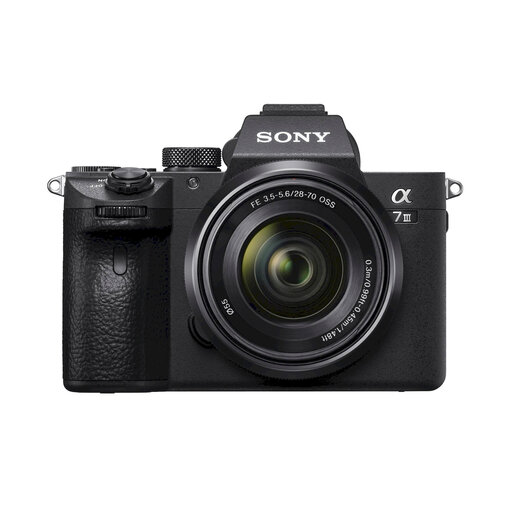
Sony Alpha 7 III full-frame with 28–70mm zoom
The supplied zoom gives you a starting lens for flower portraits and their surroundings. If small floral structures are your main subject, check its maximum magnification and closest focusing distance before relying on it for close-ups.
View on Joybuy
 No image available
Sony A6400 APS-C with 16–50mm Power Zoom
This zoom kit is relevant to walks and wider flower scenes. For frame-filling details, check the included lens's close-focus figures; if you often shoot at ground level, check whether the screen's movement suits your framing.
View on Joybuy
 No image available
Sony Alpha ZV-E10 II K with 16–50 mm f/3.5–5.6 Power Zoom
The supplied zoom gives this APS-C kit a starting point for wider wildflower photographs. Check its maximum magnification for detailed close-ups, and confirm the still-photo stabilisation options if you expect to shoot handheld.
View on Joybuy
Wildflower camera questions
Do I need a macro lens to photograph wildflowers?
No: a zoom can show flowers within their surroundings, and a compact camera with a macro mode can serve for occasional close-ups. If life-size floral detail is your priority, check a compatible dedicated macro lens's stated maximum magnification rather than relying on the word “macro” alone.
Why is only part of a close-up flower photograph sharp?
Depth of field becomes very shallow at close focusing distances. Nikon School UK discusses using a smaller aperture to keep more of a plant sharp; focus stacking is another option when the flower stays sufficiently still between frames.
Do I need a tripod for flower close-ups?
Not for every photograph, but a tripod is useful when a slower shutter speed suits a still subject or when you need frames to align for focus stacking. Canon UK advises sturdy camera support for stacking sequences; moving flowers remain a separate difficulty.
Can I move a wildflower to get a clearer photograph?
Photographing it in place avoids disturbing the plant and is the safer starting approach. Before touching wild vegetation, check the rules for the specific location and any instructions from the land manager; requirements can differ by jurisdiction and site.


