
24/7 Customer Support

Free returns

Same-day & Next-day Delivery

Quality Guaranteed

Unlock Your Welcome Offers: FREE Delivery | Up to 80% OFF | Free 30-day JoyPlus trial
Download the APP
A wine cooler can make serving bottles more convenient, but choosing the wrong model often leads to wasted space, unnecessary energy use or disappointing temperature control. Product listings may highlight bottle capacity while overlooking shelf spacing, ventilation and installation requirements.
Three common buying traps are worth avoiding:
A single-zone wine refrigerator is straightforward for one main type of wine. Many models offer a range around 5°C to 18°C, which can suit chilled whites, rosé and reds at serving temperature.
A dual-zone wine cooler allows two independently controlled areas. This is useful when you regularly store red and white wines together, although the exact temperature range and loading arrangement should be checked in the product specifications.
For food, drinks or frozen storage during travel, look for a compressor model with a stated range such as -20°C to +20°C. This differs substantially from a thermoelectric mini fridge, which may cool to a stated number of degrees below room temperature but cannot freeze.
A built-in wine cooler or under-counter wine cooler needs the correct aperture dimensions and ventilation arrangement. Never assume that a 60 cm appliance will fit every 60 cm kitchen space. Check height, width, depth, door clearance and the manufacturer’s installation instructions.
A freestanding wine cooler needs clear airflow around the ventilation area. Blocking the vents can increase running costs and place additional strain on the appliance. For integrated appliances, installation by a suitably qualified person may be required, particularly where electrical connections or fixed wiring are involved.
Renters and smaller households may prefer a freestanding model because it can be repositioned more easily. A reversible door and adjustable feet are practical features where room layouts are restricted.
Noise figures are normally shown in decibels (dB). Models rated around 39–40 dB may be more suitable for open-plan kitchens, bedrooms or offices than louder appliances, although the surrounding room and installation surface also affect perceived sound.
UK energy labels use an A to G scale. Compare the stated rating alongside the appliance’s annual energy consumption rather than relying on the letter alone. A larger 93-litre beverage cooler will naturally have different storage and running characteristics from a compact 7-bottle appliance.
For bottles stored over longer periods, consider UV-resistant glass, double glazing, smoked glass and low-vibration shelving. These are practical design features, not guarantees of wine quality. Horizontal storage can also help keep traditional corks in contact with the wine.

Why This Fits Their Persona: Its 15 cm width suits a narrow fitted-kitchen gap, making it practical for homeowners or renters with limited space and a small collection.
The seven-bottle capacity is clearly stated, helping avoid paying for unused space. Its single 5°C–18°C zone is also easy to understand.
39 dB noise rating, bamboo shelves, reversible door and smoked UV-resistant glass.
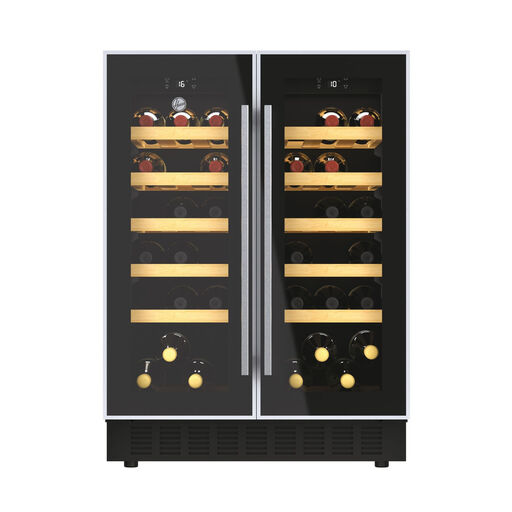
Why This Fits Their Persona: Designed for a 60 cm integrated installation, it suits kitchen renovations and households that want separate storage for different wine styles.
Its two independently controlled zones avoid the limitation of a single setting, while the stated 38-bottle capacity is based on standard Bordeaux bottles.
Bamboo shelving, 39 dB operation, UV-resistant smoked glass and app-based temperature monitoring.
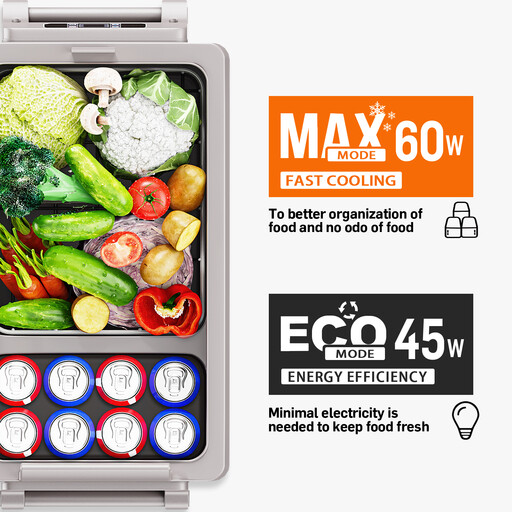
Why This Fits Their Persona: Its large capacity and dual storage areas suit caravan owners, boat users, campers and drivers carrying food and drinks for several people.
It uses a compressor rather than thermoelectric cooling, with a stated -20°C to +20°C range and three-stage battery protection.
49.4-litre capacity, 12/24V DC and 240V AC compatibility, app control and approximately 40 dB operating noise.
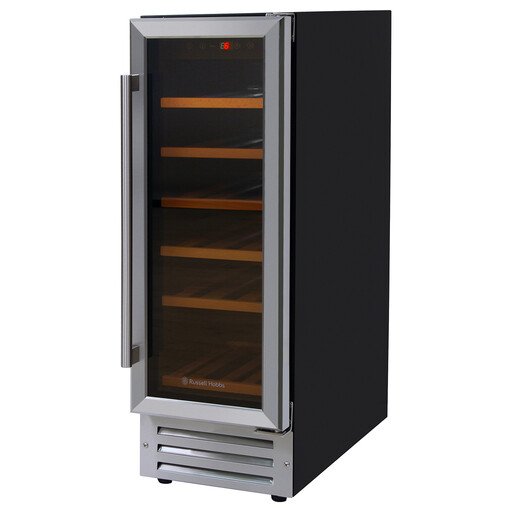
Why This Fits Their Persona: It offers a middle-ground capacity for flats, dining rooms, home bars and kitchens where installation flexibility matters.
The freestanding or built-in format helps prevent an unsuitable fixed installation, while six shelves provide clear bottle organisation.
58-litre capacity, 5°C–18°C thermostat, reversible door, adjustable feet and 39 dB(A) noise rating.
We have compiled a complete, real-time list of products that fully satisfy these strict selection criteria and UK safety regulations.
Running cost depends on size, energy rating, room temperature, thermostat setting and how often the door is opened. Check the appliance’s energy label and annual consumption figure. Keeping ventilation clear and positioning the unit away from heat sources can also support efficient operation.
Some models are specifically designed as under-counter wine coolers, while others are freestanding only. Check the installation type, aperture dimensions and ventilation instructions before purchase. Do not place a freestanding appliance inside cabinetry unless the manufacturer permits it.
Lifespan varies with construction, usage, installation and maintenance. Follow the manual, keep ventilation openings unobstructed, clean the interior safely and avoid overloading shelves. For a portable car fridge, secure the unit during transport and use the correct 12V, 24V or mains adapter specified for the product.