
24/7 Customer Support

Free returns

Same-day & Next-day Delivery

Quality Guaranteed

Unlock Your Welcome Offers: FREE Delivery | Up to 80% OFF | Free 30-day JoyPlus trial
Download the APP
A dedicated wine cooler can make a kitchen, dining room or home bar more organised, but choosing the wrong model can create unnecessary expense and installation problems. A wine fridge is not simply a smaller household refrigerator: it is designed around bottle storage, stable temperature control and convenient presentation.
The main buying mistakes usually come from three traps:
Decide whether you need a freestanding wine cooler, a built-in wine cooler or an integrated wine cooler before comparing finishes and features.
A freestanding unit can usually be positioned in a dining room, office, utility room or home bar, provided there is sufficient ventilation. An under-counter wine cooler needs carefully checked measurements, including:
Some slimline appliances are designed for unusually narrow kitchen gaps. For example, a 15cm-wide model may hold only seven standard bottles but could be more practical than a larger appliance that cannot fit your layout. Never assume that a cooler can be placed directly inside cabinetry because its dimensions appear suitable.
A single-zone wine refrigerator is generally suitable when you mainly store one type of wine or want a consistent temperature for everyday bottles. Models with ranges such as 5°C to 18°C or 5°C to 20°C can accommodate common serving and storage preferences, although the ideal setting depends on the wine style and the manufacturer’s guidance.
A dual-zone wine cooler has two independently controlled areas. This can be useful for households that regularly serve white or sparkling wines cooler than reds. However, two zones are not automatically necessary for every collection. Check the capacity of each zone, not just the total bottle figure.
Wine coolers are often installed in living areas, so noise matters. A published rating of 39dB(A) to 40dB(A) gives a useful comparison point, although the perceived sound may change according to flooring, ventilation and compressor cycling.
Check the appliance’s current UK energy label rather than relying on older rating terminology. Energy classes run from A to G, and annual consumption in kWh is more useful for estimating running costs. Multiply the stated annual kWh figure by your electricity tariff to create a rough yearly estimate.
Other practical features include:
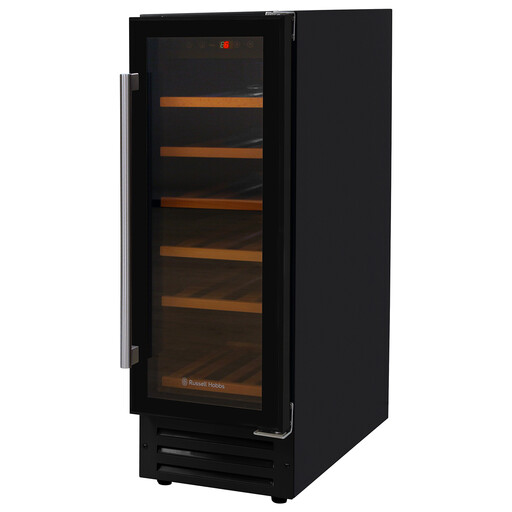
Why This Fits Their Persona: A practical starting point for UK homes needing compact storage in a black finish, with flexibility to use it freestanding or in a suitable built-in setting.
Its stated 18-bottle capacity, six wooden shelves and reversible door make the storage and placement limitations clearer than vague “large capacity” wording.
58-litre capacity, 5°C–18°C temperature range, LED display and stated 39dB(A) operation.
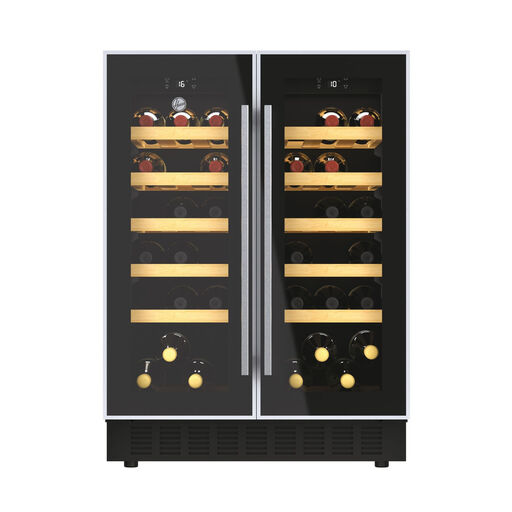
Why This Fits Their Persona: Suits kitchen renovators wanting a coordinated 60cm integrated appliance with separate temperature control and connected inventory features.
It specifies a 60cm integrated format, dual independent zones and a 38-bottle Bordeaux capacity, helping buyers compare like with like.
Bamboo shelves, UV-resistant smoked glass, Wi-Fi app control and stated 39dB noise level.
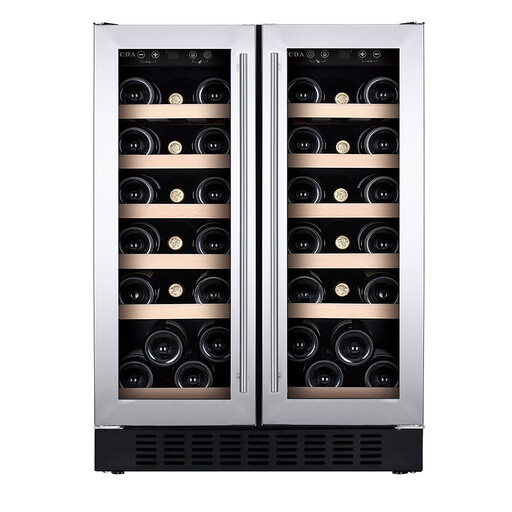
Why This Fits Their Persona: Designed for entertainers and larger collections requiring a stainless steel, under-counter or freestanding wine storage solution.
Its stated 38-bottle capacity is paired with 12 shelves, dual zones and a published approximate footprint, making space planning more straightforward.
5°C–20°C dual-zone control, triple-glazed lockable door, UV protection and over-temperature alarm.

Why This Fits Their Persona: A slimline option for fitted kitchens, flats and landlords filling a narrow 15cm aperture without allocating space for a full-width appliance.
The 145mm appliance width and seven-bottle capacity set realistic expectations for a narrow installation rather than suggesting full-size storage.
5°C–18°C single-zone control, reversible door, bamboo shelves, UV-resistant glass and hOn app connectivity.
We have compiled a complete, real-time list of products that fully satisfy these strict selection criteria and UK safety regulations.
Position the appliance away from ovens, radiators and direct sunlight. Built-in models require the ventilation arrangement stated in the installation manual; blocking vents can increase energy consumption and place additional strain on the appliance.
Allow a new unit to stand upright for the period specified by the manufacturer before switching it on. Let the temperature stabilise before loading bottles, and avoid packing shelves so tightly that air cannot circulate. Clean the interior with a soft, damp cloth and disconnect the appliance before maintenance.
Running cost depends on the appliance’s annual kWh figure, room temperature, temperature setting and how often the door is opened. A glass-fronted cooler with LED lighting may also use more or less electricity depending on its insulation and compressor design, so compare the energy label and annual consumption rather than relying on appearance.
It can provide more stable temperature-controlled wine storage than a frequently opened household fridge, but suitability depends on the model, temperature stability, humidity conditions and the intended storage period. Follow the manufacturer’s instructions and avoid placing the appliance in a hot or damp location.
The quoted capacity normally refers to standard 750ml bottles. Wider bottles, shelving positions and the need for air circulation can reduce the practical total. An 18-bottle wine cooler may therefore suit a modest collection, while a 38-bottle wine cooler offers more room for entertaining and mixed bottle shapes.
The most reliable comparison is the annual energy consumption shown on the UK energy label. Multiply the kWh figure by your electricity tariff for an approximate annual cost. Correct ventilation, sensible temperature settings and keeping the door closed can help the appliance operate efficiently.