
24/7 Customer Support

Free returns

Same-day & Next-day Delivery

Quality Guaranteed

Unlock Your Welcome Offers: FREE Delivery | Up to 80% OFF | Free 30-day JoyPlus trial
Download the APP
A wine cooler can make entertaining easier, but choosing the wrong model may lead to wasted space, unnecessary energy use or disappointing temperature control. Product listings often focus on bottle capacity and appearance while leaving out practical details such as ventilation, bottle shape compatibility and running costs.
Before buying, watch for three common pitfalls:
Start with the space available in your kitchen, bar, office or utility room. Measure height, width and depth, including door clearance and ventilation space. An under-counter wine cooler usually has a width close to 60cm, while slimline models may be around 15cm or 30cm wide.
Capacity should be treated as a guide rather than a guarantee. An 18-bottle wine cooler may hold 18 standard Bordeaux bottles, but wider bottles could occupy more than one shelf position. A larger 46-bottle wine cooler provides more room for entertaining and collection growth, but it also requires substantially more floor or cabinet space.
Check whether shelves are removable or adjustable. This is useful if you store sparkling wine, larger bottles or drinks alongside standard wine bottles.
A wine refrigerator with a broad adjustable range gives you more flexibility. Several models listed below cover approximately 5°C to 20°C, allowing chilled whites and rosé to be served cooler than many reds.
A single-zone wine cooler is suitable when most of your collection requires a similar temperature. A dual-zone wine cooler has two independently controlled sections, making it more practical for households that regularly store reds and whites at different settings.
Do not assume that every mini fridge or beverage cooler offers cellar-style temperature stability. Thermoelectric portable coolers are designed for convenience and generally cool below ambient temperature rather than maintaining a conventional compressor-fridge environment.
UK domestic refrigeration products use the A to G energy-efficiency scale, with A representing the lower energy-use classes and G the higher ones under the current labelling system. Compare the rating alongside the stated annual consumption where available, because a larger appliance naturally uses more energy than a compact one.
Noise is particularly important in open-plan kitchens, bedrooms and offices. Models rated around 39–40dB may be more suitable for living spaces, although the sound you notice will also depend on the room and floor surface.
Choose the installation format carefully:
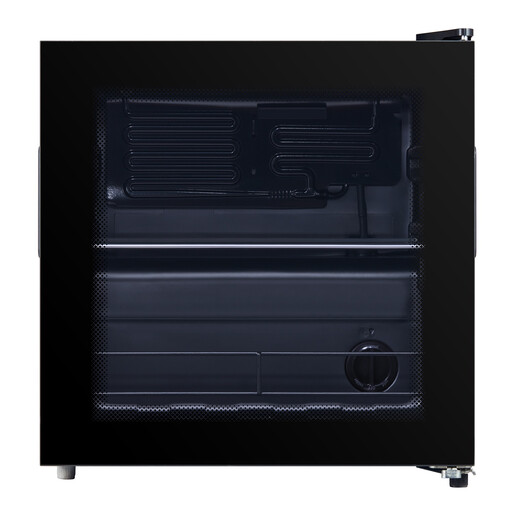
Why This Fits Their Persona: A practical entry point for flats, home bars, offices or student accommodation where a full-size wine fridge would take up too much room.
It is described as a freestanding appliance with adjustable temperature settings from 0°C to 16°C, rather than relying on vague cooling language.
44-litre capacity, reversible door and adjustable feet support flexible placement in compact UK homes.
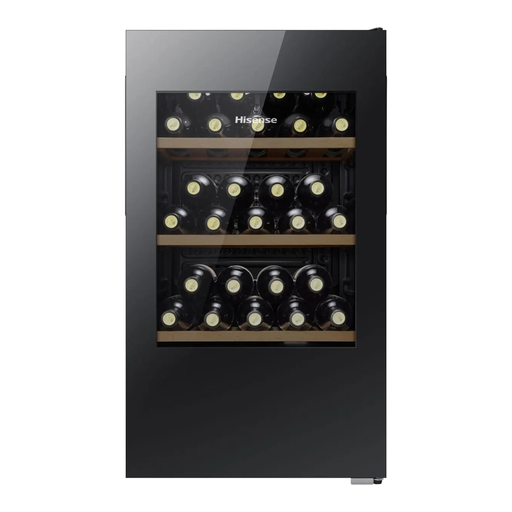
Why This Fits Their Persona: A suitable choice for wine-focused households that value a wide temperature range and quieter operation in a dining or living area.
The listing specifies a 5°C–20°C range, 39dB noise level and double-layer insulated glass, giving buyers measurable details to compare.
Horizontal bottle storage and low-vibration operation are useful considerations for a dedicated wine collection.
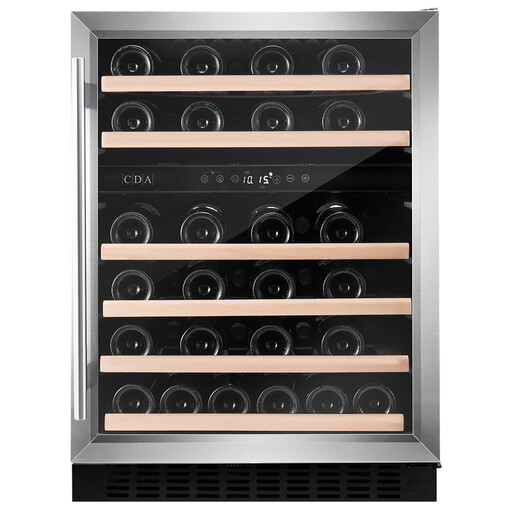
Why This Fits Their Persona: Designed for frequent hosts, kitchen renovators and bar operators who need separate red and white wine storage.
Its dual zones, reversible door and stated 46-bottle capacity make installation and storage requirements clearer than a generic beverage fridge listing.
Two temperature zones, wooden slide-out shelves, UV-protected glass and an over-temperature alarm.

Why This Fits Their Persona: Useful for desks, bedrooms, cars, travel and small personal drink or skincare storage.
The listing clearly states that thermoelectric cooling cannot freeze and depends on ambient temperature, preventing unrealistic expectations.
6-litre storage, AC and 12V DC power options, plus cooling and warming modes.
We have compiled a complete, real-time list of products that fully satisfy these strict selection criteria and UK safety regulations.
Running cost depends on capacity, energy rating, ambient temperature, usage and how often the door is opened. Compare the annual energy consumption in kWh when it is provided, rather than relying on the energy letter alone. A smaller drinks fridge will usually require less electricity than a large dual-zone appliance, but its storage capacity and temperature control will also be more limited.
Some beverage coolers can store cans and bottles, but a dedicated wine cooler is configured around horizontal bottle storage and wine-friendly temperature settings. A thermoelectric mini fridge is suitable for personal drinks, snacks or skincare, but it may not provide the same temperature stability as a compressor wine refrigerator.
Lifespan depends on build quality, ventilation, room temperature, cleaning and usage. Keep the appliance level, avoid overloading shelves and follow the manual’s defrosting and maintenance guidance. Before purchase, check the stated warranty, replacement-part availability and whether the installation method matches your kitchen or room.