
24/7 Customer Support

Free returns

Same-day & Next-day Delivery

Quality Guaranteed

Unlock Your Welcome Offers: FREE Delivery | Up to 80% OFF | Free 30-day JoyPlus trial
Download the APP
A dedicated wine cooler can free up space in the main fridge and keep bottles organised for dinners, entertaining or everyday use. However, attractive glass doors and large bottle counts do not always tell the full story. The wrong appliance may be difficult to install, expensive to run or unsuitable for the bottles you actually drink.
Advertised capacity usually assumes standard 750ml Bordeaux bottles. Champagne bottles, Burgundy bottles and larger formats may take more room, while shelves can become awkward to use when fully loaded. Allow spare capacity if you are building a collection rather than storing a fixed number of bottles.
A glass door can make a wine refrigerator look attractive, but check whether it is double-glazed, Low-E, UV-resistant or smoked. These features can reduce light exposure and condensation, although they do not remove the need to position the appliance away from direct sunlight.
A compact drinks fridge may be suitable for cans and short-term chilling, but wine benefits from stable temperatures, horizontal bottle storage and shelves that support different bottle shapes. A thermoelectric mini fridge, such as a portable cooler, may also cool relative to room temperature rather than providing the same type of compressor cooling as a full-sized wine cabinet.
Measure the available space carefully, including door clearance, plug access and ventilation gaps. A freestanding wine cooler needs room around the cabinet according to its manual. An integrated wine cooler or under-counter wine cooler must match the cabinet aperture, with sufficient ventilation to prevent heat build-up.
Slim appliances can solve difficult layout problems. For example, a 15cm built-in model may fit a narrow kitchen gap, while a 60cm wine cooler is designed for a more conventional under-counter or tall-cabinet installation. Check the product’s listed dimensions rather than relying on the nominal width alone.
A single-zone wine cooler offers one adjustable temperature range and is straightforward for collections consisting mainly of one wine style. A dual-zone wine cooler has two independently controlled areas, making it more practical for households storing reds, whites and sparkling wines at different serving temperatures.
Temperature ranges vary. Models listed at approximately 5°C–18°C or 5°C–20°C provide flexibility, but the temperature inside the cabinet can change with room conditions and how often the door is opened. Follow the manufacturer’s instructions for intended storage and serving settings.
Noise is particularly important in open-plan kitchens, flats and home offices. Look for the stated dB(A) rating; several models below are listed at 39dB or 40dB. Energy labels in the UK use the A-to-G scale, so compare the stated class and, where available, annual consumption rather than assuming a larger cabinet is automatically more economical.
Useful practical features include:
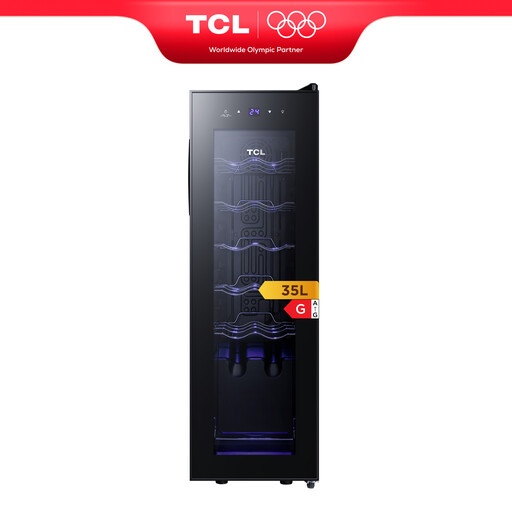
Why This Fits Their Persona: Its compact 35L format suits smaller kitchens, flats, bedrooms or dining areas where a full-size wine cabinet would take up too much space.
A dedicated wine refrigerator separates bottles from everyday food and drinks, while its stated 12-bottle capacity sets clearer expectations than an oversized general-purpose fridge.
Small footprint and glass-door design for accessible bottle storage.
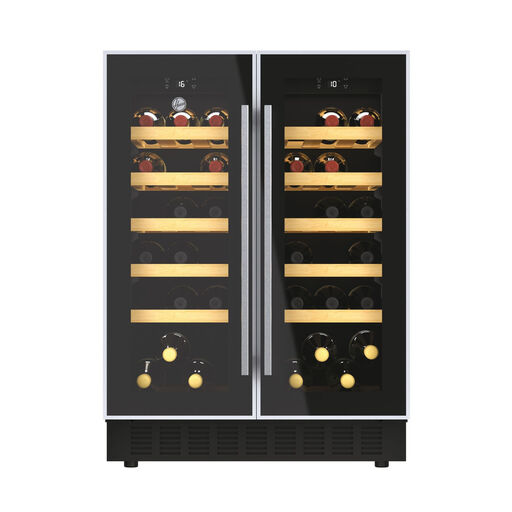
Why This Fits Their Persona: Designed for a fitted kitchen, this 60cm integrated wine cooler offers a neat built-in appearance and separate settings for different wine styles.
Its dual-zone layout avoids relying on one compromise temperature, while the installation specification makes it clearer that cabinet ventilation is required.
38-bottle capacity, two temperature zones, UV-resistant smoked glass and 39dB listed noise level.
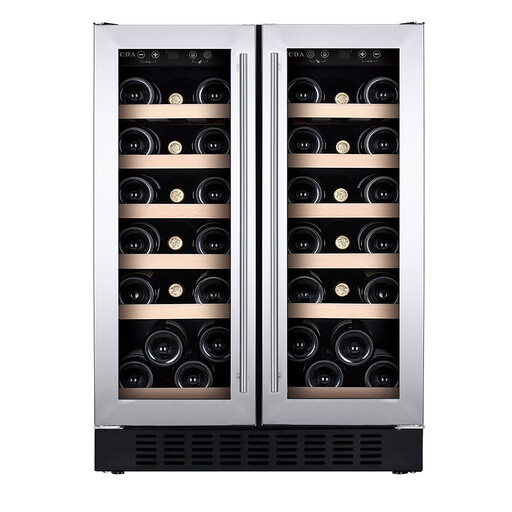
Why This Fits Their Persona: A 38-bottle capacity and under-counter or freestanding installation suit regular entertainers and households with a larger, mixed collection.
Independent zones and 12 slide-out wooden shelves reduce the need to stack or mix bottles in one undifferentiated compartment.
Dual temperature zones, UV-protected triple-glazed door, anti-vibration system and over-temperature alarm.
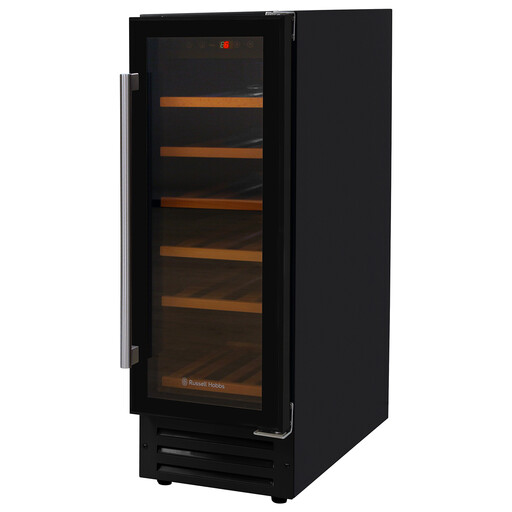
Why This Fits Their Persona: Suitable for freestanding placement or built-in use, it gives renters and home owners more flexibility when room layouts change.
Its reversible door and adjustable feet help accommodate different room positions, while the stated aperture dimensions support more accurate planning.
18-bottle capacity, six wooden shelves, 5°C–18°C range and 39dB(A) listed operation.
We have compiled a complete, real-time list of products that fully satisfy these strict selection criteria and UK safety regulations.
Running cost depends on the appliance’s energy rating, capacity, insulation, room temperature and usage. Compare the UK energy label and annual consumption where supplied. Keeping the door closed, allowing ventilation and avoiding direct heat can also support efficient operation.
Some models are specifically designed as under-counter wine coolers, while others are freestanding only. Confirm the installation type, aperture dimensions and ventilation requirements before purchase. Never push a freestanding appliance tightly into cabinetry unless the manufacturer permits it.
Service life varies with build quality, usage, ventilation and maintenance. Keep condenser areas clear where accessible, clean the door seal, avoid overloading shelves and follow the defrosting instructions. A clear manufacturer warranty is also useful when comparing similar wine cabinet models.