
24/7 Customer Support

Free returns

Same-day & Next-day Delivery

Quality Guaranteed

Unlock Your Welcome Offers: FREE Delivery | Up to 80% OFF | Free 30-day JoyPlus trial
Download the APP
Investing in a wine cooler is an exciting step for any enthusiast, promising perfectly chilled wine ready for any occasion. Yet, the path to purchase is often filled with pitfalls. Many buyers find themselves with an appliance that overheats, doesn't fit their kitchen or fails to accommodate their collection. Before you commit, it's crucial to understand the common traps that lead to disappointment and wasted money.
The most frequent issues stem from a few key areas. Firstly, there's the ventilation trap: purchasing a stylish freestanding unit only to build it into a tight cabinet, causing it to overheat and fail within months. Secondly, the capacity illusion, where advertised bottle counts are based on a single, slim bottle type, leaving no room for the varied shapes of a real-world collection. Finally, there's the single-temperature compromise, where a mixed collection of reds and whites means one type is always stored at the wrong temperature.
This guide will help you navigate these challenges, focusing on the essential factors that ensure you select a wine cooler that truly meets your needs.
To make a sound investment, move beyond the marketing gloss and focus on three non-negotiable specifications. Getting these right is the difference between a lasting appliance and a short-term frustration.
This is the single most important decision, as it dictates where and how the appliance can be used. The difference lies entirely in ventilation.
Freestanding Wine Fridge: These models are designed like a standard refrigerator, with cooling components and vents typically located at the back or sides. They require several inches of clearance on all sides for air to circulate. Placing a freestanding wine fridge inside a tight cabinet without this space will trap heat, forcing the compressor to work constantly until it fails. They are ideal for placement in a utility room, home bar or as a standalone feature in a larger kitchen.
Integrated or Under Counter Wine Cooler: These units are engineered specifically to be built into cabinetry. They feature front-facing ventilation at the base, allowing them to draw in and expel air from the front. This design means they can sit flush with your kitchen units for a seamless, professional look. A standard 60cm wine cooler will fit a typical appliance gap, while a slimline wine cooler (often 15cm or 30cm wide) is perfect for making use of narrow, otherwise wasted space.
A wine collection is rarely uniform. If you enjoy both crisp whites and full-bodied reds, a dual zone wine cooler is not a luxury; it's a necessity.
Bottle capacity figures can be misleading. A stated 40 bottle wine cooler capacity often refers to the maximum number of standard 75cl 'Bordeaux' style bottles. It may not account for the wider Burgundy, Champagne or Prosecco bottles that are common in many collections.
Look for models with adjustable or removable wooden shelves. Wood is preferable to metal as it helps to dampen vibrations from the compressor, which can disturb the sediment in older wines. Furthermore, ensure the door is made from UV-protected glass. Exposure to sunlight and even harsh indoor lighting can degrade wine over time, and a protective door is your first line of defence.
Based on these critical factors, we've matched several models to different user needs, helping you find a unit that avoids common pitfalls and delivers lasting value.

Why This Fits Their Persona: For those who host regularly and maintain a diverse collection, this unit offers everything needed. It's an integrated wine cooler designed for a premium kitchen aesthetic, with a substantial 44-bottle capacity and smart connectivity for managing inventory.
Its true dual zone capability completely solves the single-temperature compromise. As a dedicated integrated model, it's built with the correct front ventilation, eliminating the risk of overheating in a cabinet.
Features an anti-vibration system and an active carbon filter to preserve wine quality. The hOn App connectivity offers a modern way to manage your collection.
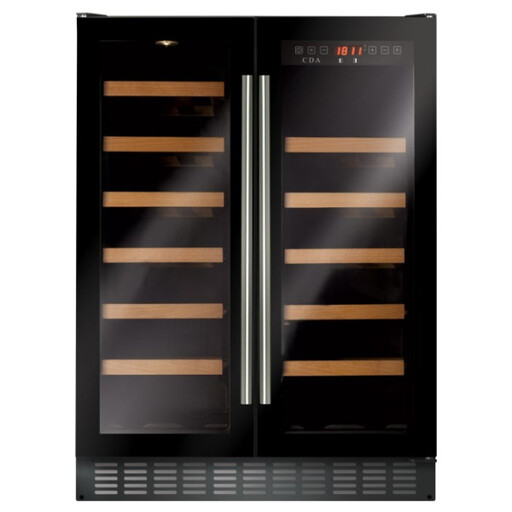
Why This Fits Their Persona: This model is for those who want a quality cooler now but may renovate their kitchen later. Its dual-installation design allows it to be used as a freestanding wine fridge or fitted as an under counter wine cooler, offering excellent versatility.
By being explicitly designed for both freestanding and under-counter use, it removes the guesswork and risk of incorrect installation. The 40 bottle wine cooler capacity is a practical size for a growing collection.
The key benefit is its adaptability. The sleek black wine fridge design with double doors is stylish in any setting, and the reversible door hinge adds to its flexible placement options.
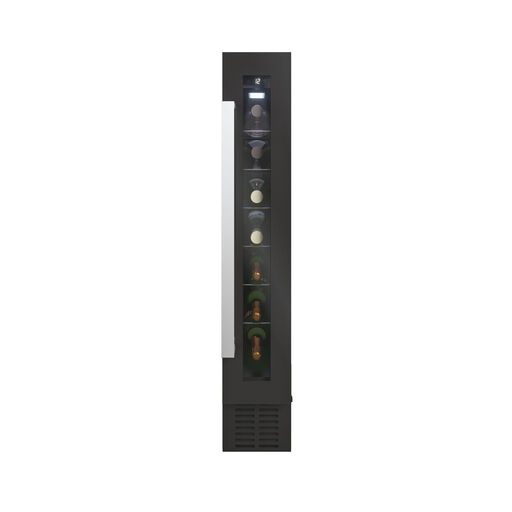
Why This Fits Their Persona: This is the perfect solution for modern kitchens where space is at a premium. This slimline wine cooler turns a narrow 15cm gap into a functional and stylish feature, holding a curated selection of 7 bottles.
As a purpose-built integrated wine cooler, it's designed for zero-clearance installation. Its modest 7-bottle capacity is clear and honest, avoiding the trap of over-promising on space.
Its primary advantage is its space-efficiency. The digital touch controls, UV-resistant glass and quiet 39dB operation provide premium features in a compact form factor.
We have compiled a complete, real-time list of products that fully satisfy these strict selection criteria and UK safety regulations.
No. A freestanding model requires open air space around its sides and back to dissipate heat. Enclosing it in a cabinet will trap this heat, causing the unit to run inefficiently and eventually leading to premature failure of the cooling system. For a built-in look, you must choose an integrated wine cooler with front-facing vents.
While personal preference for serving temperature varies, the ideal storage conditions are generally consistent.
The running cost depends on the unit's size, energy efficiency rating and the ambient temperature of the room. Newer models with better energy ratings (as indicated on the UK energy label) are significantly more efficient. A small, modern small wine cooler might cost as little as ?20-?30 per year to run, while a large, high-capacity model could be in the range of ?40-?70 annually. Always check the estimated annual kWh consumption on the product specification to make an informed comparison.