
24/7 Customer Support

Free returns

Same-day & Next-day Delivery

Quality Guaranteed

Unlock Your Welcome Offers: FREE Delivery | Up to 80% OFF | Free 30-day JoyPlus trial
Download the APP
A wine cooler can make a kitchen, dining room or home bar more organised, but choosing the wrong model may create practical problems. Capacity figures can be based on slim Bordeaux-style bottles, installation measurements may exclude ventilation space, and attractive glass doors do not always provide the same level of light protection.
This guide explains the main buying pitfalls, the specifications worth checking and a selection of wine coolers matched to different UK households.
An advertised 18-bottle wine cooler may hold fewer bottles if you store Champagne, Burgundy or larger-format bottles. Capacity is usually calculated using standard 75cl Bordeaux bottles, placed efficiently on the shelves.
If you entertain regularly or expect your collection to grow, leave some spare capacity. A cooler filled to its stated maximum can also become difficult to organise, particularly when shelves are fixed or do not slide out.
A built-in wine cooler or integrated wine cooler needs the correct cabinet aperture and airflow. A freestanding wine refrigerator may release heat from the sides or rear, while an under-counter wine cooler designed for front ventilation can be installed beneath a worktop when the manufacturer’s instructions are followed.
Do not assume that every 60cm wine cooler fits a standard kitchen opening. Check the height, width, depth, plinth and ventilation requirements before ordering. Installation and electrical connection should follow the supplied instructions, with qualified assistance where required.
A single-zone wine fridge can be practical for a collection that is mainly one style of wine. However, reds, whites, rosé and sparkling wines are commonly served at different temperatures. A dual-zone wine cooler allows two separately controlled areas, but it usually costs more and may offer less capacity per zone.
Also distinguish between serving temperature and long-term storage conditions. A domestic wine cooler is generally designed for controlled chilling and storage rather than replacing a purpose-built cellar.
Choose the format that matches your room:
Measure the available space in several places, including skirting boards, cabinet doors and handles. Allow room to open the door fully and remove shelves.
For occasional use, a 12-bottle or 18-bottle wine cooler may be sufficient. A 20- to 24-bottle unit suits a small household that keeps a mixture of everyday bottles. Larger collections may call for a 46-bottle wine cooler or a model with around 38 to 40 bottles.
Look for:
Check the actual temperature range rather than relying on phrases such as “perfect cooling”. Several models in this selection cover approximately 5°C to 20°C, while compact single-zone units may cover 5°C to 18°C or 8°C to 18°C.
A UV-protected wine cooler with smoked or tinted glass can reduce exposure to light. Double- or triple-glazed doors may also improve insulation, but they do not remove the need for sensible placement away from direct sunlight.
Noise is particularly important in open-plan UK homes. Models listed at around 38–40dB may be more suitable for kitchens and living spaces, although perceived noise can vary with installation and flooring.
Energy labels should also be compared carefully. Current UK appliance labels use the A–G scale, so a G-rated model is not equivalent to an old A-rated label. Check the annual energy consumption figure where it is provided, rather than comparing the letter alone.

Why This Fits Their Persona: A narrow 15cm footprint suits a fitted kitchen gap or compact entertaining area, with room for seven standard bottles.
Its listed 145mm width makes the space requirement clearer than a general “slim” description. Check the full aperture dimensions before installation.
Single-zone control from 5°C to 18°C, bamboo shelves, reversible door and listed 39dB operation.
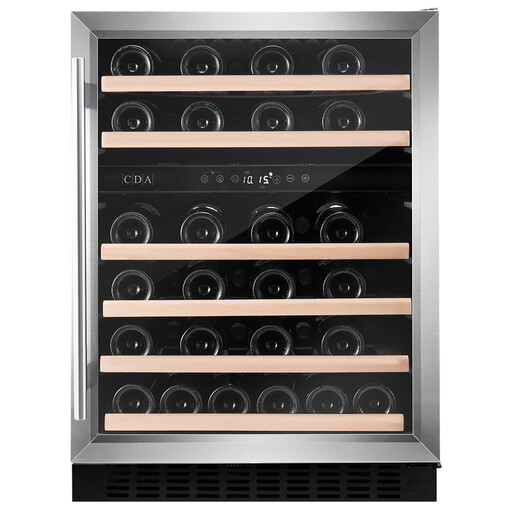
Why This Fits Their Persona: Stainless steel styling, dual-zone control and a 46-bottle stated capacity suit a modern kitchen or dedicated home bar.
The specification lists separate upper and lower temperature ranges, UV-protected smoked glass and reversible-door flexibility.
Five wooden slide-out shelves, electronic touch controls, over-temperature alarm and approximately 40dB noise.
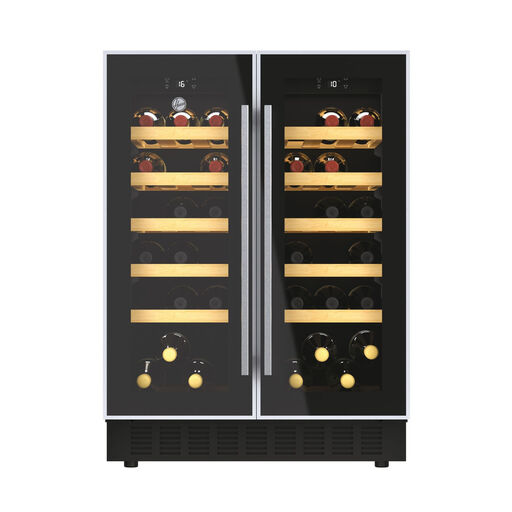
Why This Fits Their Persona: Designed for a 60cm integrated kitchen installation, it provides two zones and space for up to 38 standard Bordeaux bottles.
The listing specifies qualified installation, ventilation requirements, dual temperature settings and a reversible door.
Bamboo shelves, UV-resistant smoked glass, 39dB listed noise and Wi-Fi monitoring through the hOn app.
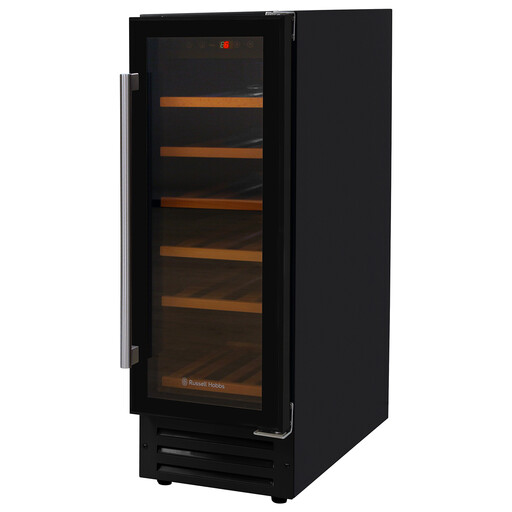
Why This Fits Their Persona: This 18-bottle wine cooler offers flexible placement for a flat, dining area or smaller kitchen without requiring a full-width appliance.
It is listed for freestanding or built-in use, but ventilation guidance still needs to be checked for the chosen installation.
Six wooden shelves, a 5°C–18°C range, reversible door, adjustable feet and listed 39dB(A) operation.
We have compiled a complete, real-time list of products that fully satisfy these strict selection criteria and UK safety regulations.
Running cost depends on the appliance’s annual energy consumption, room temperature, installation and usage. The energy label provides a useful comparison, but the actual cost changes with your electricity tariff. Keep the door closed, avoid placing the unit next to a radiator and maintain the required ventilation to support efficient operation.
Yes, some models are designed for under-counter or built-under installation. Check whether the unit is front-vented, confirm the aperture dimensions and follow the manufacturer’s clearance instructions. A freestanding wine refrigerator should not automatically be enclosed in cabinetry.
Lifespan varies according to construction, cooling system, installation and maintenance. Regularly clean the interior, keep ventilation openings clear and avoid overloading shelves. Always follow the instruction manual, particularly for defrosting, electrical connection and handling the refrigerant system.