
24/7 Customer Support

Free returns

Same-day & Next-day Delivery

Quality Guaranteed

Unlock Your Welcome Offers: FREE Delivery | Up to 80% OFF | Free 30-day JoyPlus trial
Download the APP
A wine storage rack can make a kitchen worktop, dining room corner or home bar feel considerably more organised. However, choosing by bottle capacity alone can lead to wasted money. A compact rack may not fit the bottles you own, while a tall cabinet can become unsafe if it is not level or secured correctly.
Before choosing a wine bottle organiser, look beyond attractive product photos and promotional capacity figures. The most useful comparison is based on available space, construction, stability and how often you need to access your bottles.
A rack labelled as an 8-bottle wine rack, 9-bottle wine rack or 12-bottle wine rack may be designed around standard-sized bottles. Champagne-style bottles, larger soft-drink bottles, water bottles and thermos flasks may require more width or height.
Measure the containers you actually intend to store, then compare those measurements with the product dimensions and compartment layout. If the listing does not provide internal measurements, allow extra clearance rather than assuming every bottle will slide in easily.
A stackable wine rack can be useful in a rented flat or compact kitchen because its height can be adjusted over time. Yet stackable does not mean that every configuration is suitable for every surface. Uneven worktops, overloaded layers and poorly connected sections can increase the risk of movement.
For a plastic wine rack, check whether the design is intended for stacking, whether assembly is tool-free and whether there are clear limits per layer. Keep the finished rack on a flat surface and inspect it periodically for cracks or loose connections.
A transparent wine bottle rack makes labels easy to see and can keep a cupboard looking visually open. Plastic is also generally convenient to move and clean. It should not, however, be placed close to radiators, hobs or strong direct sunlight if the manufacturer warns that heat or prolonged exposure may weaken or discolour the material.
For long-term storage, also consider whether the rack will be exposed to dampness, abrasive cleaning products or frequent knocks. These practical details often matter more than the appearance of the plastic.
Capacity should match your regular stock rather than an occasional large purchase. A 2-layer design may suit a small collection, while a 3- or 4-layer rack provides more vertical storage without using much additional floor space.
Check:
A removable, modular design may offer more flexibility than a fixed beverage bottle organiser, particularly if you move home or reorganise your kitchen.
Transparent plastic is light and allows quick identification of bottles. Look for rounded edges, secure connections and a surface that can be cleaned with warm soapy water and a soft cloth. Avoid abrasive pads that may scratch the finish.
Engineered wood and metal can provide a more substantial furniture-style appearance, but they also add weight and require more careful assembly. A cabinet made from MDF or particleboard is not the same as solid wood, so check the material description before purchase.
A freestanding rack should sit on a level surface, with heavier bottles placed lower where possible. A tall corner wine cabinet requires additional attention. Check the maximum weight capacity, whether an adjustable foot is included and whether the unit must be attached to the wall.
For furniture with an anti-tip kit, follow the supplied fixing instructions. Do not use a tall cabinet as a step, and keep children from climbing on shelves or pulling at mesh doors. These precautions are relevant whether the unit is used as wine storage furniture, a sideboard or a home bar.

Why This Fits Their Persona: Its 2-layer, 8-bottle format is suited to renters, smaller kitchens and shoppers organising a modest drinks collection without adding a large piece of furniture.
The transparent, removable format makes bottle compatibility and available capacity easier to assess before overfilling a cupboard or worktop.
Transparent plastic; stackable and removable design; suitable for wine, drink bottles and thermos containers.

Why This Fits Their Persona: This furniture-style option suits homeowners creating a defined drinks area in a dining room, living room or home bar, while making use of an otherwise awkward corner.
Its listed anti-tip kit, adjustable foot and 50 kg maximum capacity address stability considerations that are easy to overlook with tall storage furniture.
47 cm x 47 cm x 130 cm triangular footprint; adjustable interior shelf; two mesh doors and wine glass holders.
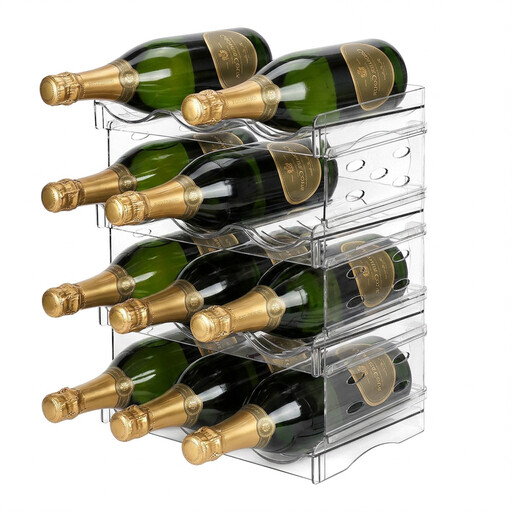
Why This Fits Their Persona: The 12-bottle capacity and vertical 4-layer layout suit larger households, frequent hosts and anyone storing a mixture of wine and everyday beverage bottles.
The stated limit of three bottles per layer provides a clear loading reference, helping prevent the common mistake of treating stackable storage as unlimited.
Four layers with up to 12 standard bottles; tool-free snap-together assembly; transparent construction for quick identification.
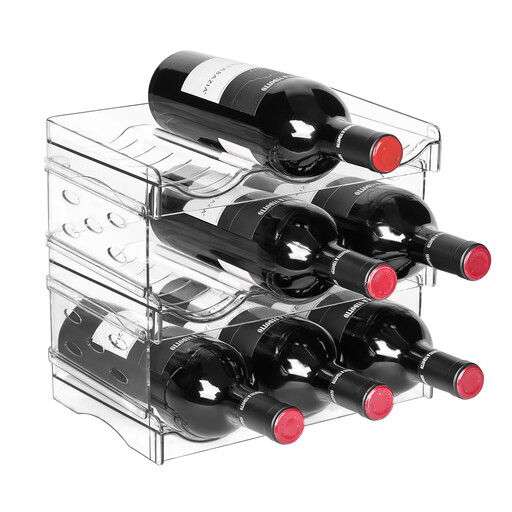
Why This Fits Their Persona: This middle-capacity option works for shoppers who want vertical storage for wine, fizzy drinks and flasks without committing to a full drinks cabinet.
Its three-layer arrangement offers a defined capacity, while the transparent format helps you spot whether wider or taller bottles may need a different storage solution.
Three-layer, 9-bottle format; transparent finish; intended for wine, soda bottles and thermos containers.
We have compiled a complete, real-time list of products that fully satisfy these strict selection criteria and UK safety regulations.
It can be suitable when used within its stated capacity and kept away from heat, direct sunlight and excessive impact. Plastic racks are particularly practical for wine, soft drinks, water bottles and thermoses in cupboards or on worktops. They are not designed to replace temperature-controlled wine storage.
Lifespan depends on material, loading, cleaning and placement. A plastic rack should be inspected for cracks, distortion or weakened connectors. A cabinet should be checked for loose screws, damaged hinges and movement at the wall fixing. Replacing a compromised rack is safer than continuing to use it when stability has changed.
A standard wine storage rack, plastic organiser or wine bar cabinet does not require electricity. It provides physical storage only. If you need controlled temperature or humidity, you would be comparing a different product category: an electrically powered wine cooler or cellar unit.