
24/7 Customer Support

Free returns

Same-day & Next-day Delivery

Quality Guaranteed

Unlock Your Welcome Offers: FREE Delivery | Up to 80% OFF | Free 30-day JoyPlus trial
Download the APP
A wireless charger can make daily charging more convenient, but the wrong model may create new frustrations. Phones can stop charging because of poor alignment, charging speeds may fall short of the advertised figure, and a multi-device station may not support every smartwatch or earbuds case in your household.
Before buying, focus on compatibility, power requirements and the way you plan to use the charger. The following guide explains the main buying traps and highlights practical options for UK smartphone users, commuters, students, office workers and households.
A listing may show 15W, 20W or 33W, but this does not mean every connected device will charge at that rate. The phone must support the relevant wireless charging standard, while the charger and power adapter must also provide sufficient input.
Multi-device charging stations divide their available power between devices. A 3-in-1 wireless charger may allocate one output to a phone, another to earbuds and a lower output to a smartwatch. Check the separate output figures rather than relying only on the total wattage.
A magnetic wireless charger needs two separate conditions: the phone must support wireless charging, and it must have a suitable magnetic alignment system or compatible magnetic case. Some Android phones support Qi charging but do not have built-in magnetic attachment.
A magnetic ring or compatible case may be needed. Without proper alignment, the phone can move out of position or charge intermittently. This is particularly important when choosing a magnetic wireless charger for a vehicle or motorcycle.
Some products require a PD or QC charger, while others include a suitable adapter or USB-C cable. A low-output plug may prevent simultaneous charging or reduce performance.
For car mounts, installation is also important. Adhesive bases need a clean, dry, smooth surface and may require curing time. Air-vent mounts must not obstruct controls or airbags. A wireless charging car mount should be positioned so it does not distract you while driving.
Look for Qi-compatible charger support when buying for a mixture of iPhone and Android devices. Qi charging is widely used, but charging speed and magnetic positioning vary by device.
For newer magnetic phones and cases, check whether the product supports the relevant magnetic alignment system. Smartwatch charging is more specialised: a phone and smartwatch charger may support only selected watch models, so confirm compatibility before ordering. The same applies to wireless earbuds chargers, as the earbuds case must usually have a wireless charging-enabled base.
Compare the stated output for each charging area:
A fast wireless charging stand is useful on a desk or bedside table because the upright angle makes it easier to see notifications. A flat wireless charging pad is more compact and can suit a pocket, luggage or shared workspace.
A charging station should have a stable base and enough spacing for your devices. Foldable designs can be useful for travel, while weighted or aluminium constructions may be more suitable for a permanent desk setup.
Check for stated safety protections and recognised markings. For example, the ACEFAST E20 lists CE, RoHS, FCC, EAC and UL62368 certifications in its product information. These markings should be treated as product documentation rather than a guarantee that every setup is risk-free. Keep chargers dry and ventilated, avoid placing metal objects on charging areas and follow the supplied instructions.
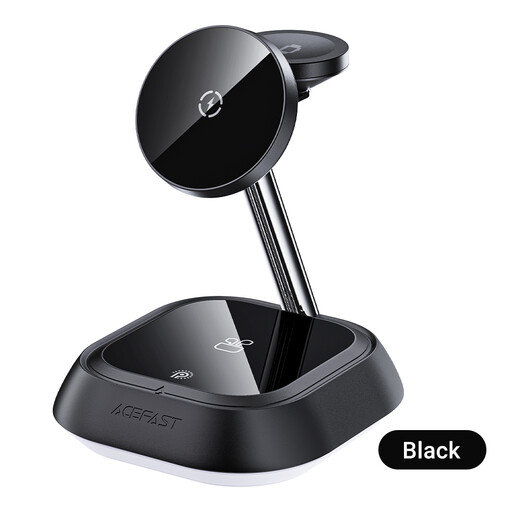
Why This Fits Their Persona: A straightforward desktop station for users who want one place for a phone, TWS earbuds and a smartwatch at home or in a student room.
Its instructions specify the required USB-C power adapter and correct placement for all three charging areas, helping users avoid unsupported setups.
Dedicated phone, earbuds and watch areas; foldable design for storage.
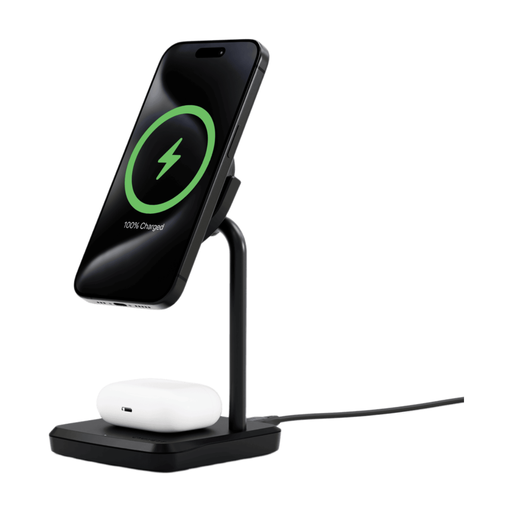
Why This Fits Their Persona: Suitable for an organised desk or bedside table where a stable, adjustable base and a defined phone-and-earbuds setup are priorities.
The listing states separate 15W and 5W outputs, includes a USB-C cable and identifies support for MagSafe and other Qi-enabled devices with a MagRing.
80° swivel head; weighted non-slip base and 2-year warranty stated in the listing.

Why This Fits Their Persona: A practical choice for drivers who want navigation visibility and charging in one dashboard, air-vent or windscreen setup.
The instructions clearly cover surface preparation, adhesive curing and the need for a magnetic case or ring, rather than implying universal magnetic support.
15W wireless output; 360° rotation and anti-slip fastening mechanism.

Why This Fits Their Persona: Designed for people who need power away from a desk, including rail commuters, business travellers and users who prefer a compact backup battery.
It states separate wired and magnetic outputs, a 5000mAh capacity, an adjustable stand and a 9.4mm-thin design, making the intended travel use clear.
7.5W magnetic wireless output; USB-C charging up to 15W and approximately 119g weight.
We have compiled a complete, real-time list of products that fully satisfy these strict selection criteria and UK safety regulations.
The electricity used for occasional phone charging is generally small, but wireless charging can lose more energy as heat than a direct wired connection. Actual running cost depends on charging frequency, the device battery and local electricity rates. Choose wireless charging for convenience rather than assuming it will reduce energy use.
Many Android phones support Qi charging, but compatibility varies by model. A Qi-compatible charger can provide wireless power where the phone supports the standard. Magnetic attachment is separate, so a magnetic case or ring may be required for a magnetic wireless charger.
Follow the charger and phone manufacturer’s instructions. Use a suitable adapter, keep the setup dry and ventilated and avoid covering the charger with bedding or other materials. If the phone becomes unusually hot, remove it and check positioning, case compatibility and the power supply.