Shortcut-heavy game-menu builders
If you repeatedly enter labels, navigate editor panels and trigger the same commands, key remapping and accessible navigation keys may matter more to your workflow than lighting.


A rechargeable wireless keyboard can remove a permanent keyboard cable from a game-menu workstation, but it still needs a suitable USB charging arrangement. Choose the layout around the keys you use in your editor: a 75% or tenkeyless board can preserve practical navigation while leaving mouse room, whereas a compact board with a numpad may suit frequent numeric entry. Check the exact UK key layout, shortcut controls and connection modes before choosing.
If you repeatedly enter labels, navigate editor panels and trigger the same commands, key remapping and accessible navigation keys may matter more to your workflow than lighting.
If your desk equipment already occupies the available wall sockets, a rechargeable wireless keyboard may avoid a permanent keyboard connection. You will still need a way to charge it periodically.
If mouse movement takes up much of your desk, a 75% or tenkeyless layout is worth considering. Check that it retains the arrows and other keys you use during menu work and testing.
Start with your charging arrangement, then check your editor shortcuts, physical layout and testing connections. A wireless connection addresses the permanent cable; it does not determine whether the keys themselves suit your work.
| Concern | What to check | Who this matters to |
|---|---|---|
| Shortcuts and remapping | Check documented key remapping, macros or programmable controls against the commands you repeat in your editor. | If I build menus through repeated commands, I want those actions within easy reach rather than buried in key combinations. Around 31% of consumers would put shortcut control first. |
| Socket use and charging | Confirm the charging connector, supplied cable and whether a suitable computer USB port can handle charging. | I want to clear a permanent keyboard connection without creating another everyday demand on a wall socket. For around 31% of consumers, that is the primary concern. |
| Desk space and keys | Compare 75%, tenkeyless and layouts with a numpad; check arrows, navigation keys and the exact UK key arrangement. | When I move between menu editing and mouse-led testing, I need room to move without losing the keys I use to navigate. Around 23% of consumers would prioritise that balance. |
| Testing connections | Check the exact model’s Bluetooth, 2.4 GHz and wired options, including any mode-specific specifications. | If I switch between a development PC and another device, I want a connection choice that fits each task. That flexibility would come first for around 15% of consumers. |
A rechargeable keyboard can remove a permanent cable, but it still needs periodic USB charging.
Check the selected model’s connector, supplied cable and charging instructions. If you need a separate mains charger, Electrical Safety First advises buying one from a reputable retailer.
On a heavily reduced layout, keys used for editor navigation or testing may require additional layer commands.
List your most-used arrows, function keys and editor shortcuts first. Compare their positions on a 75% or tenkeyless board before moving to a smaller layout.
Connection modes can have different stated specifications. Keychron lists 1,000 Hz polling for the Q1 Max in 2.4 GHz and wired modes, compared with 90 Hz over Bluetooth; those figures apply to that model and do not establish a real-world result for every keyboard.
Check the specifications for the mode you will use during game testing, rather than judging the keyboard by its list of connection options alone.
Electrical Safety First warns against connecting one extension lead to another or exceeding an extension device’s maximum current rating.
Follow the device’s rating and use one appropriately rated extension device per wall socket. If extensions would be a permanent workaround, consider asking a registered electrician about fixed sockets.
These product lines illustrate different approaches to compact layouts, wireless connections and programmable controls. Check the features of the exact variant you intend to buy.
The G915 X family includes wireless keyboards with a wired connection option; the G915 X TKL combines that flexibility with a tenkeyless layout.
Keychron lists UK-ISO variants of the K2 QMK and Q1 Max for buyers who want compact layouts and key customisation.
The BlackWidow V4 Low-Profile HyperSpeed is a wireless option for people considering device switching and dedicated controls.
The UK K65 Plus Wireless uses a 75% layout aimed at retaining practical keys while reducing keyboard width.
These wireless keyboards offer different ways to balance desk space and key access for game-menu work. Pay particular attention to the stated physical layout: a compact size alone does not establish familiar UK symbol placement.
 No image available
Consider this 75% wireless model if you want a smaller keyboard for menu work. If UK symbol placement or particular navigation keys are essential, check the physical key arrangement shown for this exact SKU before ordering.
 No image available
Consider this UK-layout wireless model if you want to retain a numpad while reducing keyboard width compared with a conventional full-size arrangement. Its 96% layout leaves a different amount of mouse room from a 75% board; check its shortcut controls if remapping is central to your work.
 No image available
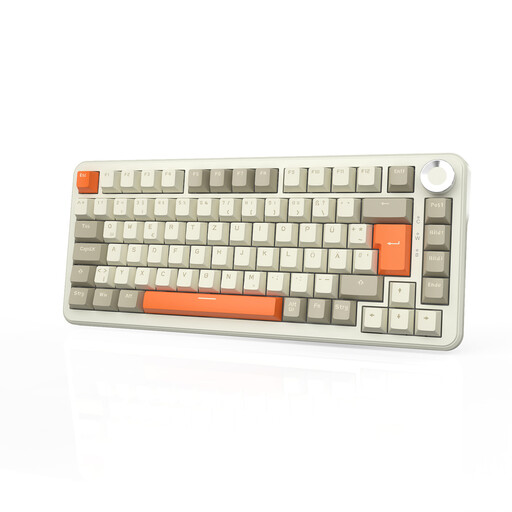
This 75% model may suit a compact desk if you are comfortable using German QWERTZ keycaps. It has a volume knob and a stated 8000mAh battery capacity; capacity alone does not tell you how long it will run. Check its navigation-key positions and German symbol layout against your editor workflow.
 No image available
Consider this compact model if US QWERTY key placement works for your menu-editing tasks. Its title specifies wired, Bluetooth and 2.4 GHz modes, but the US layout differs from UK key placement; check the exact keys you use for symbols and shortcuts.
 No image available
This 75% model is an option to examine if you want a compact keyboard with a knob. Check its physical layout, dedicated navigation keys and available key assignments against your game-menu workflow before choosing it.
It can avoid a permanent keyboard connection, but a rechargeable model still needs periodic USB charging. Check the selected keyboard’s cable and charging instructions, and whether a suitable computer USB port can provide the charging connection you need.
Choose the mode according to the exact keyboard and task rather than assuming they behave identically. Bluetooth can be useful for switching devices; Keychron states that its Q1 Max polls at 1,000 Hz in 2.4 GHz and wired modes and 90 Hz in Bluetooth mode. Check your chosen model’s mode-specific specifications if they matter to your testing setup.
Yes, if its key layers suit the commands you actually use. Before choosing one for menu work, locate your editor shortcuts, arrows and function keys on its layout; a 75% or tenkeyless board may make frequently used keys easier to access directly.
Choose a UK-ISO or stated UK variant if familiar UK symbol and Enter-key placement matters to your typing. Check the exact product variant rather than relying on the brand or keyboard-family name, particularly when you enter symbols often.
Plan a suitable USB charging connection and follow the keyboard’s charging instructions. Electrical Safety First advises buying any separate USB charger from a reputable retailer; it also warns against daisy-chaining extension leads or exceeding an extension device’s current rating.