
24/7 Customer Support

Free returns

Same-day & Next-day Delivery

Quality Guaranteed

Unlock Your Welcome Offers: FREE Delivery | Up to 80% OFF | Free 30-day JoyPlus trial
Download the APP
A wireless mechanical keyboard can make a desk cleaner, create more space for a mouse and provide a more responsive typing feel than a standard membrane model. However, the specification lists can be confusing. Terms such as “low latency”, “gasket mount” and “long battery life” may sound impressive without explaining how the keyboard will perform in your home, office or gaming setup.
Before buying, watch for three common pitfalls:
A tri-mode mechanical keyboard supports three connection methods: Bluetooth, 2.4GHz wireless and wired USB. This is useful if you move between a desktop PC, laptop, tablet and smartphone.
Check how many devices the keyboard can pair with and how switching works. The AULA F99, for example, is described as supporting up to five connected devices, while other multi-device wireless keyboard models may support fewer.
A 75% mechanical keyboard normally keeps the function row, arrow keys and a compact navigation cluster while removing the separate number pad. It offers a useful balance between desk space and everyday functionality.
A 65% keyboard is smaller but usually omits the function row. A 96% keyboard keeps more keys, including a number pad, in a compressed arrangement. Consider your regular tasks:
Do not overlook the printed layout. The products featured below use US QWERTY specifications where stated, so UK buyers should confirm whether this matches their preferred key arrangement.
Mechanical switches affect sound, resistance and key movement. Linear switches tend to provide a smooth press, tactile switches add a noticeable bump, and clicky switches produce a more pronounced audible click. Product descriptions do not always use these terms consistently, so check the named switch type before ordering.
A hot-swappable keyboard allows compatible switches to be replaced without soldering. Confirm whether the PCB accepts 3-pin, 5-pin or both types. This matters if you later want a quieter office setup or a different gaming feel.
A gasket mount keyboard uses flexible mounting materials between parts of the plate and case. It may produce a softer key feel, but the exact typing experience depends on the plate, foam, stabilisers and switches. Features such as PBT keycaps, internal padding and a volume knob can be more useful than decorative lighting alone.
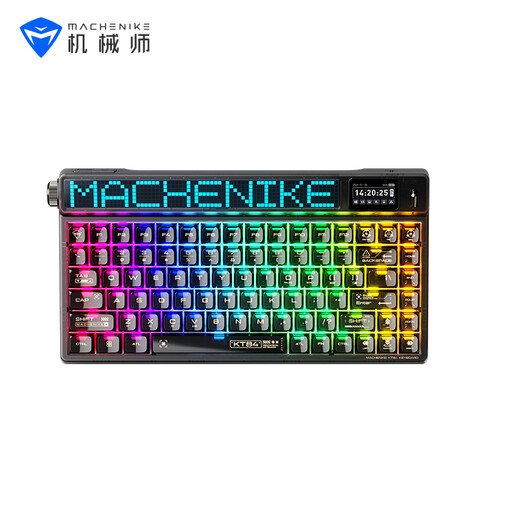
Why This Fits Their Persona: Its 75% format provides the main keys needed for study, office work and casual gaming without taking up the space of a full-size keyboard. The stated US QWERTY layout is clear for shoppers comparing compact boards.
Tri-mode connectivity reduces reliance on one connection method, while the clearly listed layout helps avoid an unsuitable key arrangement.
75% layout; wired, Bluetooth and 2.4GHz modes; Gateron White switches.

Why This Fits Their Persona: This suits users who want a customisable board with a compact footprint, sound-dampening construction and a dedicated control knob for media adjustments.
The specification lists full-key hot-swap sockets, five-layer internal padding and tri-mode connectivity rather than focusing only on RGB effects.
4000mAh battery; RGB lighting; PBT keycaps; multimedia knob; gasket structure.

Why This Fits Their Persona: The 96% layout retains a number pad for spreadsheets, coding shortcuts and frequent data entry, while remaining more compact than many full-size boards.
It combines a clearly defined 96% arrangement with hot-swap support and N-key rollover, avoiding a board that sacrifices practical keys for a smaller footprint.
8000mAh battery; Bluetooth 5.0, 2.4GHz and USB-C; 3-pin and 5-pin hot-swap support; RGB lighting.
We have compiled a complete, real-time list of products that fully satisfy these strict selection criteria and UK safety regulations.
It can be, particularly when it includes a 2.4GHz receiver and a wired USB mode. Bluetooth is convenient but may not be the preferred connection for competitive play. Check the manufacturer’s stated compatibility and use wired mode if you need a direct connection.
Battery life varies with capacity, connection type and RGB use. A larger listed capacity, such as 4000mAh or 8000mAh, indicates more stored energy, but it does not guarantee a fixed number of hours. Turn off or reduce lighting when longer use between charges matters.
For many users, yes. A 75% keyboard normally retains arrow keys and the function row while removing the number pad. If your work involves regular numerical entry, a 96% model or a separate keypad may be more practical.