
24/7 Customer Support

Free returns

Same-day & Next-day Delivery

Quality Guaranteed

Unlock Your Welcome Offers: FREE Delivery | Up to 80% OFF | Free 30-day JoyPlus trial
Download the APP
As a Joybuy Product Recommendation Officer, I see many customers looking to upgrade their audio. Whether you're a vlogger, a business professional or a budding karaoke star, a good wireless microphone can make a world of difference. However, the market is flooded with options, and it's easy to make a purchase you'll later regret. This guide is designed to help you navigate the common pitfalls and identify the key features that truly matter for UK users.
Many products make bold claims, but their real-world performance often falls short. Here are three frequent issues that can lead to wasted money and frustration.
The Compatibility Nightmare: A microphone is useless if it doesn't connect reliably to your device. Many models advertise universal compatibility but fail to deliver. You might find a wireless mic for iPhone that works with an older model but has intermittent dropouts with the latest one, or a USB-C microphone for Android that requires a specific, often clunky, third-party app to function. Always check for true plug-and-play functionality with your specific phone, camera or laptop model.
The "Noise Cancelling" Myth: The term "noise cancelling" is often used as a marketing buzzword. In cheaper models, this feature is frequently just an aggressive software filter that cuts out all low-volume sounds. While it might reduce some background hum, it can also make your voice sound thin, compressed or unnatural. A quality noise cancelling microphone uses sophisticated hardware, like a Digital Signal Processing (DSP) chip, to distinguish between your voice and background noise, resulting in a much cleaner and more professional sound.
Impractical Battery Life: There is nothing more disruptive than a microphone dying mid-recording or during an important presentation. Some wireless mics have a battery life of only 2-3 hours and lack a charging case, making them unsuitable for anything beyond short clips. For serious microphone for vlogging or all-day events, look for systems with long-lasting batteries, a portable charging case and the ability to function while charging.
To avoid the traps above, focus on these three non-negotiable specifications before you buy.
The single most important factor is how the microphone's receiver connects to your recording device.
The physical form of the microphone should match your intended use.
Look beyond simple claims and check for the technology used. A system with a dedicated DSP (Digital Signal Processing) chip actively analyses and filters out unwanted background noise like wind, traffic or air conditioning, while preserving the natural tone of your voice. This is a significant step up from basic software filters and is a key feature for anyone recording outdoors or in unpredictable environments.
Based on these practical criteria, here are a few options from our catalogue, matched to different user needs.
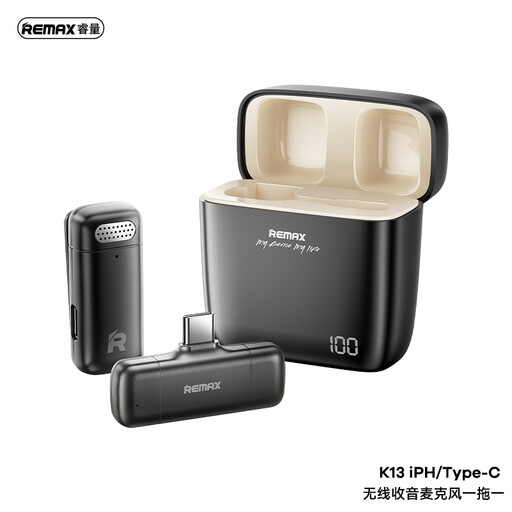
Why This Fits Their Persona: This is an excellent starting point for content creators who need a simple, no-fuss solution. Its direct plug-and-play USB-C receiver works instantly with most modern Android phones and laptops, making it perfect for recording quick vlogs, social media content or online tutorials without a complicated setup.
It sidesteps the compatibility trap by offering a dedicated USB-C receiver. There are no apps to install or Bluetooth pairing to worry about—it just works.
Its main strengths are simplicity and portability. The kit includes a furry wind muff to help reduce wind noise during outdoor recording, a practical addition for UK weather.
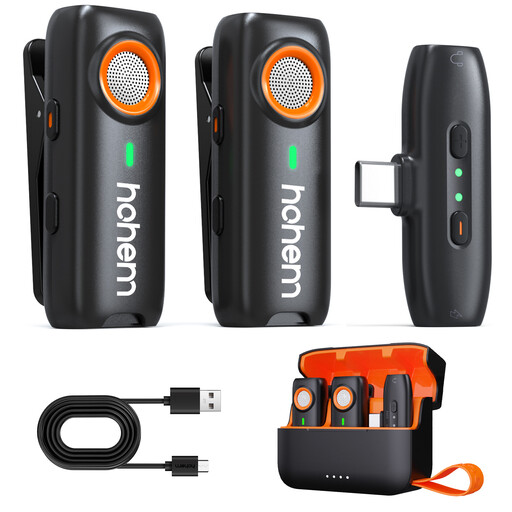
Why This Fits Their Persona: For YouTubers, podcasters and journalists, audio reliability is paramount. This system offers features that provide peace of mind, including a charging case for extended battery life and the ability to record a backup audio file directly to a TF card in the transmitter.
It tackles the "noise cancelling myth" with a 3-level DSP chip for cleaner audio and solves the battery life problem with a charging case that provides up to 20 hours of total use.
The standout features are its advanced DSP noise reduction and the TF card backup recording. This backup function is a professional-level feature that ensures you never lose an important take due to wireless interference.
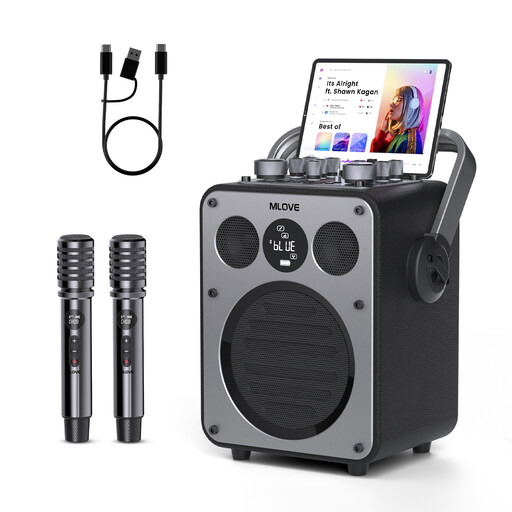
Why This Fits Their Persona: This is more than just a microphone; it's a complete portable PA system. It's ideal for family gatherings, parties or even small outdoor events. With two wireless handheld microphones, instrument inputs and a powerful speaker, it's built for entertainment rather than discreet vlogging.
This system avoids the trap of being a jack-of-all-trades. It is purpose-built as a high-quality portable karaoke and PA system, not a tiny vlogging mic, so its features are optimised for that specific use.
Its all-in-one design is the main benefit. You get a powerful 200W speaker, two UHF wireless microphones and multiple inputs for instruments and other audio sources, all powered by a long-lasting rechargeable battery.
We have compiled a complete, real-time list of products that fully satisfy these strict selection criteria and UK safety regulations.
1. How long does a wireless microphone last? The lifespan depends on two factors: battery and build quality. A single charge on a transmitter typically lasts between 4 to 8 hours. Systems with a charging case can extend the total operational time to 20 hours or more before needing to be plugged into the wall. In terms of overall device life, a well-made microphone from a reputable brand should last for several years with proper care.
2. Can I use a wireless microphone with both my iPhone and my camera? Yes, this is possible with certain models. To do this, you need a system where the receiver has multiple output options. For example, a kit might include a receiver with interchangeable Lightning and USB-C connectors for phones, as well as a separate 3.5mm audio output port and cable to connect to a camera. Always check the product description for included adapters and output ports to ensure it meets your multi-device needs.
3. Do I need a noise cancelling microphone for vlogging in the UK? For outdoor vlogging in the UK, a good noise cancelling microphone is highly recommended. The unpredictable British weather often means dealing with wind, while urban environments are full of traffic and ambient noise. A microphone with effective noise reduction, particularly one using a DSP chip and supplied with a wind muff, will significantly improve your audio quality by isolating your voice and making your content far more professional and pleasant to listen to.