
24/7 Customer Support

Free returns

Same-day & Next-day Delivery

Quality Guaranteed

Unlock Your Welcome Offers: FREE Delivery | Up to 80% OFF | Free 30-day JoyPlus trial
Download the APP
A wok pan with lid can handle stir-frying, frying, braising, steaming and simmering in one piece of cookware. However, the wrong design may result in uneven heating, a loose lid or difficult maintenance. Before choosing a pan for your kitchen, look beyond phrases such as “non-stick”, “all hobs” and “family size”.
“Non-stick” can describe several different surfaces. A non-stick wok may use a ceramic coating, a textured stainless-steel surface or a seasoned carbon-steel interior. These options require different care.
Coated pans generally need low-to-medium heat and non-metal utensils to help protect the surface. Coating-free carbon steel and iron woks do not have a factory-applied non-stick layer, but they require seasoning and regular oiling. If a listing does not clearly explain the material and care routine, treat the claim cautiously.
A flat base is important for an induction wok, as traditional round-bottom Chinese stir-fry pans usually require a wok ring and may not make reliable contact with an induction zone. Gas, electric and ceramic hobs also benefit from a stable, level base.
Compatibility does not necessarily mean identical results on every hob. Induction tends to heat the magnetic base quickly, while gas flames can heat the sides more directly. Always check the manufacturer’s instructions, particularly for halogen or infrared hobs.
A 32 cm wok may sound ideal for family cooking, but the stated diameter does not show how much food can be comfortably tossed. A narrow base, shallow sides or a bulky handle can reduce practical capacity.
For stir-frying, avoid filling the pan to the rim. Overloading lowers the cooking temperature and can leave vegetables steamed rather than lightly seared. A family-size wok is useful only when the base, depth and hob size work together.
A carbon steel wok heats rapidly and can develop a seasoned oil patina with use. It is suitable for high-heat stir-frying and is typically coating-free, but it can rust if left damp. Initial seasoning and ongoing oil maintenance are essential.
A stainless steel wok is resistant to rust and often easier to clean. Tri-ply or composite-base construction can improve heat distribution. Without a chemical non-stick coating, food may stick if the pan is not preheated correctly. The hot-pan, cold-oil method can help, although temperature control remains important.
A ceramic wok usually means metal cookware with a ceramic non-stick coating, rather than a pan made entirely from ceramic. It can support low-oil cooking and easy food release, but coated surfaces should normally be protected from prolonged empty heating, abrasive cleaners and unsuitable utensils.
For a wok for gas and induction hobs, look for a flat magnetic base with enough contact area for your induction zone. A flat-bottom Chinese stir-fry pan is also more stable on electric and ceramic hobs than a round-bottom model.
Check whether the stated compatibility includes your exact hob type. Some products list induction, gas, electric and ceramic compatibility but recommend checking separately for halogen or infrared hobs. A pan that sits securely without wobbling is preferable for stirring, pouring and covered simmering.
A wok with glass lid allows you to monitor simmering sauces, noodles or braised dishes without repeatedly releasing heat. Check that the lid has a secure rim, a heat-resistant knob and a suitable fit. A vent can also help manage steam, although the product specification should confirm whether one is included.
Handle design affects storage and safety. Detachable handles can help in smaller UK kitchens, while stainless steel handles may be suitable for oven use only when the manufacturer confirms it. Dishwasher-safe claims should be checked against the complete product, including the handle, lid and coating. Coating-free iron and carbon steel models are commonly hand-wash only.
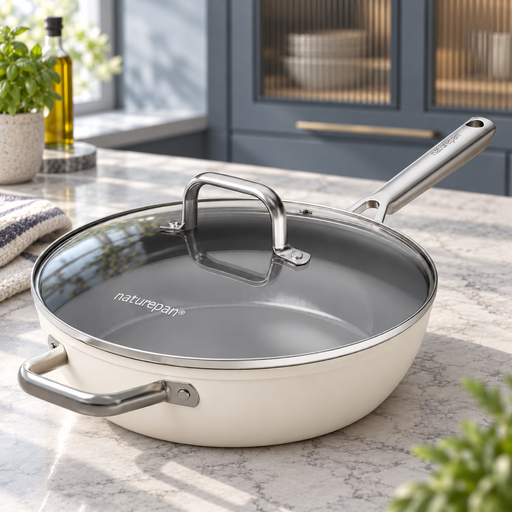
Why This Fits Their Persona: A practical 28 cm option for smaller households and everyday one-pan meals on induction, gas, electric or ceramic hobs.
The listing identifies it as ceramic-coated aluminium, so shoppers can distinguish it from a coating-free iron wok and follow the correct care routine.
Ceramic non-stick surface, matching lid, dishwasher-safe specification and oven use up to 230°C with the lid removed.
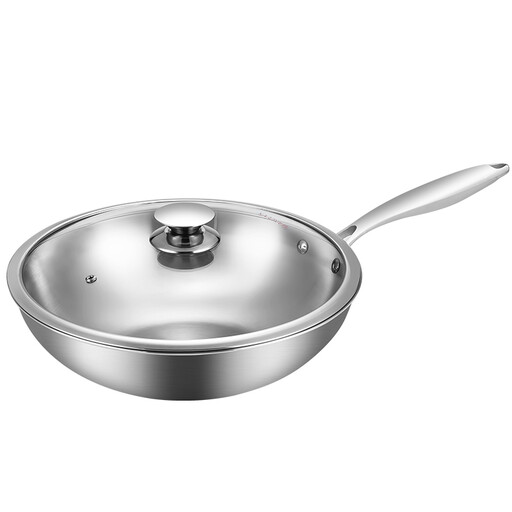
Why This Fits Their Persona: Suitable for cooks who prefer a coating-free stainless steel wok with a visible lid and broad hob compatibility.
Its specifications clearly state 304 stainless steel, a composite base and no non-stick coating, helping set realistic expectations about food release and cleaning.
Tri-ply construction, glass lid, compatibility with induction, gas, electric and ceramic hobs, plus a dishwasher-safe specification.
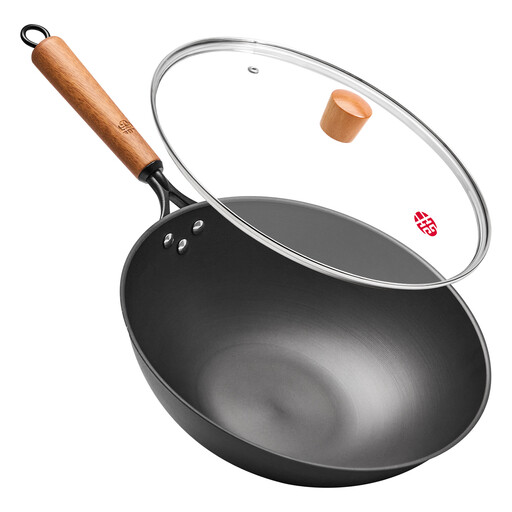
Why This Fits Their Persona: A 3–5 serving carbon steel wok for family stir-fries, braising, steaming, frying and larger weekend meals.
The product states that seasoning and daily oiling are required, avoiding the misleading expectation that an uncoated wok is maintenance-free.
1.5 mm carbon steel, flat base for all listed hob types, detachable wooden handle and shatter-resistant glass lid.
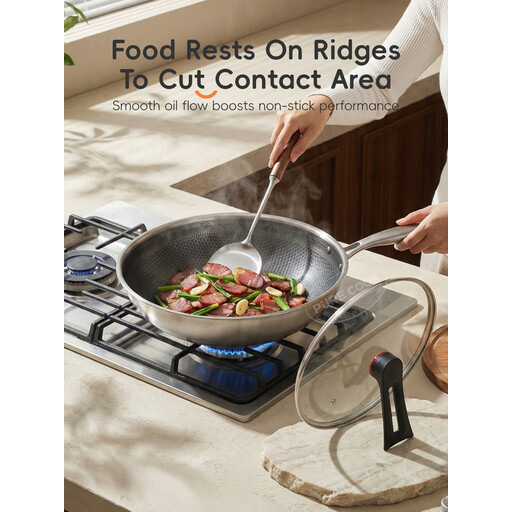
Why This Fits Their Persona: Designed for cooks wanting a 32 cm wok with a textured interior, transparent lid and compatibility with gas, induction and electric ceramic hobs.
The listing identifies the honeycomb interior and describes hand washing, drying and avoiding thermal shock, providing practical care guidance.
Three-layer 304 stainless steel construction, glass lid and a textured cooking surface designed to reduce direct food contact.
We have compiled a complete, real-time list of products that fully satisfy these strict selection criteria and UK safety regulations.
Yes, provided it has a magnetic flat base and the manufacturer lists induction compatibility. Place the wok centrally on the cooking zone and avoid sliding it across a glass hob, which may cause scratches.
A 28 cm wok can suit one or two people, while a 30–32 cm wok offers more room for family portions. Check your hob diameter and storage space before selecting a larger pan.
A coating-free carbon steel or stainless steel wok does not rely on a non-stick layer that can wear through use, but it still needs appropriate care. Carbon steel requires seasoning to limit rust and sticking; stainless steel needs correct heat and oil control. Lifespan depends on construction, frequency of use and maintenance.