
24/7 Customer Support

Free returns

Same-day & Next-day Delivery

Quality Guaranteed

Unlock Your Welcome Offers: FREE Delivery | Up to 80% OFF | Free 30-day JoyPlus trial
Download the APP
Choosing woodworking measuring tools is not simply a matter of selecting the longest ruler or the tool with the most features. For carpenters, joiners, makers and DIY users in the UK, a poorly made square or loose locking mechanism can introduce errors across an entire project.
The right selection depends on the type of work, the measurement system you use and how well the tool maintains its position during marking. This guide explains the practical specifications to check before buying, followed by recommendations matched to different workshop needs.
A 300mm combination square covers more distance than a 150mm model, but size alone does not establish accuracy. A longer blade can also be less convenient for small components or cramped workbenches. Check the ruler material, scale clarity and how securely it locks into the head.
An adjustable combination square is only useful if the ruler remains fixed while you mark or check a workpiece. A weak screw, uneven clamp or poorly fitting head may allow movement. This can affect 90-degree checks, depth measurements and repeated layout lines.
A bubble level, scriber or dual scale can be useful, but these additions do not compensate for a bent blade or an inaccurate edge. Look first for a straight ruler, clear graduations, a stable head and materials suited to regular workshop use.
A combination square is versatile, but it does not duplicate irregular profiles like a profile gauge. Similarly, a try square is convenient for checking a fixed right angle, while a sliding bevel is designed to copy and transfer angles. Matching the tool to the task helps prevent wasted cuts and repeated adjustments.
For general furniture work and DIY carpentry, 150mm tools are compact and easy to control. A 200mm to 300mm ruler provides more reach for larger boards, framing tasks and engineering layouts.
Many UK workshops use metric measurements, while imperial dimensions still appear in instructions, older plans and imported tools. Dual-sided metric and imperial scales can reduce conversion mistakes. Laser-engraved or clearly etched markings are preferable to faint printed graduations because they are easier to read and less likely to disappear through ordinary handling.
Look for stainless steel blades where rust resistance and a stable measuring edge are important. Zinc alloy heads can provide a substantial feel, while hardwood handles may be comfortable for hand-held marking.
Material claims should still be considered alongside the design. A stainless steel blade does not guarantee a square tool, so inspect the straightness of the ruler and the fit between blade and head. For tools with moving parts, check that the adjustment screw operates smoothly and secures the ruler without excessive force.
A combination square may combine 90-degree and 45-degree checks with length, depth and height measurement. Some include a scriber and spirit level, which can be useful for marking timber or checking basic alignment.
A try square is intended for checking and marking a fixed right angle. A sliding bevel copies an existing angle, making it useful for stair components, mitres and non-standard layouts. The set described below states a declared accuracy of ±0.3 degrees; this is a product specification rather than a guarantee that every project result will have that tolerance. Keep the tool clean, lock it securely and verify important cuts against a trusted reference.
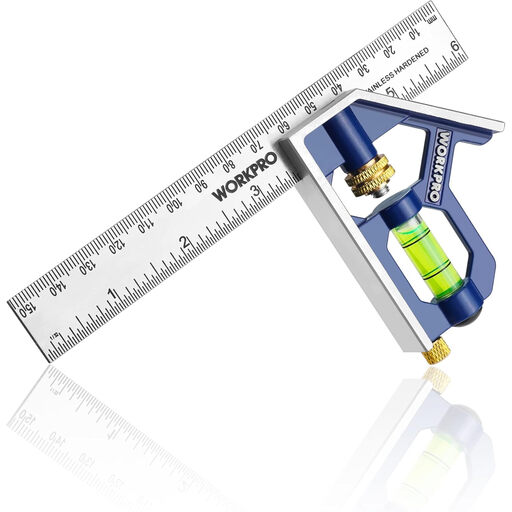
Why This Fits Their Persona: The 150mm format is manageable for home workshops, small furniture parts and everyday DIY carpentry tasks where bench space is limited.
Its adjustable head is designed to be secured on the ruler, while the laser-engraved metric and imperial scales are intended to remain readable with regular use.
Built-in spirit level and scriber; stainless steel and zinc alloy construction; supports 45- and 90-degree work.
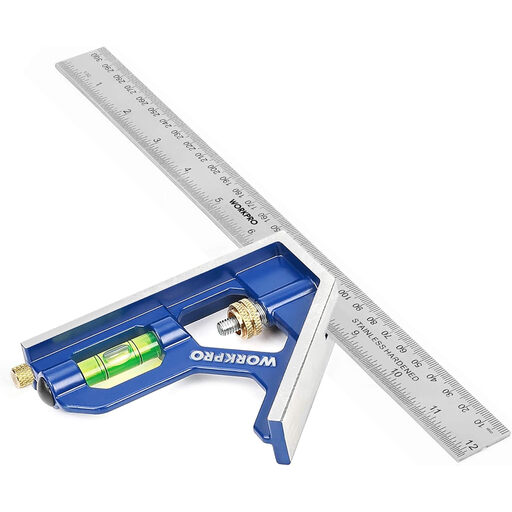
Why This Fits Their Persona: The longer ruler suits joiners, engineers and serious home woodworkers who regularly lay out larger boards or need additional depth and width reach.
The spring-screw clamping system allows the ruler to slide and lock at the required position, rather than relying on a fixed measurement.
300mm ruler with dual metric and imperial graduations; integrated bubble level and scriber; measures 45-degree and right angles.
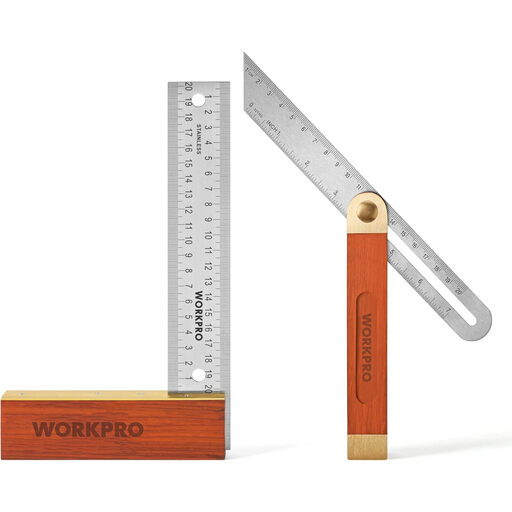
Why This Fits Their Persona: This pairing suits users who need both a fixed right-angle check and a way to copy changing angles across repeated woodworking or construction tasks.
It separates two jobs instead of forcing one multi-purpose tool to handle every layout task. The bevel also has a central adjustment knob to secure the chosen angle.
Includes a 200mm try square and 230mm sliding bevel; metric and imperial scales; declared accuracy of ±0.3 degrees.
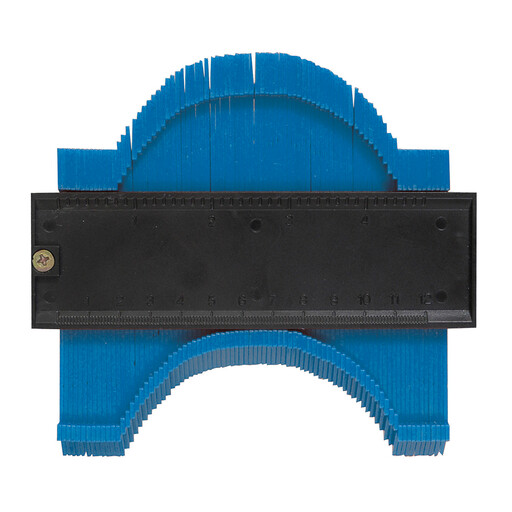
Why This Fits Their Persona: Suitable for flooring, tiling, woodworking and renovation work where skirting, pipes, corners or other irregular contours need to be transferred to a cutting line.
It is designed specifically for profile duplication, avoiding the unreliable practice of estimating an irregular shape with a straight ruler.
Compact 125mm design; captures profiles up to 45mm deep; plastic pins adapt to irregular contours.
Before relying on any square or gauge:
A quick verification against a known straight edge can reveal movement or damage before it affects a larger project. For important joinery, make a test mark on scrap timber first.
A 150mm combination square is a practical starting point because it can check right angles, mark lines and measure short depths. Add a longer ruler or a try square when your projects involve larger boards or repeated fixed-angle work.
Place the square against a straight reference edge and draw a line. Turn the square over from the same starting point and draw a second line. If the lines do not match, the tool may not be square. Repeat the check on scrap material before using it for a finished component.
Service life depends on storage, frequency of use and handling. Stainless steel rulers can resist rust when kept clean and dry, while locking mechanisms may need occasional cleaning and light lubrication. Avoid drops, impact and using a square as a lever, as these can affect alignment.