What matters when choosing a label maker?
Start with where you will print and what the drawer fronts are exposed to. Then check compatible media and width before deciding whether saved labels, connectivity or industrial formats would help.
| Concern |
What to check |
Who this matters to |
| Legibility and label life |
Match the printer’s compatible media, adhesive and label width to the drawer surface and likely exposure to rubbing, cleaning liquids or light. |
When shared drawers are handled and cleaned regularly, I need their names to remain readable; around 33% of consumers put label durability and legibility first. |
| Repeatable relabelling |
Check for saved labels, an automatic cutter and the particular computer or mobile connection you intend to use. |
If drawer assignments change, I want consistent names without entering every label from scratch; roughly 27% of consumers prioritise repeatable batch relabelling. |
| Printing around the workshop |
Check the handheld size, power arrangement and supported media width for labels made away from a fixed bench. |
I need to make replacement labels beside benches rather than return to a desk; around 20% of consumers put mobile printing first. |
| Simple setup |
Choose only the connectivity and specialist formats you will use, while still checking that the accepted labels suit the drawers. |
For stable drawer names, I would rather use a straightforward machine than manage unnecessary cable-labelling functions; roughly 20% of consumers prioritise simple setup. |
Joybuy options for drawer labelling
These options cover a label printer for work at a fixed bench and a portable label maker for creating drawer names nearby. For either approach, check the compatible labels and their fit with your drawer fronts.
 No image available
Brother QL-600B Label Printer
For drawer labels prepared at a fixed bench, check which compatible DK roll and adhesive will suit the drawer surface. If labels will face prolonged bright light, compare the chosen media’s stated limitations before use.
View on Joybuy
 No image available
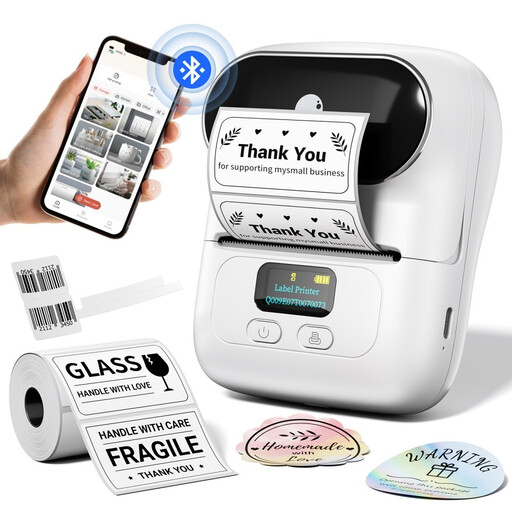
Phomemo M110 Portable Label Maker with One Label Roll
For labels made near the drawers, check the required mobile device, compatible media and adhesive. Assess the intended workspace against the printer’s moisture and extreme-temperature cautions.
View on Joybuy
Questions about workshop drawer labels
What tape should I use on workshop tool drawers?
Choose a tape or roll that is compatible with the printer and suited to the drawer surface and exposure. Brother UK describes environmental testing for its laminated TZe tapes, while DYMO UK lists industrial materials for its Rhino 4200; neither establishes that every adhesive will suit your drawer front. Clean and dry the surface before applying a label.
Is a 12 mm label wide enough for a tool drawer?
A 12 mm label may accommodate a short drawer name, but check the finished text at the distance from which people need to read it. For longer names or a location code, consider a wider compatible label. Brother UK Store lists widths up to 24 mm for the PT-D610BT and PT-E560BT, while DYMO UK lists up to 19 mm for the Rhino 4200.
Does a shared workshop need a phone-connected label maker?
Phone or computer connectivity is useful if people create labels from shared templates or prepare batches, but it is not necessary for every drawer name. If replacement labels also need to be made without a phone or computer, check for a built-in keyboard; Brother UK Store describes both connected creation and keyboard use for the PT-D610BT and PT-E560BT.
Can a tool-drawer label serve as a UK workplace safety sign?
Do not rely on an ordinary drawer-name label as a substitute for a required safety sign or hazard control. The UK Health and Safety Executive says employers must provide safety signs where a significant risk cannot be avoided or controlled in another way; assess signage separately from drawer organisation.
Will direct-thermal drawer labels last as long as laminated tape?
Do not assume the two media will have the same service life. DYMO warns that direct-thermal labels can darken or fade after extended sunlight or fluorescent-light exposure, while Brother UK reports exposure testing for its own laminated TZe tapes. Compare the exact labels and their stated conditions for the workshop location.


