Keyboard-first speech drafters
If you expect to write several paragraphs or revise a complete speech at a café table, the keyboard and typing position matter more than pen features alone.


For drafting and revising a full speech at a café table, start with a compatible physical keyboard and a stable typing position. A pen-capable tablet suits handwritten planning, while a Windows 2-in-1 suits work that depends on a Windows workflow; whichever you choose, account for the complete setup you will carry and how you will access and protect your drafts.
If you expect to write several paragraphs or revise a complete speech at a café table, the keyboard and typing position matter more than pen features alone.
If you develop your speech through handwritten ideas, notes or a visual outline, look for pen support as well as a way to type the finished draft.
If your speech preparation involves existing Windows documents and laptop-style multitasking, a 2-in-1 may suit your workflow better than a tablet-first setup.
Choose the writing workflow first: Apple offers a keyboard route for iPad Air, Samsung pairs pen support with a separate keyboard option for Galaxy Tab S10 FE, and Microsoft offers an optional keyboard for Surface Pro’s laptop mode. Then check how the complete setup fits your café table, bag and connection needs.
Consider it when: You mainly type your speech and want an 11-inch tablet; Apple specifies a 464 g weight for the Wi‑Fi model before accessories.
Bear in mind: Apple’s compatible Magic Keyboard is a separate purchase.
Consider it when: You want to outline or annotate with the S Pen before typing; Samsung describes the standard model as a 10.9-inch tablet.
Bear in mind: Samsung sells its Book Cover Keyboard Slim separately, so check the exact tablet match and keyboard layout.
Consider it when: Your speech preparation depends on a Windows workflow and laptop-style use; Microsoft describes a kickstand and laptop mode with an optional keyboard.
Bear in mind: The compatible keyboard is separate, and the complete 2-in-1 setup needs to suit the space you have for writing.
| Concern | What to check | Who this matters to |
|---|---|---|
| Typing position | Check keyboard compatibility, UK key layout and how the screen stands on a table. | If I will draft and revise full paragraphs, I need a physical keyboard and a position I can use for the session; around 42% of consumers put typing setup first. |
| Carrying and screen size | Compare the tablet and keyboard together for weight, bag space and the table space they occupy. | When I move between writing locations, I want enough room to read my draft without carrying a setup that feels cumbersome; portability comes first for around 25% of consumers. |
| Handwritten planning | Confirm pen compatibility and whether the pen is included or purchased separately. | If I shape a speech through handwritten prompts or annotations, I want to keep that step in my workflow; roughly 17% of consumers prioritise pen-based planning. |
| Access to drafts | Check offline saving and whether a hotspot or a cellular version would meet your connection needs. | If café Wi‑Fi fails or my draft is sensitive, I need another way to work or connect; for about 16% of consumers, dependable access and careful handling of drafts take priority. |
A touchscreen alone may not give you the writing position you want for a full speech. Apple, Samsung and Microsoft offer keyboard routes for the models discussed here, but their compatible keyboards are separate purchases.
Check the keyboard for your exact model, its UK layout and how it supports the screen before choosing the tablet.
If your draft or reference material depends on an internet connection, an unavailable or unreliable network can interrupt the session. Apple says the Wi‑Fi + Cellular iPad Air can connect through a mobile data plan when Wi‑Fi is unavailable; that does not apply to its Wi‑Fi-only version.
Decide whether offline documents, your own hotspot or a cellular-capable model will be your fallback.
The UK National Cyber Security Centre warns that attackers on public or insecure networks may be able to intercept or modify data. This matters particularly when a speech contains personal or confidential material.
For sensitive online work, consider a connection you control rather than treating the café network as the default.
Extra display space may help when you read notes alongside a draft, but the device and its accessories must still fit your bag and writing spot. Apple specifies 464 g for the 11-inch Wi‑Fi iPad Air before accessories.
Compare the complete carried setup and the space it needs on your usual table, not screen size alone.
The 11-inch iPad Air is a tablet-first option for typing a speech with a compatible keyboard or planning it with an Apple Pencil.
The standard Galaxy Tab S10 FE offers an Android tablet route for writers who combine typed drafting with S Pen outlining or annotation.
Surface Pro is a Windows 2-in-1 route when preparing a speech calls for laptop-style work as well as tablet use.
These choices include compact tablets offered with keyboards and a Windows convertible laptop. Check the keyboard position and carrying size for your own café sessions; the convertible is an alternative to a tablet-first device, not the same format as one.
 No image available
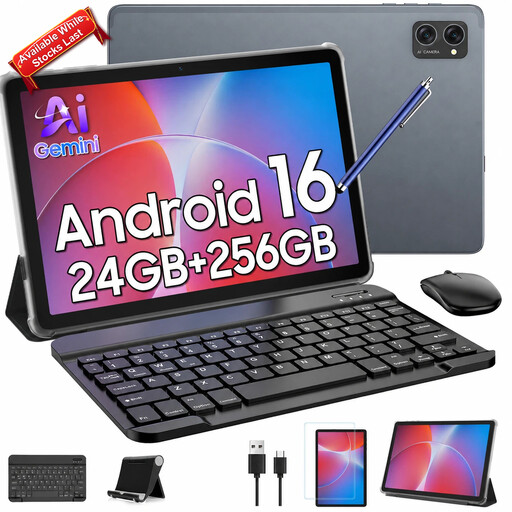
Consider this bundle if you want to type a speech and also make handwritten outline notes. Its listed configuration includes a 10.1-inch display, 256 GB storage, keyboard, mouse and stylus.
Check the UK keyboard layout and try to establish whether the stand gives you a suitable typing position. Confirm the exact Android version if it affects the apps you intend to use.
 No image available
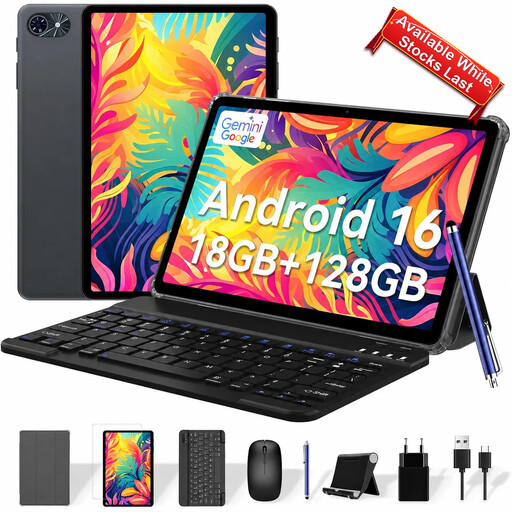
Consider this 10-inch tablet if having a physical keyboard is central to your café drafting setup. The listed variant has 128 GB storage and a 6000 mAh battery.
Check the UK key layout and whether the keyboard has a stand that works at your table. Confirm the exact RAM and Android configuration if either matters for your writing apps.
 No image available
Consider this convertible laptop if your speech-writing work calls for an integrated keyboard and Windows 11 Home rather than a tablet-first setup. Its listed configuration includes 16 GB RAM and a 1 TB SSD.
Check its carrying size and the space it needs on a café table before choosing it in place of a compact tablet.
A physical keyboard is worth prioritising if you expect to draft or substantially revise full paragraphs. Apple, Samsung and Microsoft offer compatible keyboard routes for the tablet models discussed here, but check the exact model and do not assume the keyboard comes with the device.
A Wi‑Fi-only tablet can suit café writing if you can work on saved documents offline or use a connection you trust. If you need mobile data without café Wi‑Fi, Apple says that capability requires the Wi‑Fi + Cellular iPad Air and a mobile data plan.
Use caution with sensitive online work on public or insecure Wi‑Fi. The UK National Cyber Security Centre warns that attackers may be able to intercept or modify data on such networks, so consider a connection you control or work offline when appropriate.
Check the complete typing setup, particularly keyboard compatibility, key layout and screen support. If you also plan to annotate by hand, confirm the pen supported by your exact model and whether it is part of the configuration you are choosing.