What to check before choosing
Start with a flavour and texture the child is willing to try, then choose a pack size the household can use. Compare labels on the exact flavours rather than assuming every pot in an assortment has the same recipe.
| Priority |
What to check |
Your needs |
| Flavour and texture |
Read the flavour breakdown. Distinguish smooth fruit purée, fruit pieces and yoghurt with fruit on the side; check whether the child prefers foods kept separate. |
My child accepts a familiar, smooth flavour, or would rather keep yoghurt and fruit apart. An assorted pack only helps if its other flavours are likely to be used. |
| Pack and storage |
Compare the number and size of pots with a shareable tub. Follow the chilled-storage and after-opening directions; ASDA Groceries says its Onken Cherry 450g pot should be enjoyed within 3 days of opening. |
Will several of us eat this flavour, or would separate portions be easier to offer and keep for another meal? |
| Sugars and ingredients |
Compare sugars per 100g for each flavour, then consider the portion served. Tesco Groceries lists 12.0g per 100g for Strawberry and 13.4g for Peach & Apricot in the Müller Corner 6 x 136g pack; it lists 8.1g per 100g for Little Yeos Fruity Favourites 4 x 85g. |
If yoghurt is offered regularly, I want to compare the actual recipes, not assume that fruit flavours or a no-added-sugar label tell the whole story. |
| Milk and other label details |
Check the current ingredients and allergen declaration for the product and its flavours. The Food Standards Agency identifies milk as an allergen commonly found in yoghurt. |
When milk or another ingredient must be avoided, I need the label on the pack being served, not a general statement about the brand. |
Relevant brand and range references
These examples show different pack formats and recipes to compare; a brand name alone cannot establish which yoghurt a child will accept.
Müller
The Corner Strawberry, Peach & Apricot 6 x 136g multipack offers individual pots with yoghurt and fruit on the side.
- Tesco Groceries lists three pots of each fruit variety.
- Tesco Groceries declares 12.0g sugars per 100g for Strawberry and 13.4g for Peach & Apricot; check the variety being served.
Onken
Its fruited big-pot range is a shareable alternative to individually sealed multipacks.
- The Cherry pot listed by ASDA Groceries contains 450g, allowing portions to be served from one tub.
- ASDA Groceries says the Cherry pot contains milk and should be enjoyed within 3 days of opening.
Yeo Valley
Little Yeos Fruity Favourites 4 x 85g uses yoghurt blended with smooth fruit purée.
- The four individual pots offer a defined 85g portion.
- Tesco Groceries lists milk as an allergen; the smooth, creamy format will not suit every texture preference.
Activia
The Strawberry & Mixed Fruit 8 x 115g multipack is labelled no added sugar and fat free.
- Individual pots may suit a household specifically seeking that labelled format.
- The manufacturer’s probiotic and gut-health positioning does not establish whether a child will accept the yoghurt.
Rachel’s Organic
Luscious Fruits Bio-Live Yoghurt comes as a 4 x 110g fruit multipack.
- It offers individual pots for households seeking this organic fruit-yoghurt format.
- Rachel’s Organic declares 12.5g sugars per 100g and says the cherry variety may occasionally contain stones.
Tesco
Its multipack listings cover several formats, including corner or split pots, children’s yoghurts and low-fat or fat-free products.
- The range categories offer a way to compare pack formats.
- Check the named product’s ingredients, nutrition and allergens; a category label does not establish suitability for a particular child.
A Joybuy product option
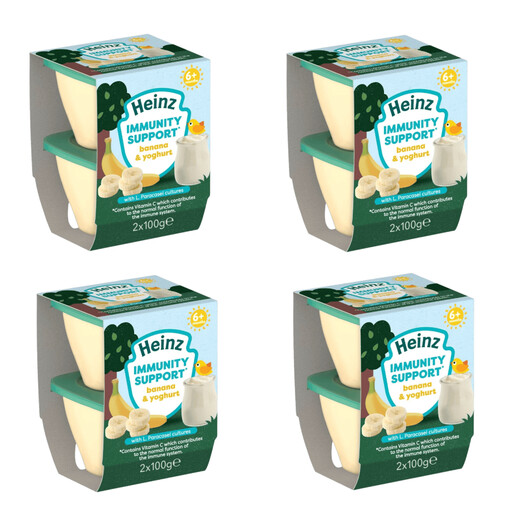
This banana-and-yoghurt bundle is an individual-pot option for a household considering one familiar flavour, rather than an assorted fruit pack or a shareable tub.
 No image available
Heinz Banana & Yoghurt 6+ Months, 2 x 100g × 4
For a household choosing separate portions of one banana-and-yoghurt flavour, this bundle contains four packs of two 100g pots, eight pots in total. It is not a flavour assortment. The product information says it contains milk; check the current label if an ingredient needs to be avoided.
View on Joybuy
Questions about family-pack yoghurt
Should I buy individual pots or a large tub for a fussy eater?
Choose individual pots when separate portions or trying a limited number of flavours matters. A large tub is more practical when the child already accepts that yoghurt or others will share it. Follow its storage directions: ASDA Groceries says its Onken Cherry 450g pot should be enjoyed within 3 days of opening.
Do live cultures or gut-health wording mean a child will accept the yoghurt?
No. Those terms describe a product or its manufacturer’s positioning, not a child’s flavour or texture preference. Choose a format the child is willing to try, and follow the NHS advice to offer variety without forcing rejected food.
How can I compare sugars in an assorted yoghurt pack?
Compare each flavour on the same per-100g basis, then look at the pot size. Tesco Groceries lists 12.0g sugars per 100g for Strawberry and 13.4g for Peach & Apricot in the Müller Corner 6 x 136g multipack, so one figure does not describe both varieties.
What should I check if my child needs to avoid milk?
Check the current allergen and ingredient information on the exact pack before serving it. The Food Standards Agency identifies milk as an allergen commonly found in yoghurt; do not assume that another flavour or product from the same brand has identical ingredients.
What if my child refuses the yoghurt at a meal?
Do not force them to eat it. The NHS advises offering small portions and continuing to offer a variety of foods over time; a refused flavour need not determine every future yoghurt choice.


