What should you check?
Establish whether the meal is simply easier to chew or must meet a prescribed swallowing texture before comparing ingredients and pack formats.
| Priority | What to check | Your needs |
|---|
| Even texture |
Look for fruit pieces, seeds and separate toppings on the label. Inspect the yoghurt itself before serving; a flavour or ‘creamy’ description does not establish a uniform texture. |
I need a spoonable yoghurt without bits or crunchy additions for an ordinary easy-chew meal. |
| Prescribed consistency |
Confirm the person’s prescribed IDDSI level with their clinician and check the food after preparation at serving temperature. South Tees Hospitals NHS Foundation Trust describes Level 4 puréed food as smooth, lump-free and without separated liquid. |
When I am serving someone with a texture-modified diet, the yoghurt must meet their individual plan; smooth appearance alone is not enough. |
| Pack format |
Compare net weight and pot count rather than assuming that a ‘6 pint’ request means a yoghurt container size. Check whether a multipack has separate fruit or chocolate components. |
For several prepared portions, I may want a larger pot. For separate small servings, I may prefer individual pots without unsuitable mix-ins. |
| Milk and lactose |
Read the current ingredients and allergen declaration. Rachel’s Organic lists cows’ milk in its lactose-free natural yoghurt and states that it is unsuitable for people with a milk allergy. |
If I am avoiding lactose, I need a specifically labelled product; if milk allergy is the concern, a lactose-free dairy label does not answer it. |
| Storage after opening |
Follow the instructions on the exact pack. Tesco Groceries lists refrigeration and use within three days of opening for its Onken Raspberry 450g yoghurt listing; other products may give different directions. |
When I use one pot across several meals, I need to plan portions around that product’s storage instructions. |
Brand and range references
Choose by the exact variety rather than assuming every yoghurt from a brand has the same texture or additions.
Müller
Tesco Groceries lists Müller multipacks, including Corner varieties with separate chocolate additions.
- Six-pot packs provide individually portioned options.
- Check Corner components before using a variety for a smooth-texture meal.
Onken
Onken appears in UK grocery listings in larger pots, including fruit varieties.
- A larger pot can be portioned for more than one meal when its storage directions allow.
- Tesco Groceries lists raspberries in its Onken Raspberry 450g yoghurt; do not assume a fruit variety is free of pieces.
Yeo Valley
Tesco Groceries lists Yeo Valley natural Greek-style yoghurt in larger pots.
- A natural variety is worth checking when you want to avoid separate toppings.
- Check the exact product and serving texture; fruit and flavoured varieties are not interchangeable with plain natural yoghurt.
Rachel’s
Rachel’s Organic lists natural, Greek-style and lactose-free yoghurt varieties.
- Its specifically labelled lactose-free natural yoghurt is an option to check when avoiding lactose.
- That yoghurt contains cows’ milk and, according to Rachel’s Organic, is unsuitable for people with a milk allergy.
Activia
Tesco Groceries lists Activia fruit-yoghurt multipacks in individual 115g pots.
- Individual pots make it straightforward to set out separate portions.
- Check the specific fruit variety for pieces and its suitability for the intended meal.
Tesco
Tesco Groceries lists own-label Greek-style pots and a 500g natural yoghurt labelled high protein.
- The range includes natural larger-pot formats to compare for meal preparation.
- A product category or protein label does not establish its serving texture; check the exact pot.
Joybuy product options
These are small, baby-labelled fruit-and-yoghurt portions to consider where a small serving is useful. Check whether that format suits the intended meal; neither product name establishes suitability for a prescribed swallowing texture.
 No image available
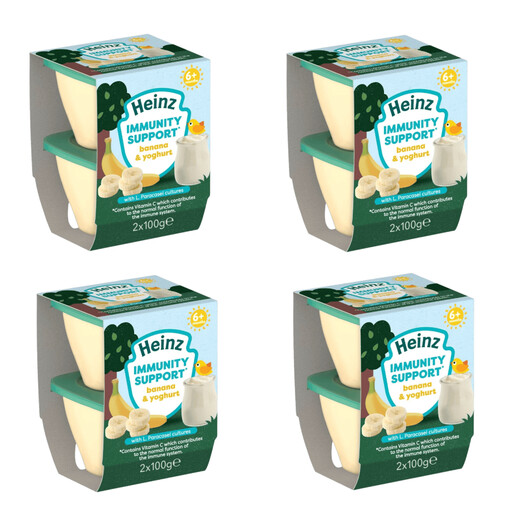
Heinz Banana & Yoghurt 6+ Months, 2 × 100g pots × 4
Eight individual 100g pots provide small portions, though this banana-and-yoghurt product is labelled for babies aged 6 months and over rather than specifically for adult meals. Check its ingredients and the texture of a served portion; a smoothness description does not establish that it meets a prescribed IDDSI level.
View on Joybuy
 No image available
Ella’s Kitchen Organic Mango Greek Style Yoghurt 6+ Months, 90g
The 90g pouch offers a small portion and is labelled for babies aged 6 months and over, not specifically for adult soft meals. It contains fruit and milk; check the current ingredients and the served texture rather than treating a smoothness description as confirmation of an IDDSI level.
View on Joybuy
Questions about choosing yoghurt
Can yoghurt work for someone who finds chewing difficult?
For an ordinary easy-chew meal, smooth yoghurt without pieces can be a spoonable option. If the person has swallowing difficulty or a prescribed texture-modified diet, follow their clinician’s advice on consistency rather than choosing by the supermarket description alone; University Hospitals Sussex NHS Foundation Trust identifies speech and language therapists as advisers on swallowing-related food texture.
Can fruit yoghurt be served on an IDDSI Level 4 diet?
Do not assume a fruit yoghurt meets Level 4. South Tees Hospitals NHS Foundation Trust describes Level 4 puréed food as smooth and free of lumps, so check the person’s prescribed plan and the prepared yoghurt for pieces and liquid separation at serving time.
Does ‘thick and creamy’ establish a safe swallowing texture?
No. ‘Thick and creamy’ is a product description, not an individual texture recommendation. IDDSI says testing should reflect intended serving conditions and that a clinician makes recommendations for a particular patient following assessment.
Is lactose-free dairy yoghurt suitable for a milk allergy?
A lactose-free label does not mean a dairy yoghurt is free of milk. Rachel’s Organic lists cows’ milk in its lactose-free natural yoghurt and states that the product is unsuitable for people with a milk allergy; check each product’s current allergen declaration.
How should I keep a large yoghurt pot after opening?
Follow the storage directions on that pot. For example, Tesco Groceries lists refrigeration and use within three days of opening for Onken Raspberry 450g yoghurt; do not apply that product’s timeframe to every yoghurt.


