Choose the pot size and pack count for the people eating the snacks: small child-focused pots make it easier to portion several occasions, while larger pots may suit older children or adults who want more in one serving. Compare each flavour’s ingredients and nutrition label rather than relying on claims such as ‘no added sugar’ or ‘organic’, and follow the pack’s milk-allergen, storage and use-by information when taking yoghurt out.
Who is the multipack for?
Start with the eater and the snack occasion; a children’s label alone does not tell you whether one pot is the right size.
Parents packing snacks for younger children
Small individual pots can be allocated across several half-term snack occasions. Yeo Valley Organic’s Little Yeos range includes 6 x 42g and 4 x 85g packs, according to Tesco Groceries; check the ingredients and milk-allergen declaration on the pack you choose.
Families comparing sugar and ingredients
Compare the exact flavour’s ingredients with its sugars figure per 100g and per pot. Total sugars and free sugars are different measures, so neither a fruit flavour nor an organic label settles the comparison.
Older children and adults sharing a pack
A larger individual pot may be more useful than a small child-focused portion. Tesco Groceries lists 6 x 140g Müller Light and 4 x 115g Activia multipacks, while Rachel’s Organic describes a 4 x 110g fruit multipack; check the chosen product’s ingredients and storage instructions too.
What should you check before choosing?
Compare the portion and pack format first, then read the label for the particular flavour you intend to buy.
| Priority |
What to check |
Your needs |
| Portion and format |
Compare grams per pot and pots per pack. Decide whether a pot or pouch fits where the snack will be eaten. |
For a younger child, I want a portion that works on its own or alongside other food; for an older child, a tiny pot may not be enough for the planned snack. |
| Sugars and ingredients |
Read the ingredients and sugars per 100g, then check the amount in one pot. ‘No added sugar’ does not mean the total-sugars figure is zero. |
I want to compare the recipes, rather than assume a fruit-flavoured or organic yoghurt has a particular sugar content. |
| Milk and other ingredients |
Check the exact flavour’s ingredient and allergen declarations. The Food Standards Agency identifies milk as a common ingredient in yoghurt. |
When milk is an issue for someone eating the snack, I need to check the actual pack rather than rely on a range name or a live-culture claim. |
| Storage and use-by date |
Follow the printed storage instructions and check the use-by date. Do not assume every yoghurt can spend the same time out of chilled storage. |
If I am packing yoghurt for an outing, I need a way to follow its storage instructions until it is eaten. |
Common mistakes when choosing
-
Treating total sugars as free sugars
The total-sugars figure also includes sugars naturally present in milk and fruit. NHS guidance distinguishes these from free sugars, so the number alone does not explain where a yoghurt’s sugars come from.
Read the ingredients alongside the nutrition panel, comparing both per-100g and per-pot figures for the flavours you are considering.
-
Choosing solely by a children’s label
Children’s multipacks can contain different portion sizes: Tesco Groceries lists Little Yeos in both 6 x 42g and 4 x 85g formats.
Check the weight of each pot against the child’s appetite and whether the yoghurt is the whole snack or one part of it.
-
Assuming front-of-pack claims answer the nutrition question
Organic, fat-free and live-culture descriptions refer to different product characteristics. Rachel’s Organic lists organic sugar among the ingredients of its Luscious Fruits 4 x 110g multipack and 12.5g sugars per 100g.
Compare exact flavours, portions, ingredients and nutrition panels rather than choosing by a brand or range description alone.
-
Packing yoghurt without checking storage
The Food Standards Agency warns that food kept too long or at the wrong temperature can cause food poisoning; a use-by date does not replace the storage instructions.
Check both on the printed pack before an outing and plan how to follow the storage instructions while the yoghurt is being carried.
Brand and retailer ranges to compare
These ranges illustrate different pack formats and label claims; choose by the specific product rather than assuming every item from a brand has the same recipe.
Yeo Valley Organic
Its Little Yeos range is aimed at younger children and includes small pots and pouches.
- Tesco Groceries lists Little Yeos No Added Sugar as 6 x 42g and Fruity Favourites as 4 x 85g.
- Check the exact flavour’s ingredients, allergens and storage label; a no-added-sugar description does not replace them.
Müller
Its yoghurt ranges include Corner and Light, which use different formats and product descriptions.
- Tesco Groceries lists a Müller Light Red Fruit Assorted Fat Free Yogurt 6 x 140g multipack.
- Müller describes its Light range as fat free and 0% added sugar; check the exact flavour’s label rather than applying range wording to every Müller pot.
Activia
Activia offers fruit multipacks positioned around live cultures, including a Strawberry 4 x 115g pack listed by Tesco Groceries.
- The Tesco Groceries page for that Strawberry pack describes live cultures and five ferments.
- Live-culture positioning does not determine the portion size, sugar content or milk-allergen suitability of every Activia product.
Rachel’s Organic
Its Luscious Fruits Bio-Live Yogurt comes in a 4 x 110g organic fruit multipack.
- The manufacturer lists organic yoghurt and fruit in the cited multipack.
- Rachel’s Organic lists organic sugar in its ingredients and 12.5g sugars per 100g for this product; organic does not mean lower sugar.
Onken
Onken has Kids, fruit and natural yoghurt ranges, so the recipe depends on the product selected.
- Onken describes its Kids recipe as containing three ingredients and being fortified with vitamin D.
- Check the exact pack rather than assuming that recipe description applies to its other ranges or flavours.
Tesco
As a retailer, Tesco separates children’s multipacks from other multipack yoghurt categories, making formats easier to compare.
- Its listings show examples of different pot counts, weights and yoghurt types.
- Check the current listing and the physical pack for the precise flavour, ingredients and instructions.
A Joybuy snack-pot option
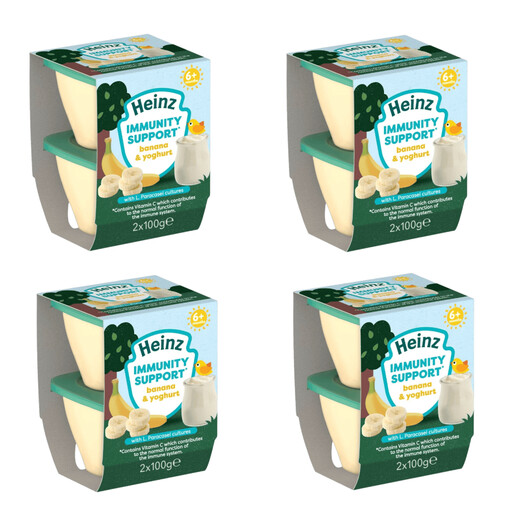
This option is a banana-and-yoghurt snack-pot bundle labelled for babies aged 6 months and over, rather than a conventional yoghurt multipack for every half-term age group.
 No image available
Heinz Banana & Yoghurt Pot 6+ Months, 8 x 100g
The eight individual 100g pots offer separate snack portions where a banana-and-yoghurt blend suits the eater. The bundle contains four 2 x 100g packs and is labelled for babies aged 6 months and over; it is not plain yoghurt. Check the exact pack’s ingredients, milk-allergen declaration, storage instructions and use-by date before serving or taking it out.
View on Joybuy
Questions about yoghurt multipacks
Does ‘no added sugar’ mean a yoghurt contains no sugar?
No. NHS guidance explains that the total-sugars figure includes sugars naturally present in ingredients such as milk and fruit. Check the ingredients and nutrition panel of the exact flavour to understand what the label describes.
How do children’s daily free-sugar limits relate to one pot?
NHS guidance gives a maximum of 19g of free sugars a day for children aged 4 to 6 and 24g a day for those aged 7 to 10. These are whole-day limits, not a per-pot threshold; a yoghurt’s total-sugars figure is not necessarily its free-sugars amount.
Is a dairy yoghurt multipack suitable for a child with a milk allergy?
Do not assume it is. The Food Standards Agency identifies milk as a common ingredient in yoghurt, so check the exact product against the child’s allergy plan before choosing it.
Is the use-by date enough when taking yoghurt on an outing?
No. Follow the pack’s storage instructions as well as its use-by date. The Food Standards Agency warns that food kept too long or at the wrong temperature can cause food poisoning.
Should live cultures decide which multipack to buy?
Live cultures can be a product preference, but they do not settle portion size, ingredients, allergens or storage. Check those details on the exact multipack rather than treating its live-culture wording as a general suitability claim.


